
We read your photo as:
Study the poem, The road not taken (Robert Frost) and the song, Any Road (George Harrison) and answer the question that follows.
English
ScanSolve AI Answer
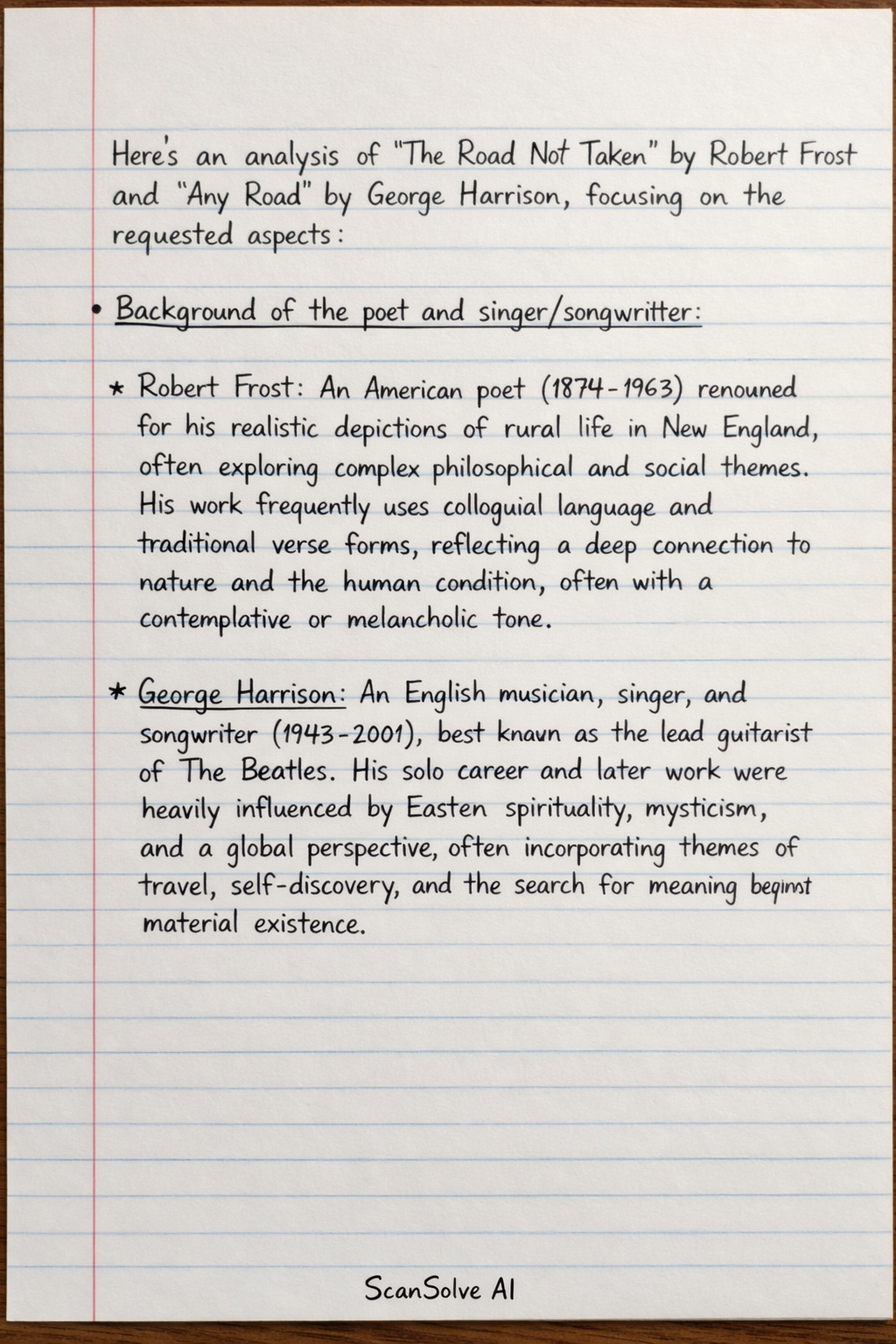
Here's an analysis of "The Road Not Taken" by Robert Frost and "Any Road" by George Harrison, focusing on the requested aspects:
-
Background of the poet and singer/songwriter
- Robert Frost: An American poet (1874-1963) renowned for his realistic depictions of rural life in New England, often exploring complex philosophical and social themes. His work frequently uses colloquial language and traditional verse forms, reflecting a deep connection to nature and the human condition, often with a contemplative or melancholic tone.
- George Harrison: An English musician, singer, and songwriter (1943-2001), best known as the lead guitarist of The Beatles. His solo career and later work were heavily influenced by Eastern spirituality, mysticism, and a global perspective, often incorporating themes of travel, self-discovery, and the search for meaning beyond material existence.
- Comparison/Contrast: Frost's background is rooted in American pastoral life and a more traditional poetic style, reflecting a grounded, introspective view. Harrison's background is in modern rock music and global spiritual exploration, leading to a more expansive, philosophical, and often optimistic outlook on life's journey. Both, however, became iconic figures whose works resonated deeply with audiences, exploring universal human experiences through their unique lenses.
-
Relevance of the title to the content
- "The Road Not Taken": The title is central to the poem's meaning, directly referencing the speaker's contemplation of a path not chosen. It highlights the theme of decision-making and the lasting impact of choices, emphasizing the hypothetical alternative and the speaker's reflection on what might have been. The title itself creates a sense of introspection and the weight of irreversible decisions.
- "Any Road": The title suggests a sense of openness, acceptance, and the continuous nature of life's journey. It implies that regardless of the specific path taken, one will always arrive somewhere, reflecting a more fluid and less anxious approach to direction. The title conveys a message of embracing uncertainty and finding meaning in the journey itself, rather than fixating on a single destination or a missed opportunity.
- Comparison/Contrast: Frost's title focuses on the significance of a specific, unchosen path and the retrospective pondering of its implications. Harrison's title, conversely, emphasizes the universality and continuity of all paths, suggesting a more relaxed and accepting attitude towards life's unfolding journey, where the destination is less important than the experience of traveling.
-
Theme(s)
- "The Road Not Taken":
- Choice and Consequence: The primary theme is the act of making a decision between two seemingly similar options and the profound, often irreversible, impact that choice has on one's life path.
- Individualism vs. Conformity: The speaker claims to have taken the "less traveled" road, suggesting a desire for uniqueness, though the poem subtly questions the objective truth of this claim, hinting at the human tendency to romanticize past choices.
- Retrospection and Regret: The poem is imbued with a tone of looking back, pondering the "what ifs" and the ultimate significance of a past decision, carrying a hint of wistful regret or self-justification.
- "Any Road":
- Life as a Continuous Journey: The central theme is the ongoing nature of life's journey, both physical and spiritual, emphasizing exploration and movement rather than a fixed destination.
- Acceptance of Uncertainty: The song embraces the idea that one doesn't always know where they're going ("You may not know where you came from / May not know who you are"), but that the journey itself is valid and purposeful ("Any road will take you there").
- Spiritual and Philosophical Outlook: Harrison's lyrics reflect a broader, more spiritual perspective on existence, suggesting that all experiences contribute to a larger understanding, and that the path itself is a form of enlightenment.
- Comparison/Contrast: Frost's poem delves into the weight and singularity of a defining choice and the retrospective reflection on its impact. Harrison's song, in contrast, celebrates the fluidity and multiplicity of life's paths, advocating for an acceptance of uncertainty and finding meaning in the continuous journey itself, rather than dwelling on specific decisions or missed opportunities. Both explore the concept of "roads" in life, but with vastly different emotional and philosophical approaches.
- "The Road Not Taken":
Was this helpful?
Still stuck on this one?
Ask a follow-up, and the answer starts from this question.
Got a different question?Ask your own question
More English Questions
QWhat are the answers to the questions about Robert Frost's poem "A Time to Talk"?QRead one of the poems below carefully and answer the questions below it.QRead the poem "Rise Around the Rosie" and answer the questions.QGive answers to the questions in Section B based on the poem.QAnalyze the poem "A Time to Talk" by Robert Frost, focusing on its theme and use of literary…
Browse by topic:Literature
Handwritten Step-by-Step Solution
Get this as a handwritten image on WhatsApp — like a tutor wrote it for you.
Try on WhatsApp