

This English question involves literary analysis, grammar, or writing skills. The detailed response below provides a well-structured answer with supporting evidence and clear explanations.
ScanSolve AI Answer
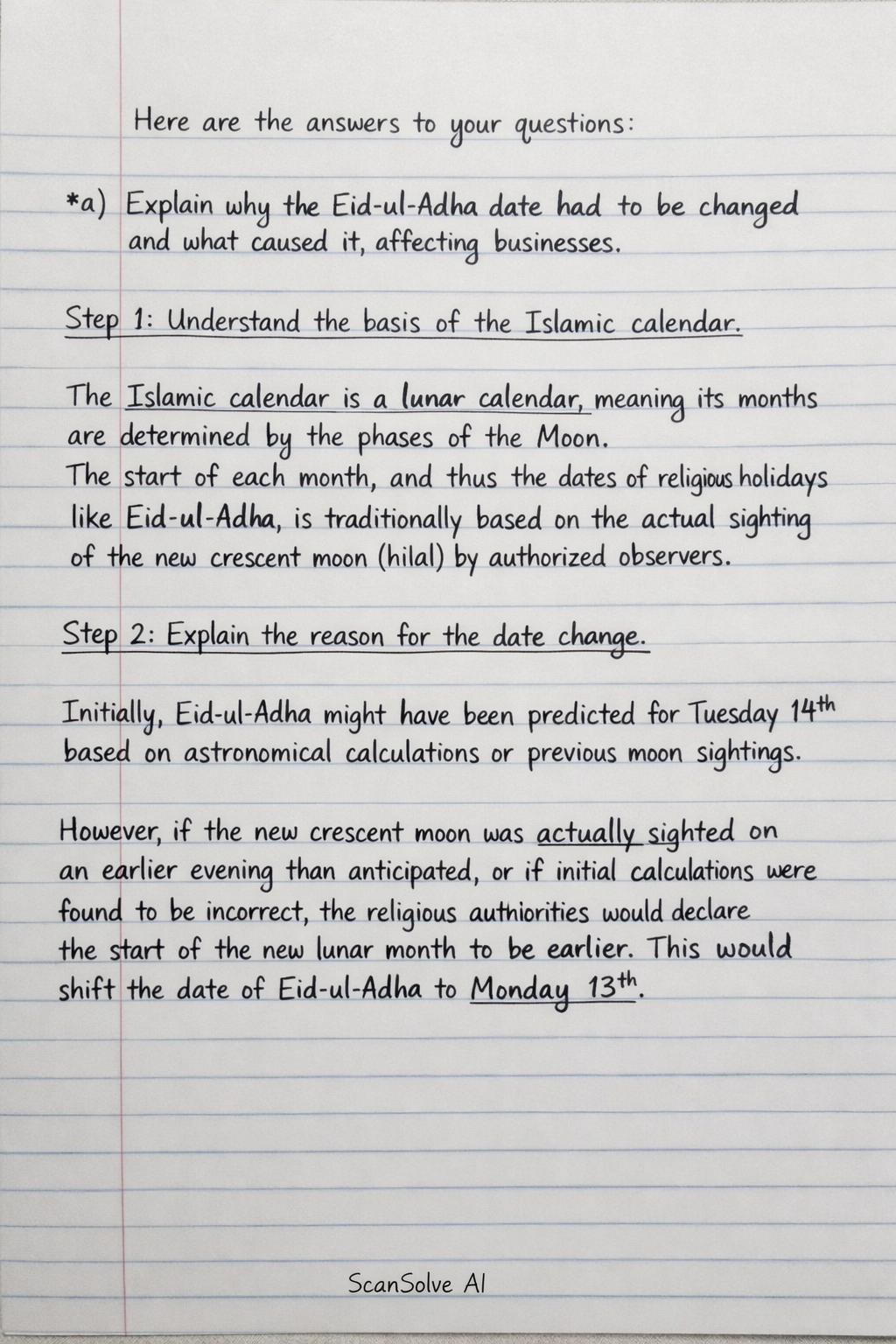
Here are the answers to your questions: a) Explain why the Eid-ul-Adha date had to be changed and what caused it, affecting businesses. Step 1: Understand the basis of the Islamic calendar. The Islamic calendar is a lunar calendar, meaning its months are determined by the phases of the Moon. The start of each month, and thus the dates of religious holidays like Eid-ul-Adha, is traditionally based on the actual sighting of the new crescent moon (hilal) by authorized observers. Step 2: Explain the reason for the date change. Initially, Eid-ul-Adha might have been predicted for Tuesday 14th based on astronomical calculations or previous moon sightings. However, if the new crescent moon was actually sighted on an earlier evening than anticipated, or if initial calculations were found to be incorrect, the religious authorities would declare the start of the new lunar month to be earlier. This would shift the date of Eid-ul-Adha to Monday 13th. Step 3: Explain the impact on the business community. Businesses rely on predictable dates for planning. A sudden change in a major holiday date means: • Disrupted inventory: Goods ordered or prepared for the original date might be too much or too little for the new date. • Marketing and promotions: Advertisements and sales campaigns might become outdated or ineffective. • Staffing and logistics: Schedules for staff, deliveries, and operations would need to be rapidly adjusted, leading to inefficiencies and potential losses. • Customer behavior: Consumers might have already made plans or purchases based on the original date, leading to confusion or reduced spending on the new date. b) Explain Jupiter's characteristics (orbital period, rotation, moons) compared to Earth, using physical concepts. Step 1: Explain Jupiter's orbital period (12 Earth years). Jupiter is much farther from the Sun than Earth. According to Kepler's Third Law of Planetary Motion, the square of a planet's orbital period is proportional to the cube of its average distance from the Sun (T^2 r^3). Since Jupiter's orbital radius is significantly larger than Earth's, its orbital period is consequently much longer. It also has a much longer path to travel around the Sun. Step 2: Explain Jupiter's rotation period (10 hours). Jupiter is a gas giant, primarily composed of hydrogen and helium. Its rapid rotation (completing a day in about 10 Earth hours) is due to the conservation of angular momentum from the vast cloud of gas and dust from which it formed. As this massive cloud collapsed, its rotation sped up. Being a fluid body, it can rotate much faster than a solid, rocky planet like Earth, which has a more rigid structure. This rapid rotation also causes Jupiter to bulge significantly at its equator. Step 3: Explain Jupiter's numerous moons (over 95) compared to Earth's one. Jupiter is the most massive planet in our solar system, possessing an immense gravitational field. This powerful gravity allows it to capture and hold many celestial bodies (asteroids, comets, and other debris) in orbit around it, forming a large system of moons. Earth, being much less massive, has a significantly weaker gravitational pull and therefore fewer objects captured into orbit. The formation conditions in the early solar system also favored the accretion of many moons around the gas giants. c) Explain how a "shooting star" comes about using your knowledge of physics. Step 1: Define a "shooting star." A "shooting star" is not actually a star. It is a meteor, which is the visible streak of light that occurs when a small piece of space rock or dust enters Earth's atmosphere. Step 2: Describe the process of light emission. • A small particle of rock or dust, called a meteoroid, enters Earth's atmosphere at extremely high speeds (tens of kilometers per second). • As the meteoroid plunges through the atmosphere, it experiences intense friction with air molecules. • This friction generates enormous heat, causing the meteoroid to glow brightly and often vaporize. The surrounding air also becomes superheated and glows. • The luminous trail we observe is this glowing, superheated air and the vaporizing material from the meteoroid. • Most meteoroids are very small and burn up completely before reaching the ground. If a piece survives and hits the ground, it is called a meteorite. Last free one today — make it count tomorrow, or type /upgrade for unlimited.