

This English question involves literary analysis, grammar, or writing skills. The detailed response below provides a well-structured answer with supporting evidence and clear explanations.
ScanSolve AI Answer
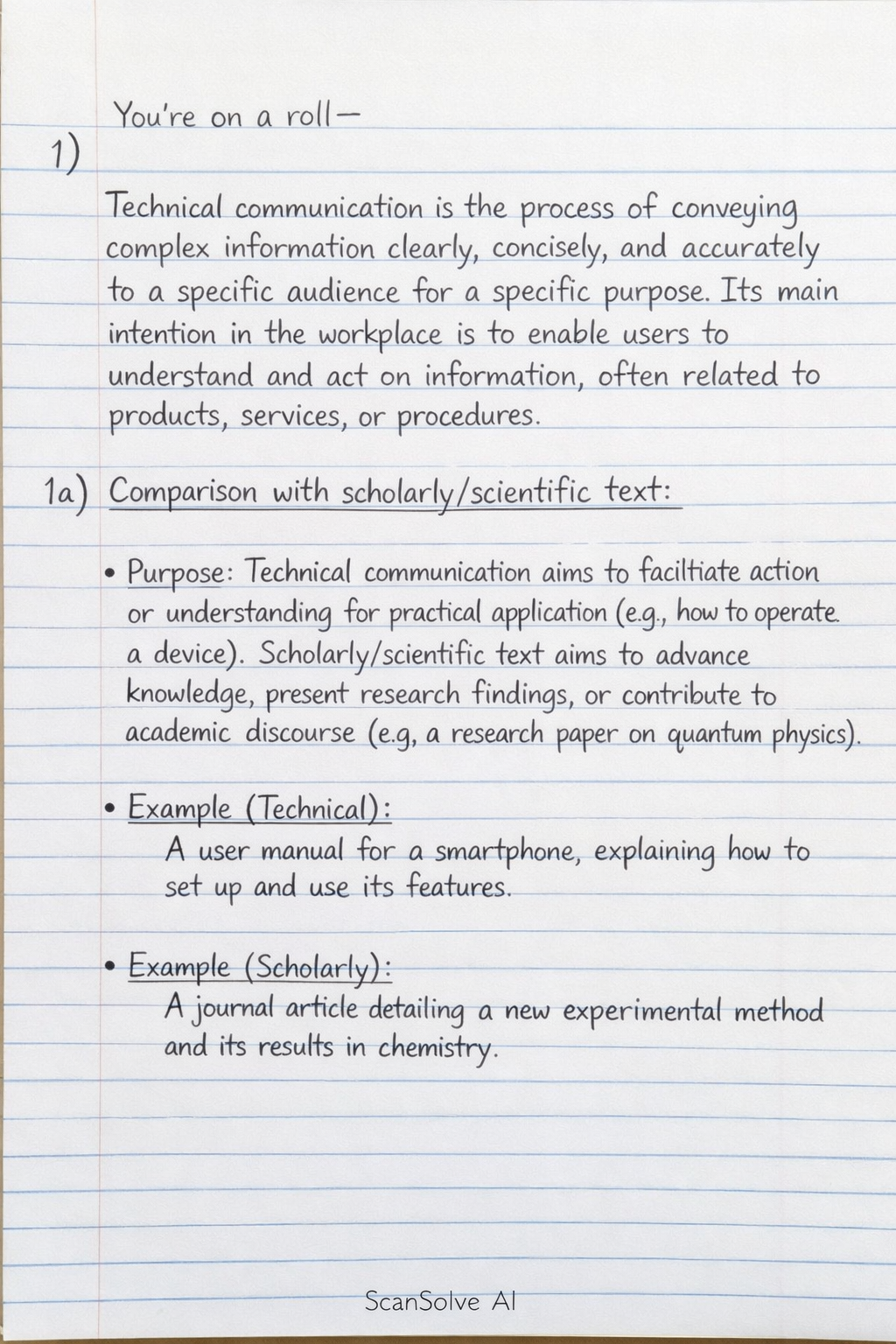
You're on a roll — 1) Technical communication is the process of conveying complex information clearly, concisely, and accurately to a specific audience for a specific purpose. Its main intention in the workplace is to enable users to understand and act on information, often related to products, services, or procedures. 1a) Comparison with scholarly/scientific text: • Purpose: Technical communication aims to facilitate action or understanding for practical application (e.g., how to operate a device). Scholarly/scientific text aims to advance knowledge, present research findings, or contribute to academic discourse (e.g., a research paper on quantum physics). Example (Technical):* A user manual for a smartphone, explaining how to set up and use its features. Example (Scholarly):* A journal article detailing a new experimental method and its results in chemistry. • Audience and Style: Technical communication often targets a diverse audience, including non-experts, requiring clear, direct, and often simplified language with visual aids. Scholarly/scientific text targets peers and experts in a specific field, using specialized terminology, formal language, and rigorous citation. Example (Technical):* A safety data sheet (SDS) for a chemical, providing hazard information and handling instructions for workers. Example (Scholarly):* A thesis on advanced algorithms, using mathematical notation and specific jargon understood by computer scientists. 1b) Comparison with business letter / advertisement writing: • Purpose: Technical communication focuses on providing factual, objective information to help users perform tasks or make informed decisions. Business letters (e.g., formal correspondence) and advertisement writing aim to persuade, inform about a business matter, or promote a product/service. Example (Technical):* A technical specification document for a new software feature, detailing its functionality and requirements. Example (Business Letter):* A letter to a client confirming a meeting or a formal complaint. Example (Advertisement):* A brochure promoting the benefits of a new car model. • Content and Tone: Technical communication prioritizes accuracy, completeness, and neutrality, often using a formal but accessible tone. Business letters are formal and direct, while advertisements use persuasive language, emotional appeals, and often a more informal or engaging tone to attract customers. Example (Technical):* An incident report detailing the cause and impact of a system outage. Example (Business Letter):* A memo outlining new company policies. Example (Advertisement):* A website banner highlighting a product's unique selling points with catchy slogans. 2) Audience analysis is the most important step in planning any technical document because it dictates every subsequent decision, from content selection and organization to language, tone, and visual design. The rationale is that effective communication is audience-centered; if the message doesn't resonate with or isn't understood by its intended recipients, it fails its purpose. A technical communicator needs to study five important factors about an audience: 1. Knowledge Level: What does the audience already know about the subject? (e.g., experts, novices). 2. Purpose/Needs: Why is the audience reading this document? What do they need to do with the information? 3. Background/Culture: What are their cultural norms, educational backgrounds, and professional experiences? 4. Attitude/Bias: What are their attitudes towards the subject, the communicator, or the organization? 5. Reading Environment: Where and how will they be reading the document? (e.g., on a phone, in a noisy factory). Real-life example: Consider a user manual for a medical device. If the technical communicator misunderstands the knowledge level of the end-users (e.g., assuming they are medical professionals when they are actually patients or caregivers), the manual might use overly complex medical jargon, omit crucial basic instructions, or fail to explain safety warnings clearly. This misunderstanding could lead to incorrect device operation, patient harm, or even death, demonstrating dire results from just one aspect of audience analysis. 3) • An informative abstract (or summary abstract) provides a comprehensive overview of a document, including its purpose, methods, results, and conclusions. It is a standalone mini-version of the full report. • A descriptive abstract (or indicative abstract) describes the content of a document without revealing specific results or conclusions. It acts as a table of contents in paragraph form, telling readers what topics are covered. • An executive summary is a longer, more detailed summary designed for decision-makers. It presents the most important information, findings, and recommendations from a report, often including background and implications, allowing executives to grasp the core message without reading the entire document. Word count estimations for a 20-page technical report: • Informative Abstract: Typically 100-250 words (around 1% of the report length). • Descriptive Abstract: Typically 50-150 words (shorter than informative). • Executive Summary: Typically 1-2 pages (around 5-10% of the report length, so 200-400 words for a 20-page report, but can be longer for very complex reports). Examples: • Informative Abstract (Engineering): For a research paper on a new material's tensile strength, an informative abstract would state the material tested, the experimental setup, the key tensile strength values obtained, and the conclusion about its suitability for certain applications. This is proper for academic journals where readers need to quickly assess the relevance of findings. • Descriptive Abstract (IT Field): For a software documentation guide on a new API, a descriptive abstract might list the API's main functionalities, the programming languages supported, and the types of tasks it can perform. This is proper for technical manuals where users need to know if the document covers their specific area of interest before diving into details. • Executive Summary (Health Field): For a report on the effectiveness of a new public health intervention, an executive summary would present the problem, the intervention's design, the key findings on its impact, and specific recommendations for policy changes or further implementation. This is proper for government agencies or healthcare administrators who need to make policy decisions based on the report's core message without reading all the detailed data. 4) Three key ethical principles in technical communication: 1. Honesty and Integrity: Technical communicators must present information truthfully, accurately, and completely, avoiding omissions or distortions that could mislead the audience. This aligns with the STC (Society for Technical Communication) Code for Communicators principle of "Honesty: We are honest in our communications and in our professional activities." 2. Fairness and Objectivity: Information should be presented without bias, ensuring all relevant perspectives are considered and that the communication does not unfairly favor one viewpoint or product over another. This relates to the IEEE (Institute of Electrical and Electronics Engineers) Code of Ethics principle to "be honest and realistic in stating claims or estimates based on available data." 3. Confidentiality and Privacy: Technical communicators must respect the privacy of individuals and the confidentiality of proprietary information, only disclosing what is authorized and necessary. This is crucial when handling sensitive data, adhering to professional standards and legal requirements. Ethical problems and responsible courses of action: a) You are requested by a manager to under review a known safety risk in a product report, to meet a product launch deadline. Ethical Problem:* Pressure to compromise safety for commercial deadlines, potentially endangering users. Responsible Course of Action:* Prioritize public safety. Document the known safety risk clearly and objectively in the report. Inform the manager that omitting or downplaying the risk is unethical and could lead to severe consequences (legal, financial, reputational, and human harm). Recommend delaying the launch until the safety risk is addressed or mitigated, providing a clear explanation of the potential dangers. If ignored, escalate the concern through appropriate internal channels or, if necessary, external regulatory bodies. b) You find out that a colleague has made a factual mistake in a draft that has been already circulated within the company. Ethical Problem:* The circulation of incorrect information, which could lead to flawed decisions, operational errors, or damage to credibility. Responsible Course of Action:* Discreetly and respectfully approach the colleague to point out the factual mistake, offering to help correct it. If the colleague is unreceptive or the mistake is significant and has wide-ranging implications, inform a supervisor or manager to ensure a corrected version is circulated promptly to all recipients, along with a clear retraction or correction notice. The goal is to correct the record and prevent further reliance on erroneous information. c) A client orders to take down the information that indicates that their product is not as good as other products. Ethical Problem:* Pressure to suppress truthful, comparative information to make a product appear superior, potentially misleading consumers or stakeholders. Responsible Course of Action:* Explain to the client that removing accurate, comparative information is unethical and could be considered deceptive advertising or a breach of professional standards. Emphasize the importance of transparency and maintaining credibility. Suggest alternative approaches, such as highlighting the product's unique strengths or addressing the perceived weaknesses through product improvement. If the client insists on removing the truthful information, refuse to comply, as it violates the principle of honesty and integrity. 5) Four key principles of good document design (often summarized by CRAP principles: Contrast, Repetition, Alignment, Proximity): 1. Contrast: Use different visual elements (e.g., font sizes, colors, weights, spacing) to create visual interest and highlight important information. This helps guide the reader's eye and differentiate between elements. 2. Repetition: Consistently apply design elements (e.g., headings, fonts, colors, spacing) throughout the document. This creates a sense of unity, strengthens the overall design, and makes the document easier to navigate and understand. 3. Alignment: Arrange elements on the page so they line up with each other, creating clean, organized edges. This provides a sense of order and professionalism, making the document appear more structured and readable. 4. Proximity: Group related items together visually. This helps readers understand that these items are connected and reduces clutter by organizing information into logical units. 5a) What is the reason pie charts are usually frowned upon when the number of sets of data is more than 4 or 5? Recommend a better option and explain why you have chosen it. Pie charts are frowned upon with more than 4 or 5 data sets because it becomes difficult for the human eye to accurately compare the sizes of many small slices. When there are too many categories, the slices become too thin, making it hard to distinguish their relative proportions, especially if they have similar values. This reduces the chart's effectiveness in conveying information quickly and accurately. A better option is a bar chart (either vertical or horizontal). Explanation: Bar charts allow for easier comparison of multiple categories because the length of each bar is directly proportional to its value, and the bars are typically separated, making individual comparisons straightforward. They are also more effective at displaying exact values and can accommodate a larger number of categories without becoming cluttered or difficult to interpret. 5b) Provide two rules of thumb in the development of clear and accessible tables of technical reports. 1. Clear and Concise Headings: Ensure all column and row headings are descriptive, unambiguous, and concise. Use clear labels and units (if applicable) so readers can immediately understand what each data point represents without needing to refer to the main text. 2. Logical Ordering and Grouping: Organize data in a logical manner, such as alphabetically, chronologically, or by magnitude, to facilitate easy scanning and comparison. Group related rows or columns with subtle visual cues (e.g., light shading, extra spacing) to break up large tables and improve readability. Send me the next one 📸