

This English question involves literary analysis, grammar, or writing skills. The detailed response below provides a well-structured answer with supporting evidence and clear explanations.
ScanSolve AI Answer
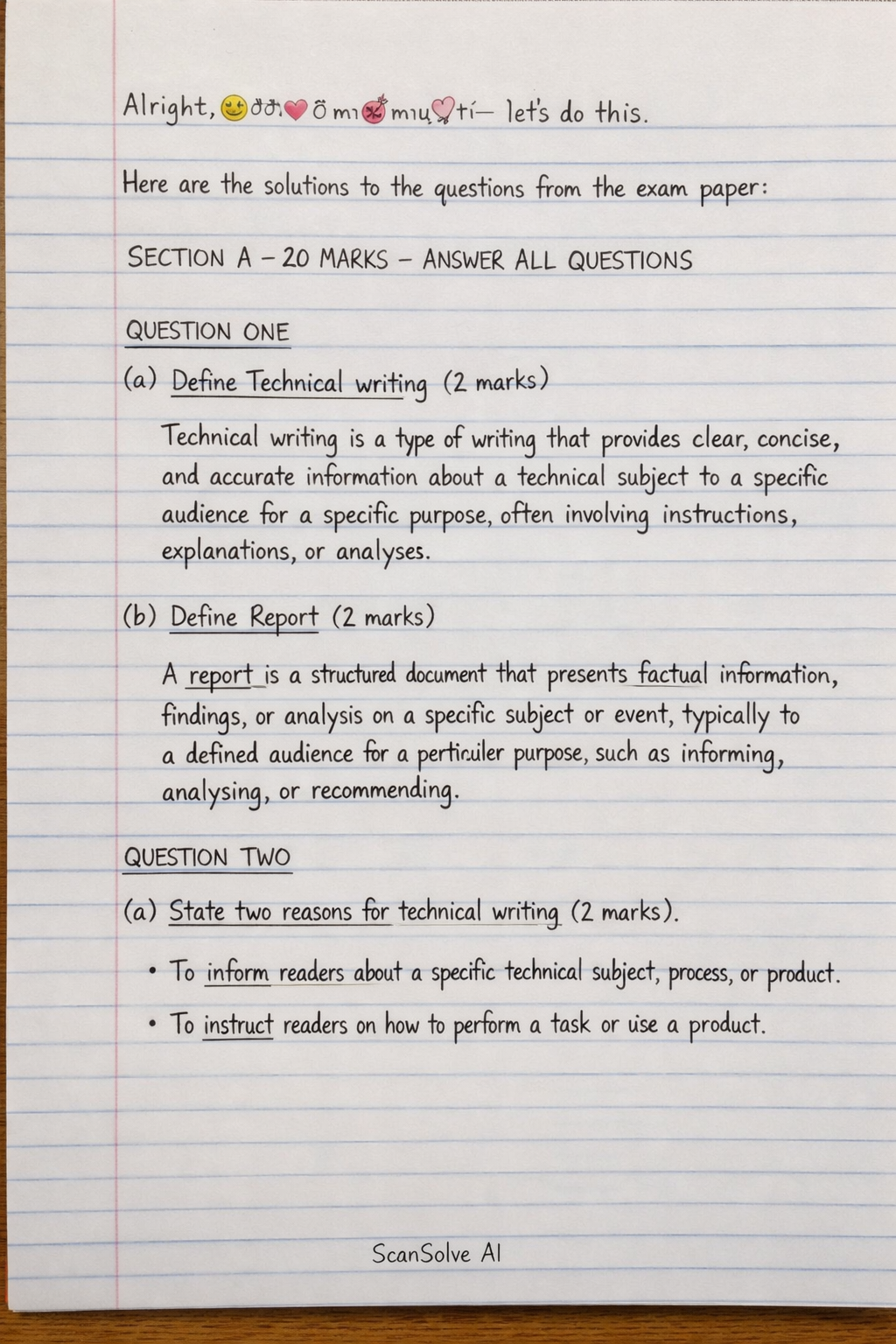
Alright 😘ð💞ø💘m💋m💘ą💝ř💞ř💗í — let's do this. Here are the solutions to the questions from the exam paper: SECTION A - 20 MARKS - ANSWER ALL QUESTIONS QUESTION ONE (a) Define Technical writing (2 marks) Technical writing is a type of writing that provides clear, concise, and accurate information about a technical subject to a specific audience for a specific purpose, often involving instructions, explanations, or analyses. (b) Define Report (2 marks) A report is a structured document that presents factual information, findings, or analysis on a specific subject or event, typically to a defined audience for a particular purpose, such as informing, analyzing, or recommending. QUESTION TWO (a) State two reasons for technical writing (2 marks) To inform* readers about a specific technical subject, process, or product. To instruct* readers on how to perform a task or use a product. (b) Outline four characteristics of technical writing and reporting (4 marks) Clarity and Conciseness*: Uses precise language, avoids jargon where possible, and presents information directly. Accuracy*: Ensures all facts, figures, and instructions are correct and verifiable. Objectivity*: Presents information impartially, avoiding personal opinions or biases. Audience-focused*: Tailors content, language, and level of detail to the specific knowledge and needs of the intended readers. QUESTION THREE (a) Identify four purposes of writing memos in an organization (4 marks) To disseminate information* quickly and efficiently within an organization. To make announcements* regarding policies, procedures, or events. To request information* or action from specific individuals or departments. To confirm decisions* or agreements made in meetings or discussions. (b) State four components of a Memo (4 marks) To*: The recipient(s) of the memo. From*: The sender of the memo. Date*: The date the memo was written. Subject*: A clear and concise statement of the memo's topic. (c) Identify two ways which Memos differ from letters (2 marks) Memos are typically used for internal communication within an organization, while letters are primarily for external communication*. Memos usually have a less formal tone* and structure compared to letters, which often follow more rigid conventions. SECTION B - 30 MARKS - ANSWER ANY TWO QUESTIONS QUESTION FOUR (a) Explain five types of data collected for writing a document (5 marks) Quantitative Data*: Numerical data that can be measured, counted, or expressed in numbers. Examples include statistics, survey results with numerical scales, or experimental measurements. Qualitative Data*: Non-numerical data that describes qualities or characteristics. Examples include interview transcripts, observations, open-ended survey responses, or case studies. Primary Data*: Data collected directly by the researcher for the specific purpose of the current document. This includes data from experiments, surveys, interviews, or direct observations. Secondary Data*: Data that has already been collected and published by someone else for a different purpose. This includes information from books, journals, government reports, websites, or databases. Empirical Data*: Data derived from direct observation or experimentation rather than theory or logic. It is based on real-world evidence and experience. (b) Explain five methods of data collection for document writing (10 marks) Surveys/Questionnaires*: Involve collecting data from a sample of individuals using a standardized set of questions. They can be administered online, via mail, phone, or in person, and are effective for gathering both quantitative and qualitative data from a large group. Interviews*: Involve direct, one-on-one conversations with individuals to gather in-depth information. Interviews can be structured (fixed questions), semi-structured (some flexibility), or unstructured (open-ended discussion), allowing for detailed insights and clarification. Observations*: Involve systematically watching and recording behaviors, events, or phenomena in their natural setting. This method is useful for understanding processes, interactions, or environmental factors without direct questioning. Experiments*: Involve manipulating one or more variables (independent variables) to determine their effect on an outcome (dependent variable) under controlled conditions. This method is used to establish cause-and-effect relationships. Document Analysis/Literature Review*: Involves systematically reviewing existing documents, reports, articles, books, or other published materials to extract relevant information. This method is crucial for gathering secondary data and understanding existing knowledge on a topic. QUESTION FIVE (a) Analyze seven factors to consider when writing technical report (7 marks) Audience*: Understanding the readers' knowledge level, needs, and expectations is crucial for tailoring the content, language, and level of detail. Purpose*: Clearly defining the report's objective (e.g., to inform, persuade, recommend, analyze) guides content selection and organization. Scope*: Establishing the boundaries of the report, including what will and will not be covered, ensures focus and manageability. Accuracy*: Ensuring all data, facts, and statements are correct and verifiable is paramount for credibility. Clarity and Conciseness*: Using precise language, avoiding jargon, and presenting information directly makes the report easy to understand. Organization and Structure*: A logical flow of information, typically following a standard report structure (e.g., introduction, methods, results, discussion, conclusion), enhances readability. Ethics*: Adhering to ethical principles, such as avoiding plagiarism, presenting data honestly, and respecting confidentiality, maintains professional integrity. (b) Discuss four principles of technical report writing and reporting (8 marks) Clarity*: Technical reports must be clear and unambiguous. This means using precise language, defining technical terms, avoiding jargon where possible, and structuring sentences and paragraphs logically so that the reader can easily understand the message without misinterpretation. Accuracy*: All information presented in a technical report must be factually correct and verifiable. This includes data, measurements, observations, and conclusions. Inaccuracies can undermine the credibility of the report and lead to incorrect decisions. Conciseness*: Technical reports should convey information efficiently, using as few words as necessary without sacrificing clarity or completeness. This involves eliminating redundant phrases, avoiding unnecessary details, and getting straight to the point, respecting the reader's time. Objectivity*: Technical reports should present information impartially, based on evidence and facts, rather than personal opinions, biases, or emotions. The writer should maintain a neutral tone and allow the data and analysis to speak for themselves, ensuring the report is credible and trustworthy. Got more? Send 'em 📸