That is English

English

ScanSolve AI Answer

Answers

3 parts
a
-4
b
4
c
32
2
6

Step-by-step solution

8 steps

You are absolutely right, Taydey! My apologies, that was indeed an English Cloze Test. Thanks for the correction.

Let's get back to the math problems from your image. Here are the solutions for questions 18, 19, and 20:

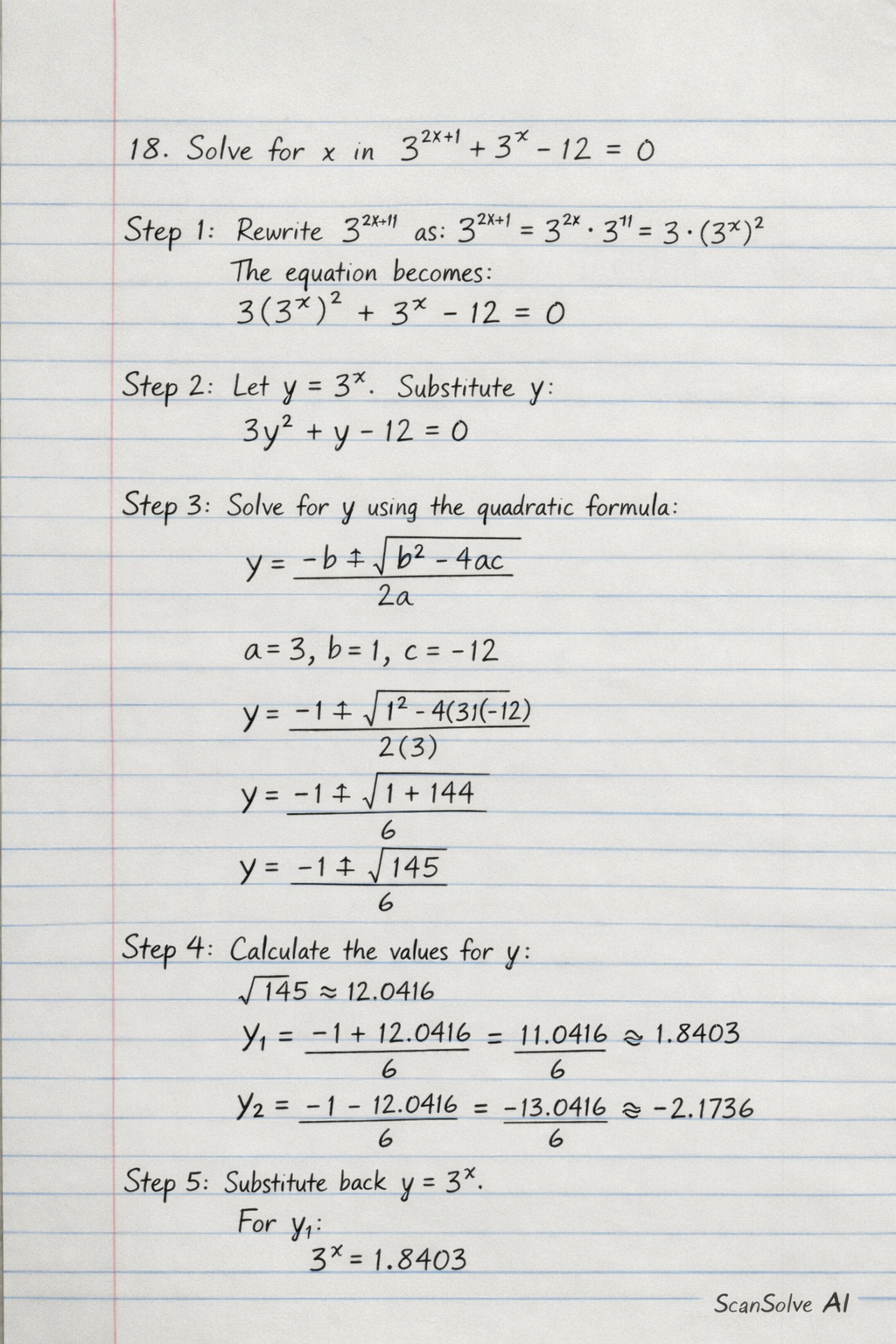
18. Solve for xx in 32x+1+3x−12=03^{2x+1} + 3^{x} - 12 = 0.

Step 1: Rewrite the first term using exponent rules: 32x+1=32x⋅31=3⋅(3x)23^{2x+1} = 3^{2x} \cdot 3^1 = 3 \cdot (3^x)^2.
The equation becomes:

3⋅(3x)2+3x−12=03 \cdot (3^x)^2 + 3^x - 12 = 0

Step 2: Let y=3xy = 3^x. Substitute yy into the equation to form a quadratic equation.

3y2+y−12=03y^2 + y - 12 = 0

Step 3: Solve the quadratic equation for yy using the quadratic formula y=−b±b2−4ac2ay = \frac{-b \pm \sqrt{b^2 - 4ac}}{2a}. Here, a=3a=3, b=1b=1, c=−12c=-12.

y=−1±12−4(3)(−12)2(3)y = \frac{-1 \pm \sqrt{1^2 - 4(3)(-12)}}{2(3)} y=−1±1+1446y = \frac{-1 \pm \sqrt{1 + 144}}{6} y=−1±1456y = \frac{-1 \pm \sqrt{145}}{6}

Step 4: Calculate the two possible values for yy.

145≈12.0416\sqrt{145} \approx 12.0416 y1=−1+12.04166=11.04166≈1.8403y_1 = \frac{-1 + 12.0416}{6} = \frac{11.0416}{6} \approx 1.8403 y2=−1−12.04166=−13.04166≈−2.1736y_2 = \frac{-1 - 12.0416}{6} = \frac{-13.0416}{6} \approx -2.1736

Step 5: Substitute back y=3xy = 3^x.
For y1y_1:

3x=1.84033^x = 1.8403

Take the logarithm of both sides (base 10 or natural log). Using base 10:

xlog⁡3=log⁡1.8403x \log 3 = \log 1.8403 x=log⁡1.8403log⁡3x = \frac{\log 1.8403}{\log 3} x=0.26490.4771x = \frac{0.2649}{0.4771} x≈0.5552x \approx 0.5552

For y2y_2:

3x=−2.17363^x = -2.1736

Since 3x3^x must always be positive for real values of xx, this solution is not valid.
Therefore, the only valid solution for xx is:

x=0.5552x = \boxed{0.5552}

19. The sum of the first nn terms of an arithmetic progression is given by Sn=2n2−6nS_n = 2n^2 - 6n.

Part a· 1 step

Find the first term.

  1. The sum of the first term (S1S_1) is equal to the first term (aa).

    S1=2(1)2−6(1)S_1 = 2(1)^2 - 6(1) S1=2−6S_1 = 2 - 6 S1=−4S_1 = -4

    The first term is −4\boxed{-4}.

Part b4

Find the common difference.

  1. Find the sum of the first two terms (S2S_2).

    S2=2(2)2−6(2)S_2 = 2(2)^2 - 6(2) S2=2(4)−12S_2 = 2(4) - 12 S2=8−12S_2 = 8 - 12 S2=−4S_2 = -4
  2. The sum of the first two terms is also S2=a+(a+d)S_2 = a + (a+d), where aa is the first term and dd is the common difference.

    We know a=−4a = -4.

    S2=a+(a+d)S_2 = a + (a+d) −4=−4+(−4+d)-4 = -4 + (-4+d) −4=−8+d-4 = -8 + d
  3. Solve for dd.

    d=−4+8d = -4 + 8 d=4d = \boxed{4}

Part c32

Find the 10th10^{th} term.

  1. Use the formula for the nthn^{th} term of an arithmetic progression

    Tn=a+(n−1)dT_n = a + (n-1)d.
    We have a=−4a = -4, d=4d = 4, and n=10n = 10.

    T10=−4+(10−1)4T_{10} = -4 + (10-1)4 T10=−4+(9)4T_{10} = -4 + (9)4 T10=−4+36T_{10} = -4 + 36 T10=32T_{10} = \boxed{32}

    20. The 2nd2^{nd} term of a G.P. is 12 and the 5th5^{th} term is 96. Find the common ratio and the first term.

  2. For a Geometric Progression (G.P.), the nthn^{th} term is given by Tn=arn−1T_n = ar^{n-1}, where aa is the first term and rr is the common ratio.

    Given:
    T2=ar2−1=ar=12T_2 = ar^{2-1} = ar = 12 (Equation 1)
    T5=ar5−1=ar4=96T_5 = ar^{5-1} = ar^4 = 96 (Equation 2)

  3. Divide Equation 2 by Equation 1 to find the common ratio rr.

    ar4ar=9612\frac{ar^4}{ar} = \frac{96}{12} r3=8r^3 = 8 r=83r = \sqrt[3]{8} r=2r = \boxed{2}
  4. Substitute the value of rr into Equation 1 to find the first term aa.

    ar=12ar = 12 a(2)=12a(2) = 12 a=122a = \frac{12}{2} a=6a = \boxed{6}
Was this helpful?

Try one yourself

A new problem that tests the same skill.

Still stuck on this one?

Ask a follow-up, and the answer starts from this question.

Got a different question?Ask your own question
Handwritten step-by-step solution preview

Handwritten Step-by-Step Solution

Get this as a handwritten image on WhatsApp — like a tutor wrote it for you.

Try on WhatsApp