
We read your photo as:
What are the answers to these English literature questions about "The Weaver Bird"?
ScanSolve AI Answer
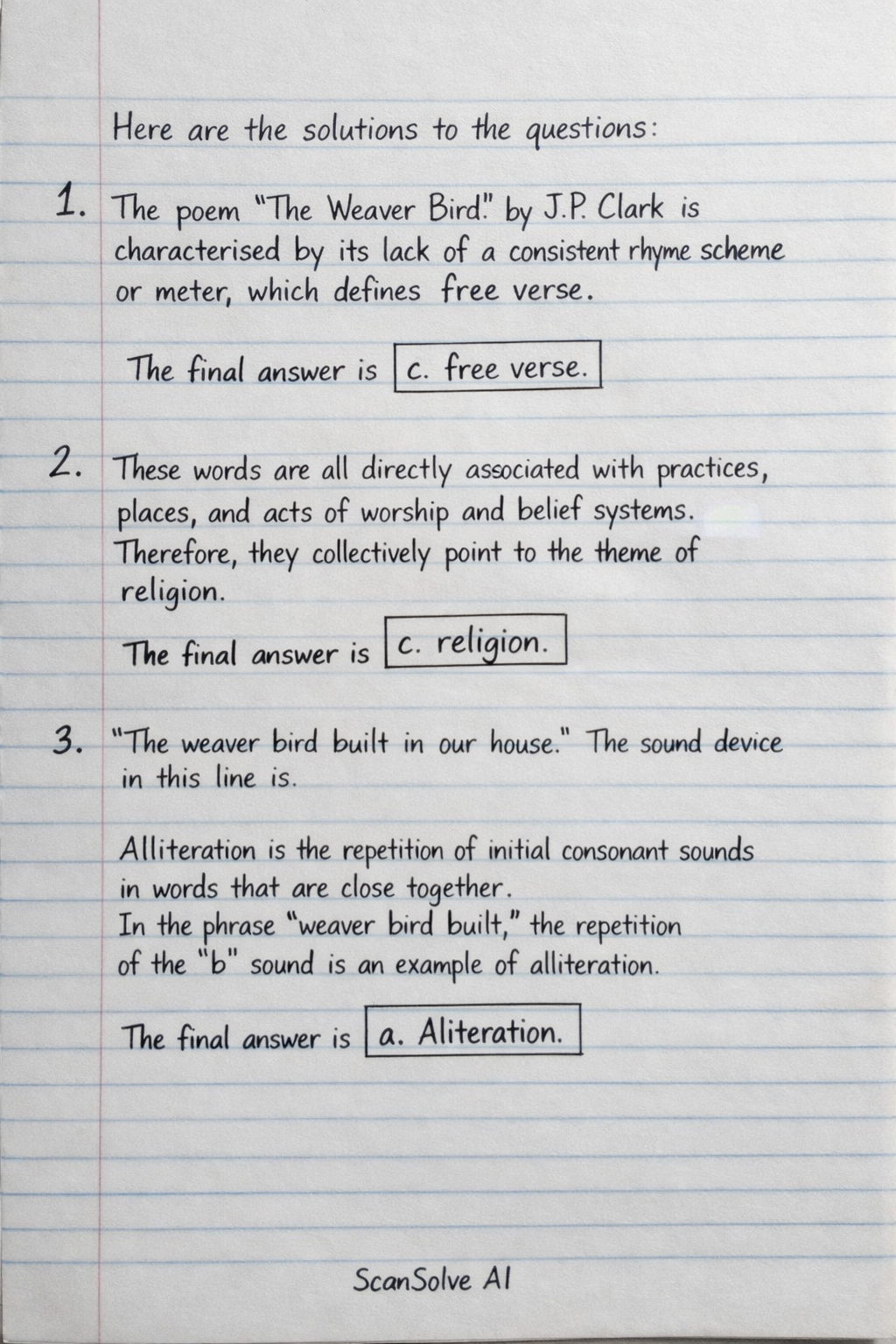
Here are the solutions to the questions:
1. "The Weaver Bird" is written in
The poem "The Weaver Bird" by J.P. Clark is characterized by its lack of a consistent rhyme scheme or meter, which defines free verse.
The final answer is .
2. Words such as 'altars', 'shrines' and 'prayers' suggest the theme of
These words are all directly associated with practices, places, and acts of worship and belief systems. Therefore, they collectively point to the theme of religion.
The final answer is .
3. "The weaver bird built in our house." The sound device in this line is
Alliteration is the repetition of initial consonant sounds in words that are close together. In the phrase "weaver bird built," the repetition of the 'b' sound is an example of alliteration.
The final answer is .
4. The coming of the weaver bird has .................... the personae.
In J.P. Clark's poem, the weaver bird's arrival and nest-building are often interpreted as an intrusion that disrupts the human inhabitants' sense of peace and ownership. This leads to a feeling of being displaced or losing control, which is best described as dispossessed.
The final answer is .
5. "And the fishers dried their nets by lantern light". This expression illustrates
This line describes a realistic scene.
- Oxymoron involves contradictory terms (e.g., "deafening silence"). This is not present.
- Sarcasm is the use of irony to mock. This is not present.
- Simile is a comparison using "like" or "as". This is not present.
- Hyperbole is an exaggeration for emphasis or effect. While the line is primarily descriptive imagery, if it is intended to emphasize the arduousness, the long hours, or the dedication of the fishers working even in dim light, it could be interpreted as a subtle form of hyperbole, exaggerating the extent of their toil. Among the given options, this is the most plausible interpretation if the line is meant to convey a heightened sense of effort or difficulty.
The final answer is .
Still stuck on this one?
Ask a follow-up, and the answer starts from this question.
More English Questions
Handwritten Step-by-Step Solution
Get this as a handwritten image on WhatsApp — like a tutor wrote it for you.
Try on WhatsApp