
We read your photo as:
Which is the correct word to complete the following sentence? Margaret ______ doesn't usually come by bus. A. doesn't B. isn't C. don't D. aren't
ScanSolve AI Answer
Answer
Step-by-step solution
12 stepsAnalyze question 29.
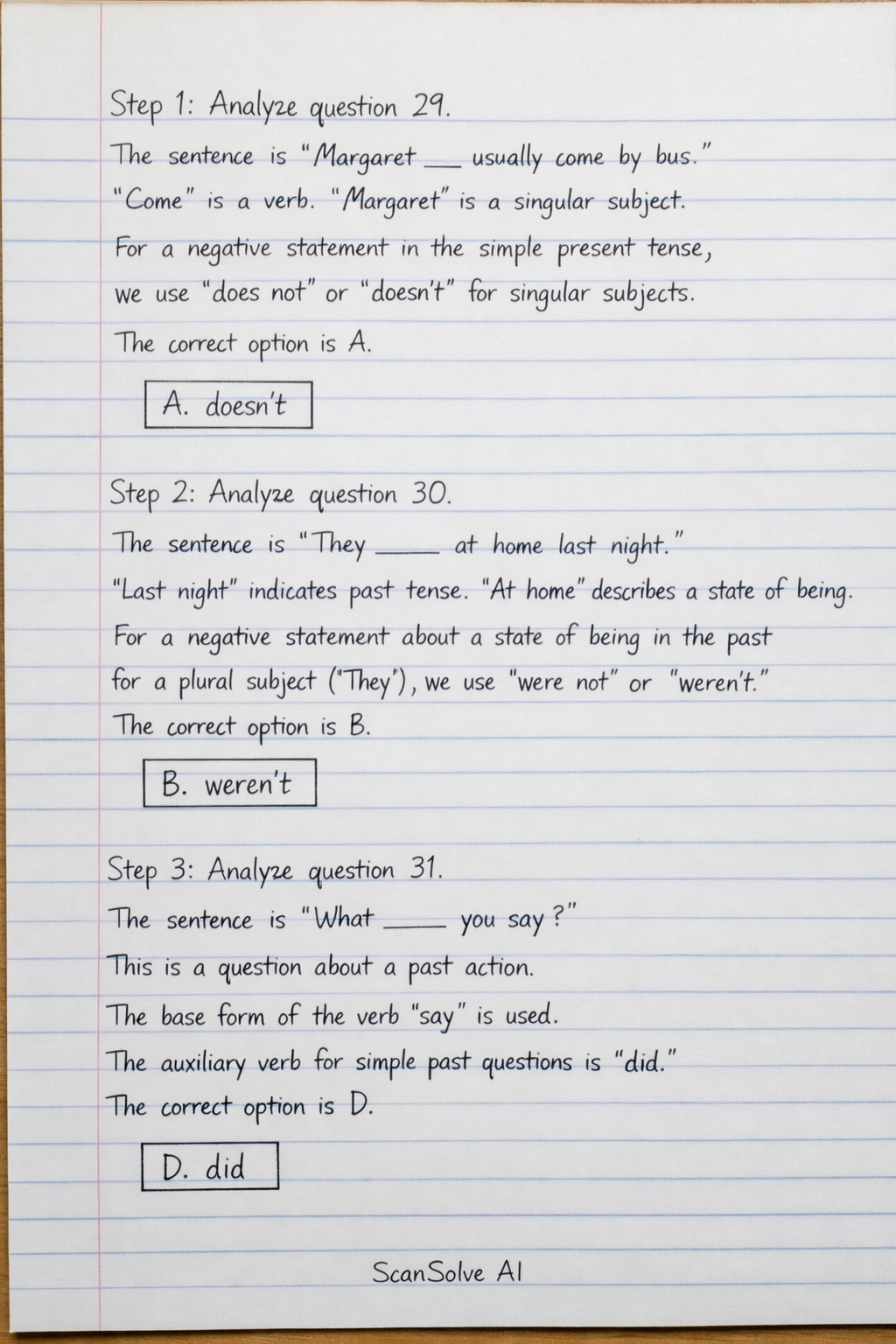
The sentence is "Margaret ______ usually come by bus." "Come" is a verb. "Margaret" is a singular subject. For a negative statement in the simple present tense, we use "does not" or "doesn't" for singular subjects.
The correct option is A.Analyze question 30.
The sentence is "They ______ at home last night." "Last night" indicates past tense. "At home" describes a state of being. For a negative statement about a state of being in the past for a plural subject ("They"), we use "were not" or "weren't".
The correct option is B.Analyze question 31.
The sentence is "What ______ you say?" This is a question about a past action. The base form of the verb "say" is used. The auxiliary verb for simple past questions is "did".
The correct option is D.Analyze question 32.
The sentence is "Why ______ crying?" "Crying" is a present participle, indicating a continuous tense. The sentence is a question. For a present continuous question with "you", the structure is "Why are you crying?".
The correct option is A.Analyze question 33.
The sentence is "Where ______ to spend your holidays next summer?" "Next summer" indicates a future plan or intention, often expressed with "be going to". The sentence is a question. For a question about future plans with "you", the structure is "Where are you going to spend...".
The correct option is B.Analyze question 34.
The sentence is "______ never been to the theatre before." "Never been" indicates the present perfect tense (have + past participle). The contraction for "I have" is "I've".
The correct option is D.Analyze question 35.
The sentence is "Bata shoes ______ in Gweru." This describes a general fact about the shoes, implying a passive voice (shoes are manufactured). "Bata shoes" is plural. The present simple passive form for plural subjects is "are made".
The correct option is A.Analyze question 36.
The sentence is "After the speech, Mario asked a ______ to Sydney." When someone "asks", they typically ask a "question".
The correct option is C.Analyze question 37.
The sentence is "Where ______ when you met him?" "When you met him" indicates a past event. The question asks about his continuous state of living at that specific past time, requiring the past continuous tense. For a singular subject "he", the past continuous question form is "was he living".
The correct option is C.Analyze question 38.
The sentence is "If ______, I'll tell him you called." This is a first conditional sentence, which uses "If + present simple, will + base verb". The second clause "I'll tell him you called" uses "will". Therefore, the "if" clause must be in the present simple tense.
The correct option is B.Analyze question 39.
The question asks to identify the verb in the sentence "Jill sets the pen on the table?". A verb is an action word. "Jill" is a noun, "pen" is a noun, "table" is a noun. "Sets" is the action performed by Jill.
The correct option is D.Analyze question 40.
The sentence is "Wine ______ made in Italy for thousands of years." "Wine" is a singular subject. "For thousands of years" indicates a duration that continues up to the present, requiring the present perfect tense. The sentence is in the passive voice. The correct present perfect passive form for a singular subject is "has been made".
The correct option is C.
Try one yourself
A new problem that tests the same skill.
Still stuck on this one?
Ask a follow-up, and the answer starts from this question.
More English Questions
Handwritten Step-by-Step Solution
Get this as a handwritten image on WhatsApp — like a tutor wrote it for you.
Try on WhatsApp