
We read your photo as:
What are the key structural and thematic elements of the poem "The Lake Isle of Innisfree"?
ScanSolve AI Answer
Step-by-step solution
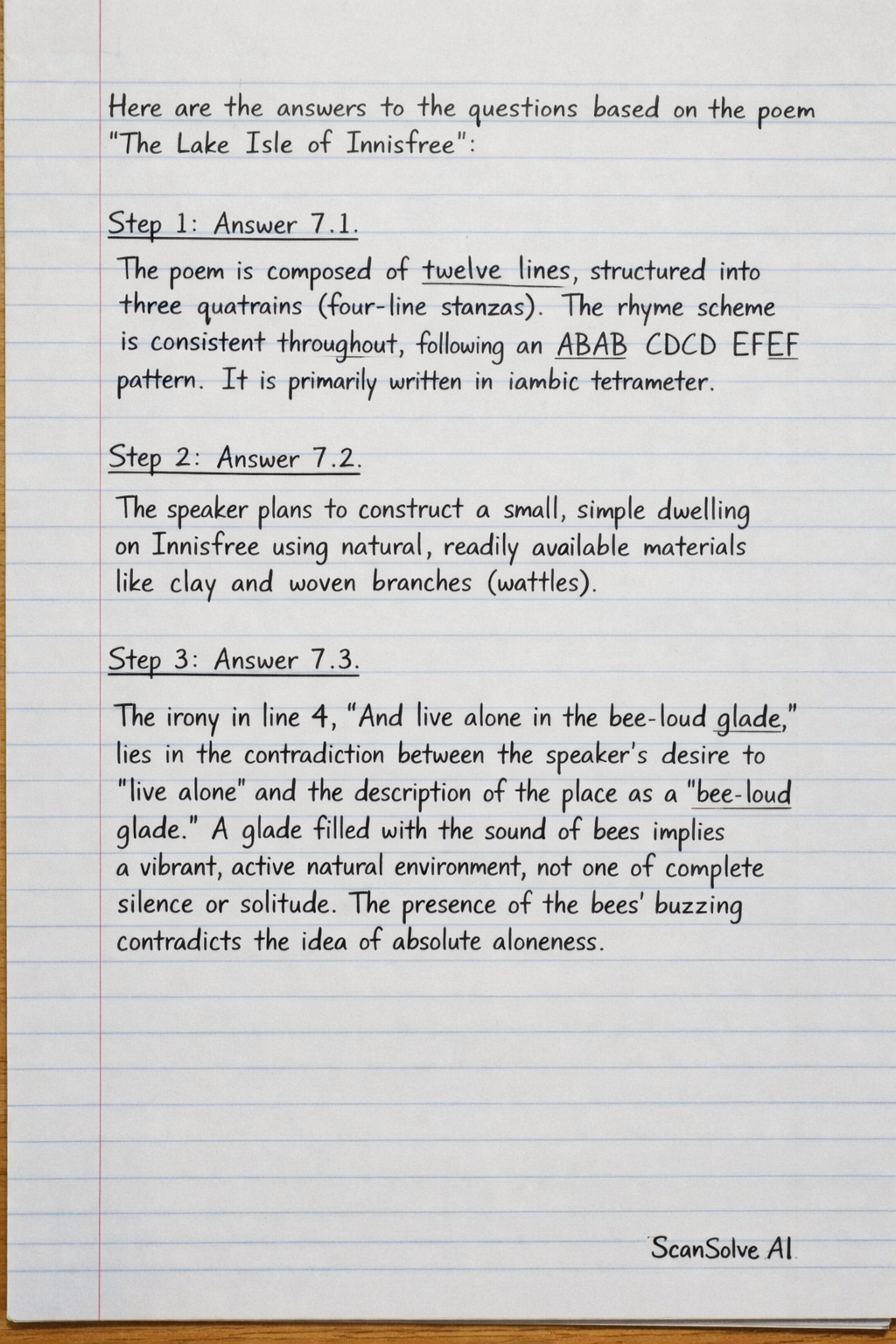
7 stepsHere are the answers to the questions based on the poem "The Lake Isle of Innisfree":
Answer 7.1
The poem is composed of twelve lines, structured into three quatrains (four-line stanzas). The rhyme scheme is consistent throughout, following an ABAB CDCD EFEF pattern. It is primarily written in iambic tetrameter.
Answer 7.2
The speaker plans to construct a small, simple dwelling on Innisfree using natural, readily available materials like clay and woven branches (wattles).
Answer 7.3
The irony in line 4, "And live alone in the bee-loud glade," lies in the contradiction between the speaker's desire to "live alone" and the description of the place as a "bee-loud glade." A glade filled with the sound of bees implies a vibrant, active natural environment, not one of complete silence or solitude. The presence of the bees' buzzing contradicts the idea of absolute aloneness.
Answer 7.4
a) The figure of speech in line 10 ("I hear lake water lapping with low sounds by the shore") is onomatopoeia.
b) This figure of speech is relevant because it directly imitates the sound of the water, making the auditory experience of Innisfree vivid and immediate for the reader. It emphasizes the peaceful and soothing natural sounds that the speaker yearns for, contrasting them with the harshness of city life and highlighting the tranquility of the island.
Answer 7.5
a) The tone the speaker would use in line 12 ("I hear it in the deep heart's core") is one of profound longing or deep yearning.
b) The speaker would use this tone to convey that his desire for Innisfree is not a fleeting wish but a fundamental, innate need that resonates deeply within his being. It emphasizes the spiritual and emotional connection he feels to the island, suggesting it is a place essential for his soul's peace.
Answer 7.6
One of the central themes in this poem is the tranquility of nature. The speaker consistently portrays Innisfree as an idyllic sanctuary of peace and calm, a stark contrast to the urban environment he currently inhabits. This tranquility is conveyed through various sensory details: "peace comes dropping slow," the gentle sounds of "lake water lapping," the soft glow of "midnight's all a glimmer," and the quiet presence of "linnet's wings." These images collectively create an atmosphere of profound serenity, highlighting nature's ability to offer solace and escape from the stresses of modern life.
Answer 7.7
Yes, the speaker succeeds in painting a life-like picture of the Island life through rich and evocative sensory imagery. He appeals to our senses of sight ("nine bean-rows," "purple glow," "linnet's wings"), sound ("bee-loud glade," "cricket sings," "lake water lapping"), and even a sense of gentle movement ("peace comes dropping slow"). These specific, tangible details, such as the "small cabin of clay and wattles," the "hive for the honey-bee," and the "veils of the morning," create a vivid and immersive mental image of Innisfree. The poem's emotional depth, stemming from the speaker's deep longing, further enhances the realism, making the island feel not just imagined, but deeply felt and desired.
Still stuck on this one?
Ask a follow-up, and the answer starts from this question.
More English Questions
Handwritten Step-by-Step Solution
Get this as a handwritten image on WhatsApp — like a tutor wrote it for you.
Try on WhatsApp