
We read your photo as:
What are the key themes and ideas in Rabindranath Tagore's poem 'Where the Mind is Without Fear'?
ScanSolve AI Answer
Here are the answers to your questions:
-
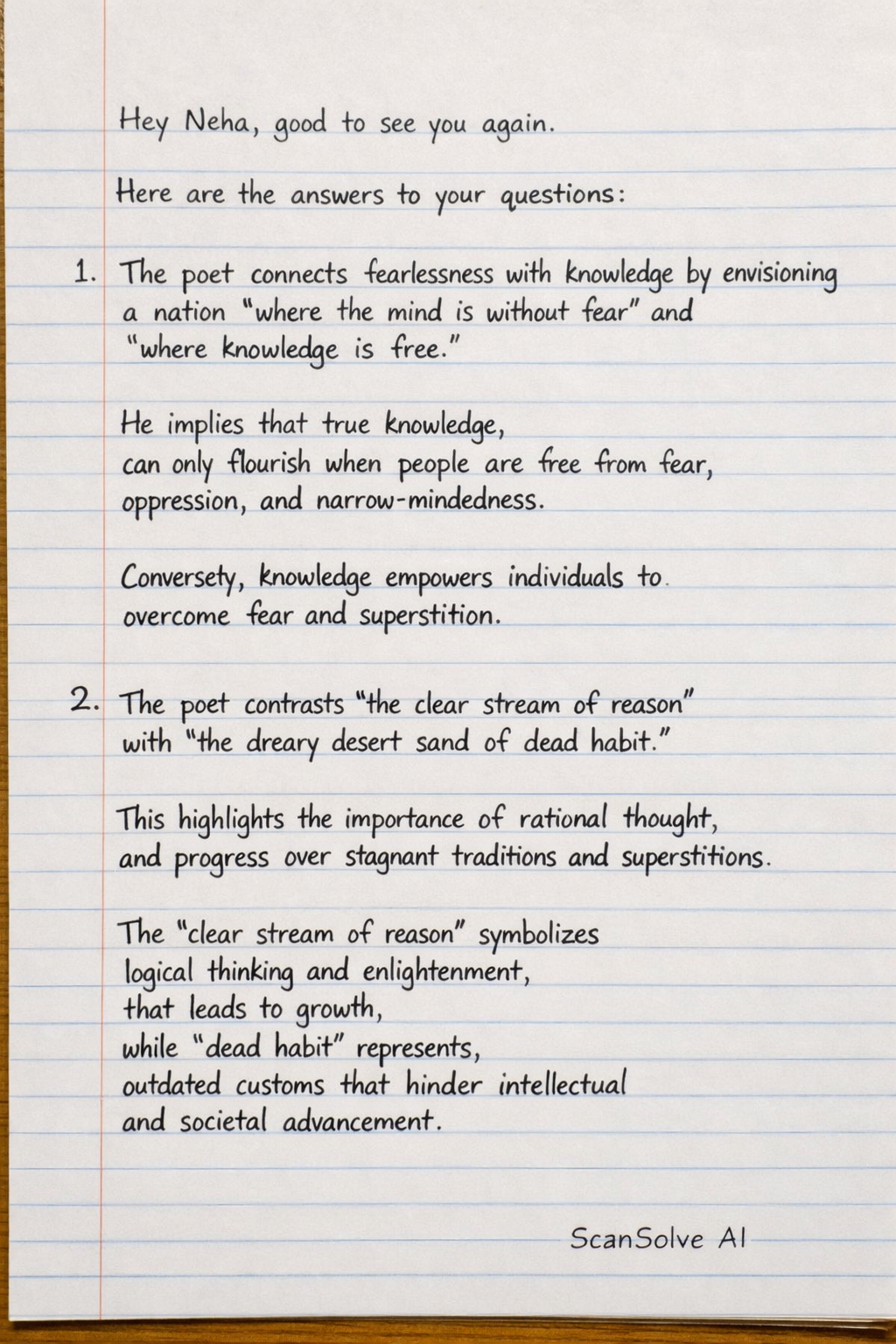
The poet connects fearlessness with knowledge by envisioning a nation "where the mind is without fear" and "where knowledge is free." He implies that true knowledge can only flourish when people are free from fear, oppression, and narrow-mindedness. Conversely, knowledge empowers individuals to overcome fear and superstition.
-
The poet contrasts "the clear stream of reason" with "the dreary desert sand of dead habit" to highlight the importance of rational thought and progress over stagnant traditions and superstitions. The "clear stream of reason" symbolizes logical thinking and enlightenment that leads to growth, while "dead habit" represents outdated customs that hinder intellectual and societal advancement.
-
The poem reflects a prayer as the poet addresses a divine entity ("My Father") to guide his country into a state of ideal freedom. It's a vision because it outlines the specific qualities and conditions of this ideal free nation. The poet emphasizes "tireless striving" because building an ideal nation requires continuous effort, hard work, and perseverance towards perfection, rather than complacency or accepting mediocrity.
-
The central idea of the poem "Where the Mind is Without Fear" is the poet's fervent desire for his country to achieve a holistic form of freedom. His vision for his country is one where its people are fearless, knowledgeable, truthful, rational, progressive, and united, constantly striving for perfection and guided by reason, free from all forms of oppression and narrow divisions.
Still stuck on this one?
Ask a follow-up, and the answer starts from this question.
More English Questions
Handwritten Step-by-Step Solution
Get this as a handwritten image on WhatsApp — like a tutor wrote it for you.
Try on WhatsApp