
We read your photo as:
What are the literary terms for: consonant sound repetition, character change, poetic stanza, and figurative language for 'The wind whispered'?
ScanSolve AI Answer
Answer
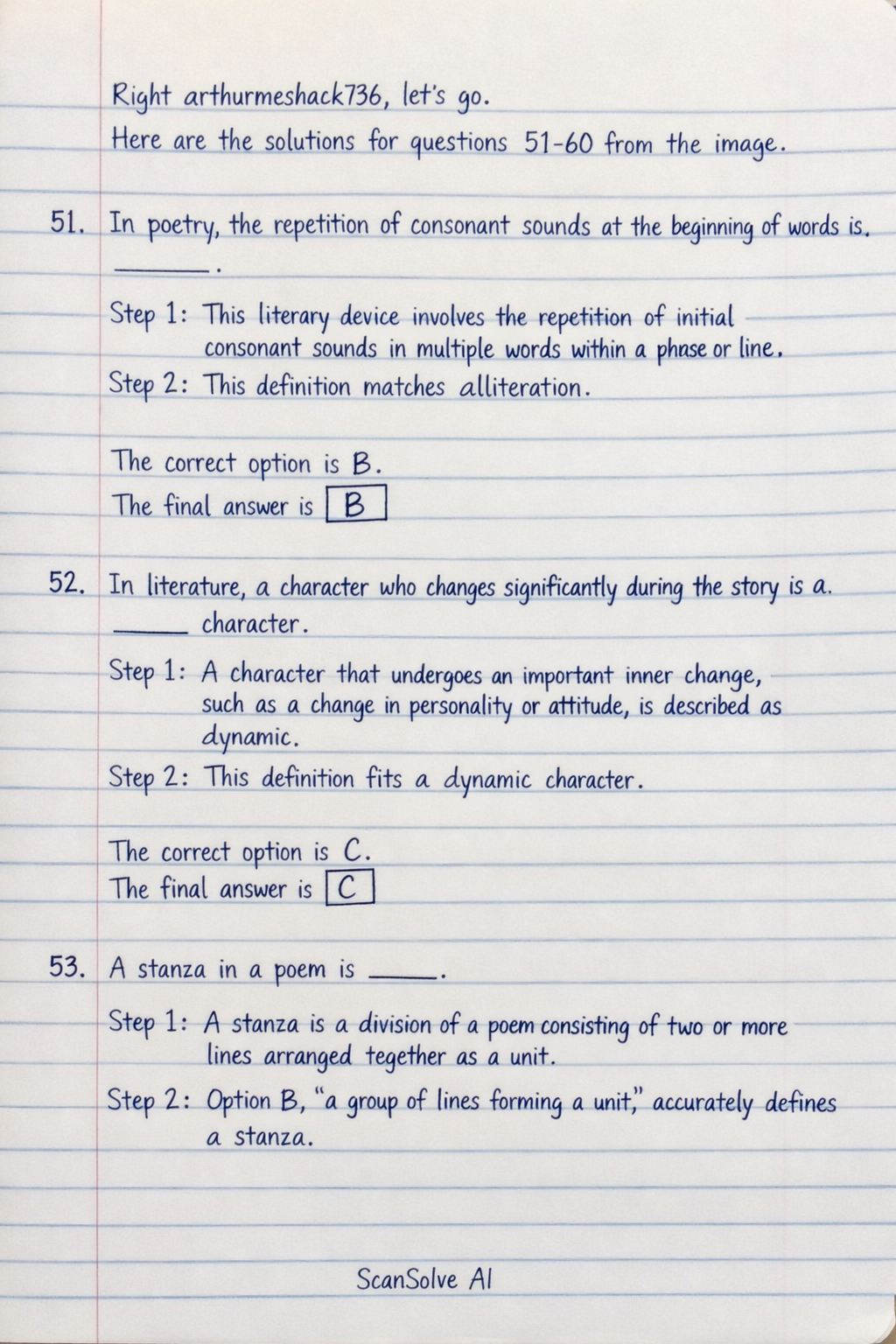
Here are the solutions for questions 51-60 from the image.
51. In poetry, the repetition of consonant sounds at the beginning of words is ______
- Step 1: This literary device involves the repetition of initial consonant sounds in multiple words within a phrase or line.
- Step 2: This definition matches alliteration.
The correct option is B.
The final answer is
52. In literature, a character who changes significantly during the story is a ______ character.
- Step 1: A character that undergoes an important inner change, such as a change in personality or attitude, is described as dynamic.
- Step 2: This definition fits a dynamic character.
The correct option is C.
The final answer is
53. A stanza in a poem is ______
- Step 1: A stanza is a division of a poem consisting of two or more lines arranged together as a unit.
- Step 2: Option B, "a group of lines forming a unit," accurately defines a stanza.
The correct option is B.
The final answer is
54. 'The wind whispered through the trees' is ______
- Step 1: This phrase attributes a human action (whispering) to an inanimate object (wind).
- Step 2: Giving human qualities or characteristics to non-human things is known as personification.
The correct option is C.
The final answer is
55. A Shakespearean sonnet ends in a ______
- Step 1: A Shakespearean (or English) sonnet consists of three quatrains and a concluding two-line couplet.
- Step 2: The final two lines form a couplet.
The correct option is C.
The final answer is
56. Four lines of poetry is a ______
- Step 1: A stanza or poem composed of four lines is a specific poetic form.
- Step 2: This is known as a quatrain.
The correct option is C.
The final answer is
57. An example of hyperbole is ______
- Step 1: Hyperbole is the use of extreme exaggeration for emphasis or effect.
- Step 2: Option D, "I have told you a million times," is an obvious exaggeration, as it's unlikely someone has literally said something a million times.
The correct option is D.
The final answer is
58. The metric foot in which a stressed syllable is followed by an unstressed syllable is ______
- Step 1: A metric foot is a basic rhythmic unit of a line of poetry. Different feet have different patterns of stressed and unstressed syllables.
- Step 2: A foot with a stressed syllable followed by an unstressed syllable (DA-dum) is a trochaic foot.
The correct option is A.
The final answer is
59. The author of a play is a ______
- Step 1: The specific term for a person who writes plays is a compound word.
- Step 2: This person is called a playwright.
The correct option is B.
The final answer is
60. 'The car zoomed past' illustrates ______
- Step 1: The word "zoomed" imitates the sound associated with a car moving quickly.
- Step 2: The formation of a word from a sound associated with what is named is onomatopoeia.
The correct option is D.
The final answer is
Try one yourself
A new problem that tests the same skill.
Still stuck on this one?
Ask a follow-up, and the answer starts from this question.
More English Questions
Handwritten Step-by-Step Solution
Get this as a handwritten image on WhatsApp — like a tutor wrote it for you.
Try on WhatsApp