
We read your photo as:
The man said he would like to see a doctor because he felt terribly ill and run .
ScanSolve AI Answer
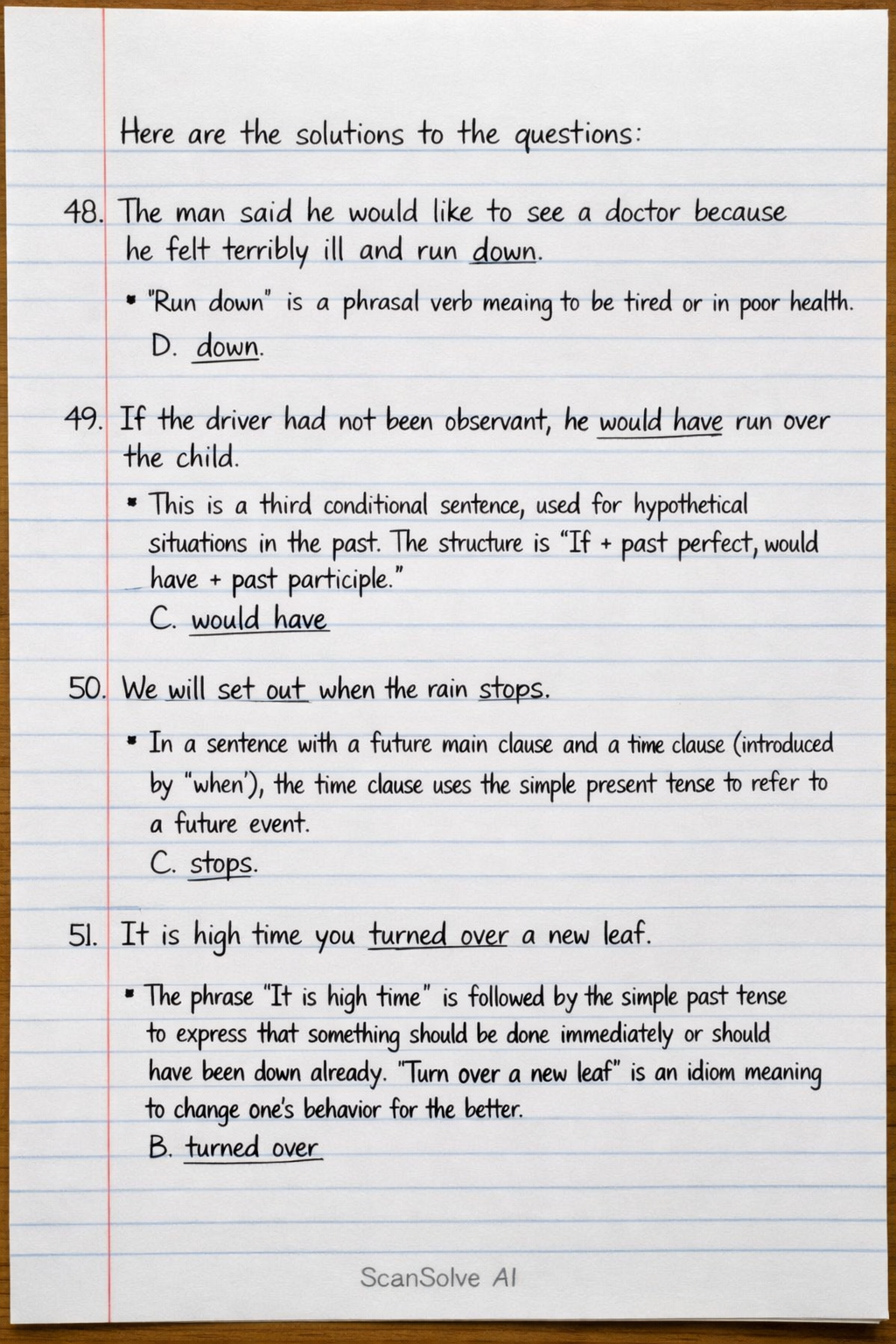
Here are the solutions to the questions:
48. The man said he would like to see a doctor because he felt terribly ill and run down.
- "Run down" is a phrasal verb meaning to be tired or in poor health.
- D. down
49. If the driver had not been observant, he would have run over the child.
- This is a third conditional sentence, used for hypothetical situations in the past. The structure is "If + past perfect, would have + past participle."
- C. would have
50. We will set out when the rain stops.
- In a sentence with a future main clause and a time clause (introduced by "when"), the time clause uses the simple present tense to refer to a future event.
- C. stops
51. It is high time you turned over a new leaf.
- The phrase "It is high time" is followed by the simple past tense to express that something should be done immediately or should have been done already. "Turn over a new leaf" is an idiom meaning to change one's behavior for the better.
- B. turned over
52. It was the chief you saw, wasn't it?
- This is a tag question. The main clause "It was the chief you saw" is positive and uses "was," so the tag question should be negative and use "wasn't" with the pronoun "it."
- A. wasn't it
53. Joseph was stung by a scorpion.
- In a passive voice sentence, the agent performing the action is introduced by "by."
- B. by
54. Ebrima was withdrawn from the private school because the fees were rather too high for his parents to pay.
- "Rather" is used here as an intensifier before "too high" to indicate an excessive degree.
- B. rather
55. The president, along with his entourage, is attending the conference today.
- When "along with" connects two subjects, the verb agrees with the first subject ("The president"), which is singular.
- A. is attending
56. Have you heard that Obi was seriously injured in a ghastly accident this afternoon?
- "Ghastly" means dreadful or horrible, fitting the context of a "seriously injured" person in an accident.
- D. ghastly
57. The doctor could find nothing wrong with neither of his ears, and was satisfied that his hearing was perfect.
- "Neither of" is used to indicate that not one of two things is true. Since his hearing was perfect, there was nothing wrong with either ear.
- A. neither of
58. Neither the parents nor their children bought a car.
- The correlative conjunction "neither... nor" is used to connect two negative elements.
- C. nor
59. By now you ought to have known the name of your teacher as he has told you time and again.
- "Time and again" is an idiom meaning repeatedly or often.
- A. and again
60. However much he tried, his boss never trusted him.
- "However" is used here to introduce a contrasting idea, meaning "no matter how much."
- B. However
61. You weren't in the office this morning, were you?
- This is a tag question. The main clause "You weren't in the office" is negative and uses "weren't," so the tag question should be positive and use "were" with the pronoun "you."
- B. were you
62. I had no option but to yield to his request.
- The phrase "no option but to" means there is no other choice than to do something.
- D. but to
63. The principal has gone to Freetown and will come back in two weeks' time.
- "In two weeks' time" is an idiom meaning "after a period of two weeks." The apostrophe indicates a possessive form for a duration.
- D. two weeks'
Still stuck on this one?
Ask a follow-up, and the answer starts from this question.
More English Questions
Handwritten Step-by-Step Solution
Get this as a handwritten image on WhatsApp — like a tutor wrote it for you.
Try on WhatsApp