
We read your photo as:
What is the meaning of the proverb "A bird in the hand is worth two in the bush"? Choose the best option below.
ScanSolve AI Answer
Answers
5 partsQuestion 11:
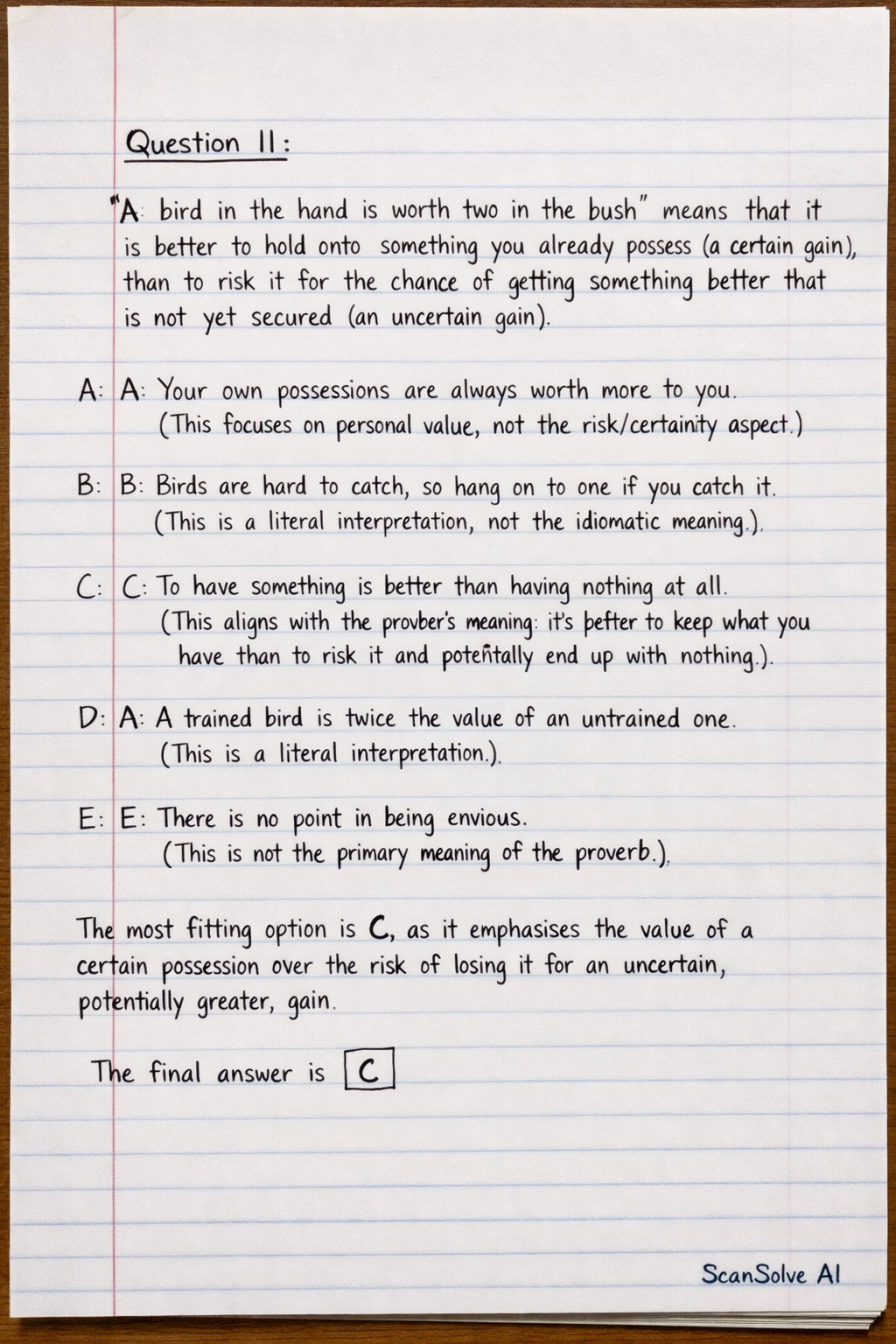
The proverb "A bird in the hand is worth two in the bush" means that it is better to hold onto something you already possess (a certain gain) than to risk it for the chance of getting something better that is not yet secured (an uncertain gain).
- A: Your own possessions are always worth more to you. (This focuses on personal value, not the risk/certainty aspect.)
- B: Birds are hard to catch, so hang on to one if you catch it. (This is a literal interpretation, not the idiomatic meaning.)
- C: To have something is better than having nothing at all. (This aligns with the proverb's meaning: it's better to keep what you have than to risk it and potentially end up with nothing.)
- D: A trained bird is twice the value of an untrained one. (This is a literal interpretation.)
- E: There is no point in being envious. (This is not the primary meaning of the proverb.)
The most fitting option is C, as it emphasizes the value of a certain possession over the risk of losing it for an uncertain, potentially greater, gain.
The final answer is
Question 12:
The passage states, "Afterwards there was silence on board the yacht." This directly indicates the narrator is telling the story from the deck of a yacht.
- A: a wharf (They are on board, not at a wharf.)
- B: the deck of a yacht (This is explicitly stated in the passage.)
- C: a high vantage point (While a yacht deck can be a vantage point, "deck of a yacht" is more specific and accurate.)
- D: the edge of the Essex marshes (They are observing the marshes, not on them.)
- E: None of the above.
The final answer is
Question 13:
The passage describes the men as "tolerant of each other's yarns and even convictions," exchanging "a few words lazily," and later feeling "meditative, and fit for nothing but placid staring." These descriptions suggest a thoughtful, calm, and reflective state.
- A: surly (Grumpy or bad-tempered; this contradicts "tolerant" and "placid.")
- B: resigned (Accepting something undesirable; while calm, their mood is more reflective than simply accepting a bad situation.)
- C: contemplative (Involving deep thought; "meditative" directly supports this.)
- D: listless (Lacking energy or enthusiasm; while "placid staring" might suggest a lack of activity, "meditative" implies mental engagement rather than mere apathy.)
- E: ecstatic (Overjoyed; this is the opposite of the described mood.)
The word "meditative" is the strongest indicator, making "contemplative" the best description.
The final answer is
Question 14:
The passage mentions the men being "tolerant of each other's yarns and even convictions" and exchanging "a few words lazily." They are together in a quiet, reflective state, not actively quarreling or showing animosity. This suggests a comfortable, unspoken understanding among them.
- A: do not get along (Incorrect; "tolerant" implies they do get along.)
- B: show a quiet understanding (Their tolerance, lazy conversation, and meditative silence suggest a comfortable, unspoken understanding.)
- C: cannot be bothered with one another (While they are quiet, "tolerant" and being together implies they can be bothered, but choose a calm interaction.)
- D: have just had a quarrel (Incorrect; the mood is calm and tolerant.)
- E: are worn out (While possible, the primary description is "meditative" and "placid," which points more to a state of mind than physical exhaustion.)
The final answer is
Question 15:
The passage describes the mist as "like a gauzy and radiant fabric, hung from the wooded slopes, and draping the low shores in diaphanous folds." The word "gauzy" means thin and translucent. "Diaphanous" means light, delicate, and translucent or transparent.
- A: almost transparent (This aligns perfectly with "gauzy" and the definition of diaphanous.)
- B: fragile (While something diaphanous might be fragile, it's not the primary meaning related to its appearance.)
- C: suffocating (This is the opposite of light and airy.)
- D: latent (Hidden or undeveloped; this is irrelevant to the description of mist.)
- E: none of the above.
The final answer is
Try one yourself
A new problem that tests the same skill.
Still stuck on this one?
Ask a follow-up, and the answer starts from this question.
More English Questions
Handwritten Step-by-Step Solution
Get this as a handwritten image on WhatsApp — like a tutor wrote it for you.
Try on WhatsApp