
We read your photo as:
The mood in the passage is one of anger. The narrative technique is first person. The reference to the fifty days of resting my hands to heal fully.... shows the writer's fear. The dominant device used in the third paragraph is personification. The passage ends as an elegy.
English
ScanSolve AI Answer
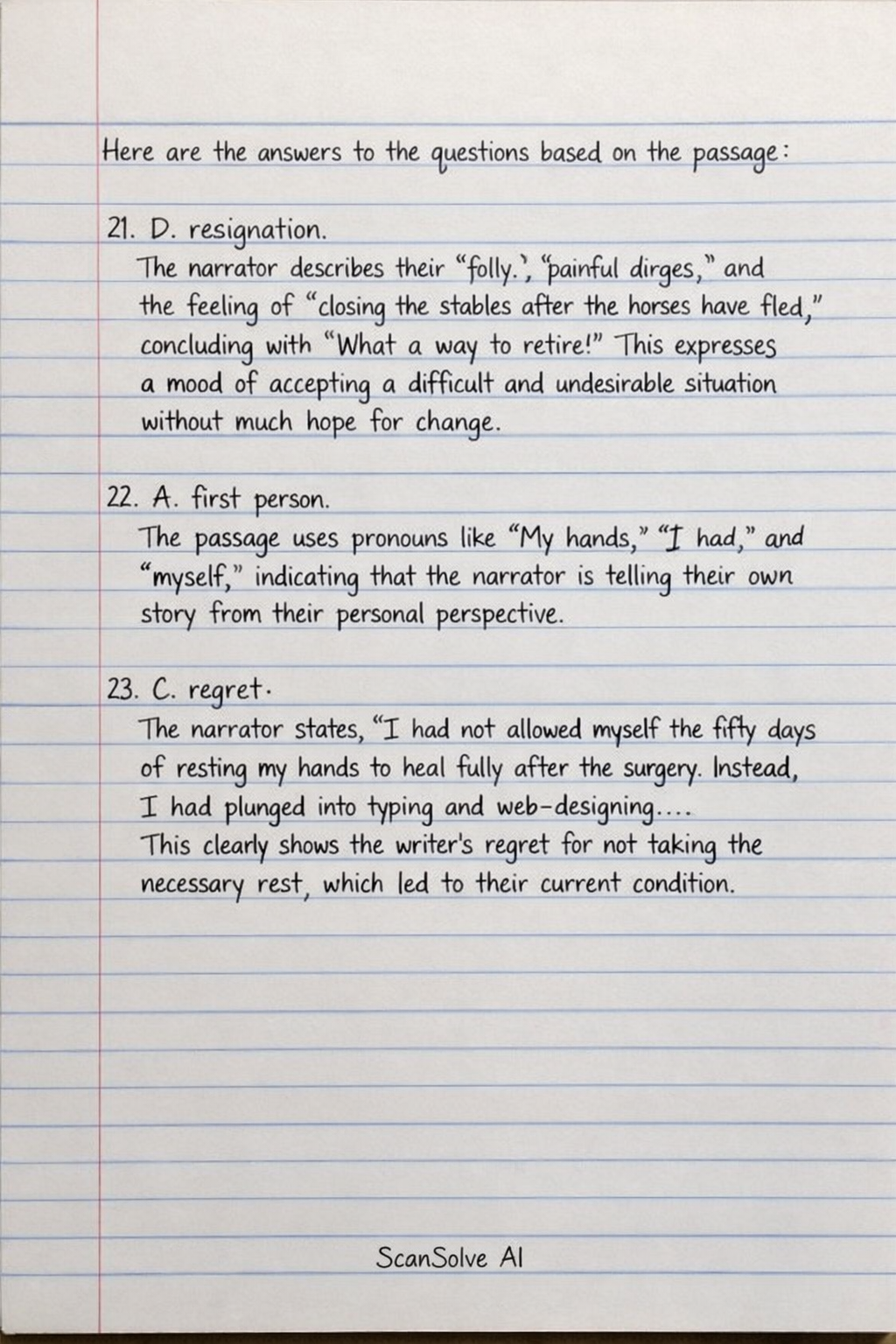
Here are the answers to the questions based on the passage:
- D. resignation. The narrator describes their "folly," "painful dirges," and the feeling of "closing the stables after the horses have fled," concluding with "What a way to retire!" This expresses a mood of accepting a difficult and undesirable situation without much hope for change.
- A. first person. The passage uses pronouns like "My hands," "I had," and "myself," indicating that the narrator is telling their own story from their personal perspective.
- C. regret. The narrator states, "I had not allowed myself the fifty days of resting my hands to heal fully after the surgery. Instead, I had plunged into typing and web-designing..." This clearly shows the writer's regret for not taking the necessary rest, which led to their current condition.
- C. personification. While the most prominent example ("My arms are singing painful dirges") appears in the second paragraph, personification is a dominant literary device in the passage overall, giving human qualities to inanimate body parts to express pain and suffering. Given the options, this is the most fitting literary device present in the descriptive parts of the passage.
- C. an elegy. The passage ends with the narrator lamenting their inability to perform simple tasks and communicate, reflecting a profound sense of loss and sorrow for their diminished physical capabilities and the life they once had. This mournful reflection on loss aligns with the spirit of an elegy, which is a lament for something lost.
Was this helpful?
Still stuck on this one?
Ask a follow-up, and the answer starts from this question.
Got a different question?Ask your own question
More English Questions
QWhat is the mood of the poem, and what literary devices or imagery are used to create it?QAnalyze the figurative language and themes in the provided excerpt, focusing on the speaker's state…QFrom the passage pick out examples of personificationQThis is the passageQWhat mood is created in the poem? Explain.
Handwritten Step-by-Step Solution
Get this as a handwritten image on WhatsApp — like a tutor wrote it for you.
Try on WhatsApp