
We read your photo as:
The phrase "have never met" correctly indicates that they had not met each other before a specific point in the past.
ScanSolve AI Answer
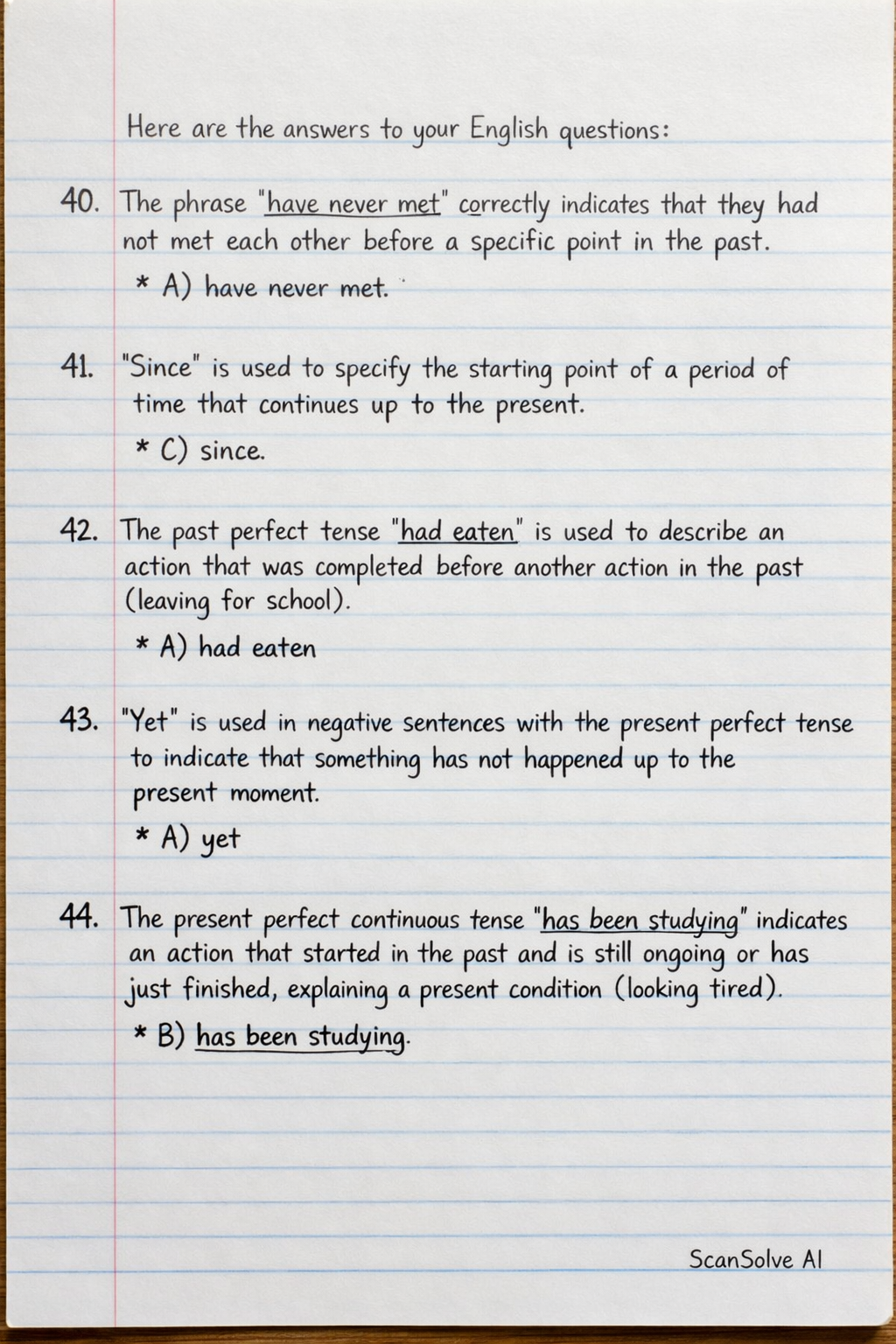
Here are the answers to your English questions:
-
The phrase "have never met" correctly indicates that they had not met each other before a specific point in the past. * A) have never met
-
"Since" is used to specify the starting point of a period of time that continues up to the present. * C) since
-
The past perfect tense "had eaten" is used to describe an action that was completed before another action in the past (leaving for school). * A) had eaten
-
"Yet" is used in negative sentences with the present perfect tense to indicate that something has not happened up to the present moment. * A) yet
-
The present perfect continuous tense "has been studying" indicates an action that started in the past and is still ongoing or has just finished, explaining a present condition (looking tired). * B) has been studying
-
The present perfect continuous tense "have been playing" indicates an action that started in the past, continued for a duration, and is still ongoing or has just stopped with present relevance. * A) have been playing
-
The past perfect tense "had you lived" is used to ask about a duration of time up to a specific point in the past (before deciding to move). * B) had you lived
-
The past continuous tense "were doing" describes an action that was in progress when another past action (the teacher entered) occurred. * B) were doing
-
The simple past tense "woke up" is used for a completed action that happened at a specific time in the past (yesterday morning). * A) woke up
-
Assuming the question is asking for the simple past tense to describe a completed action "during the week," "studied" is the correct verb form. * C) studied
-
The present continuous tense "are listening" describes an action that is happening at the moment of speaking. * C) are listening
-
Assuming the question is "Is the teacher waiting outside the classroom for a moment?", "Is/waiting" is the correct present continuous form. * A) Is/waiting
-
"Does"
Still stuck on this one?
Ask a follow-up, and the answer starts from this question.
More English Questions
Handwritten Step-by-Step Solution
Get this as a handwritten image on WhatsApp — like a tutor wrote it for you.
Try on WhatsApp