
We read your photo as:
The questions are in Swati and relate to the poem "Tibongo TaGija Mahlalela".
ScanSolve AI Answer
This answer stops before the end.
It was cut off when it was first written. Ask ScanSolve this question again for the full working.
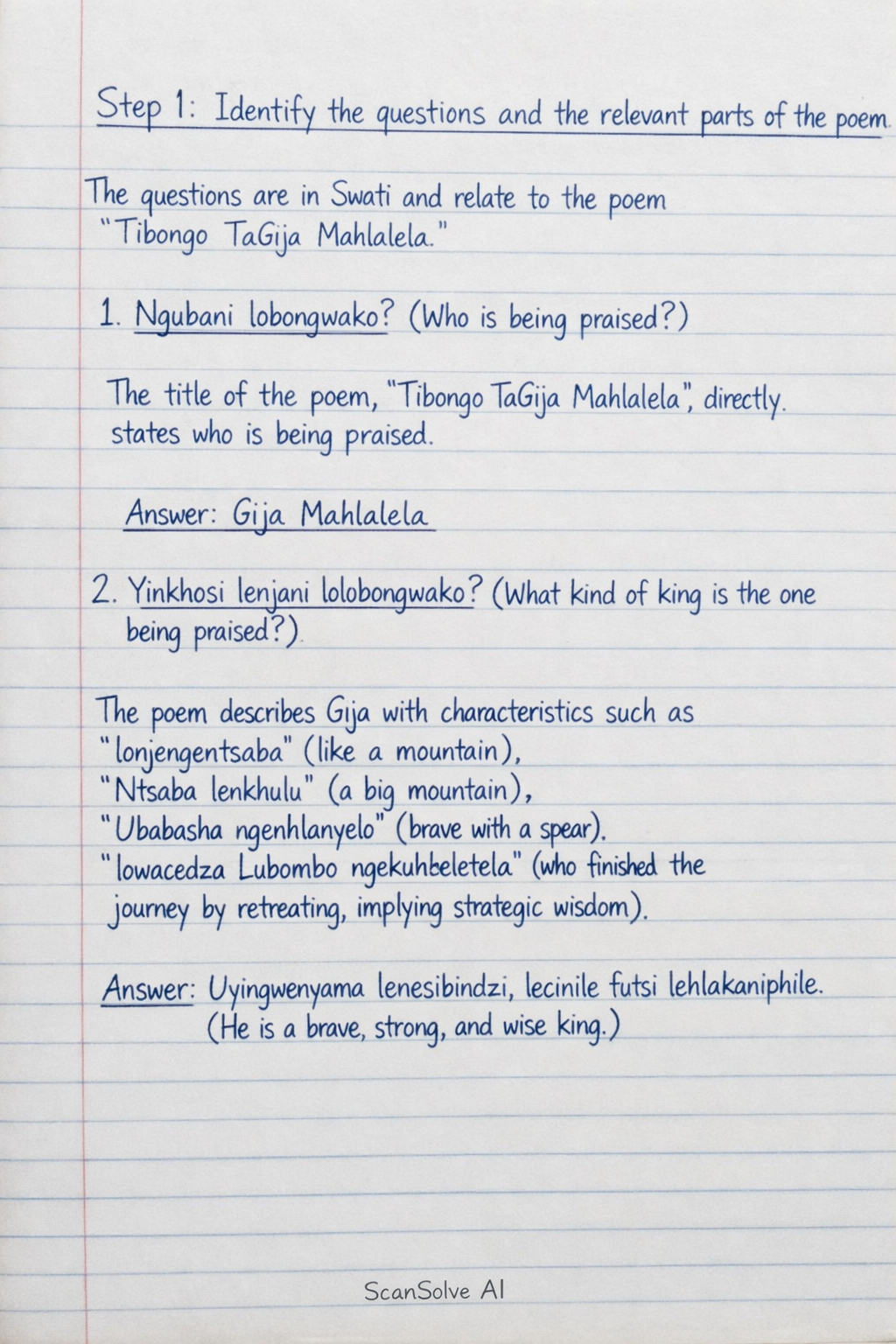
Step 1: Identify the questions and the relevant parts of the poem.
The questions are in Swati and relate to the poem "Tibongo TaGija Mahlalela".
1. Ngubani lobongwako? (Who is being praised?)
The title of the poem, "Tibongo TaGija Mahlalela", directly states who is being praised.
- Answer: Gija Mahlalela
2. Yinkhosi lenjani lolobongwako? (What kind of king is the one being praised?)
The poem describes Gija with characteristics such as "lonjengentsaba" (like a mountain), "Ntsaba lenkhulu" (a big mountain), "Ubabasha ngenhlanyelo" (brave with a spear), and "lowacedza lubombo ngekuhlehletela" (who finished the journey by retreating, implying strategic wisdom).
- Answer: Uyingwenyama lenesibindzi, lecinile futsi lehlakaniphile. (He is a brave, strong, and wise king.)
3. Batsa Maziya.........? (They say Maziya.........?)
This question is incomplete in the image. However, the poem contains the line "Basho batsi titsatseni boMaziya," which translates to "They said take them, Maziya." This is the most direct completion of the phrase "Batsa Maziya".
- Answer: Batsa Maziya titsatseni. (They say Maziya, take them.)
4. Niketa sinye sifaniso lesikhona kulenkonldlo (Give one simile present in this poem)
A simile compares two different things, often using "like" or "as". In Swati, this is often indicated by "njenga-" or "njenge-". The poem states "Gija lonjengentsaba," which means "Gija who is like a mountain."
- Answer: Gija lonjengentsaba. (Gija who is like a mountain.)
5. Khetsa umusho lonemvumelwano (Choose a sentence with alliteration)
The provided definition for Sifanamsindvo (alliteration) includes an example from the poem. Alliteration is the repetition of consonant sounds.
- Answer: Sisale sihlekelela sive saMlambo.
6. Ibhalwe ngubani lenkondlo? (Who wrote this poem?)
The author's name is indicated at the end of the poem.
- Answer: M Zwide
Still stuck on this one?
Ask a follow-up, and the answer starts from this question.
More English Questions
Handwritten Step-by-Step Solution
Get this as a handwritten image on WhatsApp — like a tutor wrote it for you.
Try on WhatsApp