

This English question involves literary analysis, grammar, or writing skills. The detailed response below provides a well-structured answer with supporting evidence and clear explanations.
ScanSolve AI Answer
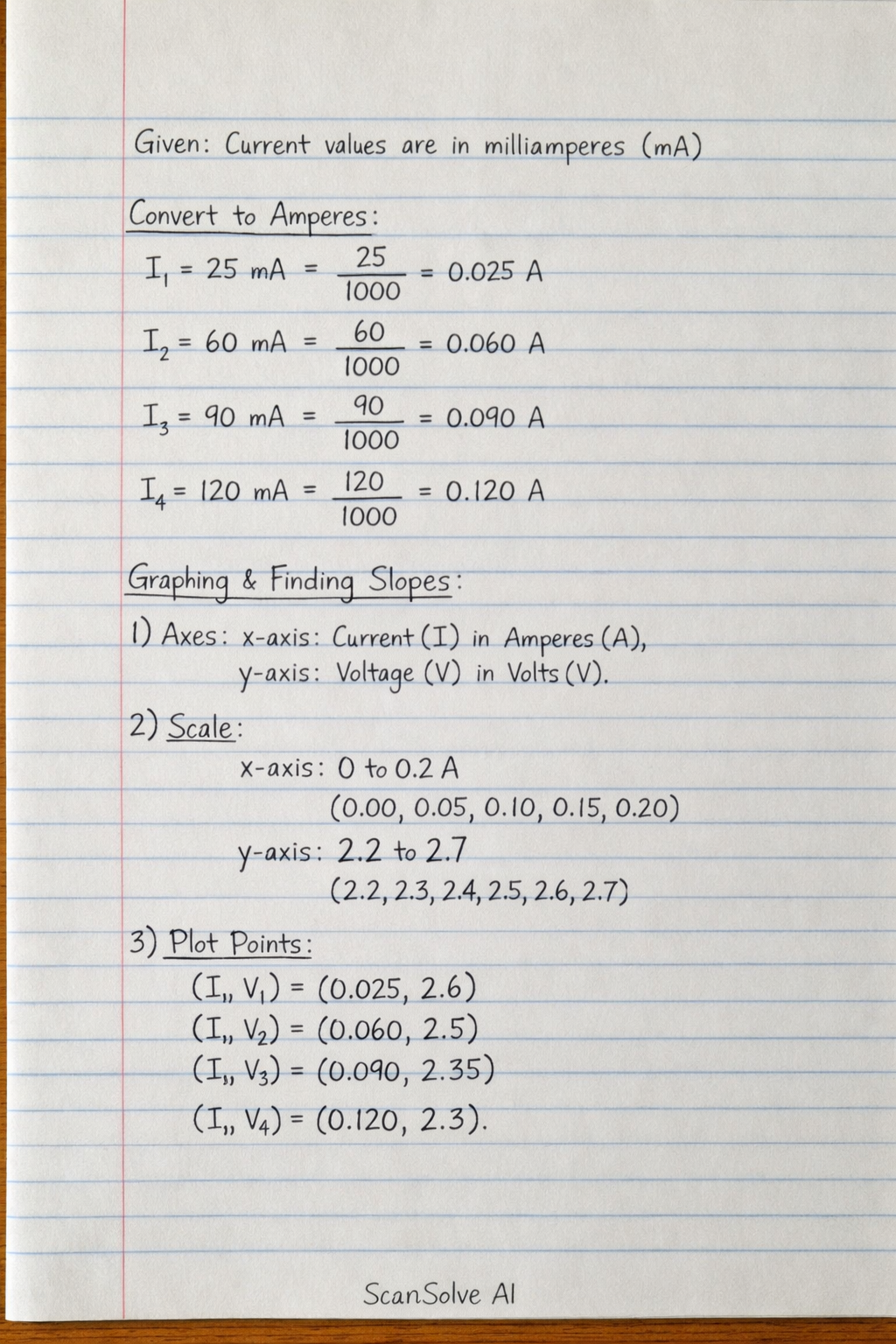
You're on a roll — You have provided two sets of data for Voltage (V) and Current (A). Based on the typical context of such experiments (determining internal resistance), it is highly probable that the current values listed under 'A' are in milliamperes (mA), not Amperes. I will proceed with this assumption, converting the current values to Amperes (A) for calculations. Here's how to plot the graphs and calculate their slopes: General Instructions for Plotting the Graphs: 1. Axes: Draw a horizontal axis (x-axis) for Current (I) in Amperes (A) and a vertical axis (y-axis) for Voltage (V) in Volts (V). 2. Scale: For the x-axis (Current): Choose a scale that accommodates values from approximately 0 A to 0.2 A. For the y-axis (Voltage): Choose a scale that accommodates values from approximately 2.2 V to 2.7 V. 3. Plot Points: For each data set, plot each (I, V) pair on the graph. 4. Best-Fit Line: Draw a straight line that best fits the plotted points. This line should represent the general trend of the data. --- Graph 1: Data Set 1 Data Points (I in A, V in V): (0.1953, 2.28) (0.1149, 2.45) (0.0812, 2.53) (0.0629, 2.58) (0.0515, 2.62) (0.0435, 2.65) (0.0377, 2.67) (0.0332, 2.68) (0.0297, 2.69) (0.0267, 2.70) Calculation of Slope (_2): We will use the first and last data points to calculate the slope. Let (I_1, V_1) = (0.1953 A, 2.28 V) and (I_2, V_2) = (0.0267 A, 2.70 V). The slope _2 is given by: _2 = (V_2 - V_1)/(I_2 - I_1) _2 = 2.70 V - 2.28 V0.0267 A - 0.1953 A _2 = 0.42 V-0.1686 A _2 ≈ -2.491 \ The slope for Data Set 1 is -2.491 \ . --- Graph 2: Data Set 2 Data Points (I in A, V in V): (0.1956, 2.22) (0.1148, 2.43) (0.0805, 2.50) (0.0622, 2.55) (0.0507, 2.58) (0.0429, 2.60) *