
This assignment comprises TWO sections. Both sections are COMPULSORY. Section A: Reflection: Poetry (Unit 2) Read Unit 2 of TL501 carefully. Then choose a prescribed poem that is not discussed in TL501 from the list in TL102 on the ENG1501 myModules site (the poems are available as e-reserves on the Library website). Write three short paragraphs in response to the prompts below. You must refer to the specific poem, the lines you studied and TL501. Paragraph 1: Identify the poem and poet you have chosen. Briefly explain why you chose this poem and what your first reaction to it was. Did anything about the poem surprise or confuse you? Paragraph 2: Choose two poetic devices discussed in Unit 2. Quote at least two lines or phrases from the poem and explain how these devices helped you better understand the poem’s message or emotional impact. Remember to give page references for where these poetic devices appear in Unit 2. Paragraph 3: Reflect on how engaging with this poem changed or challenged your thinking about poetry. Has it changed how you read or respond to poems in general? Give specific reasons based on your personal reading experience. Note: This question is based on your personal response and your learning from TL501. Answers that do not refer to the poem, lines from the poem, and TL501 will not receive marks. Section A: 10 marks
ScanSolve AI Answer
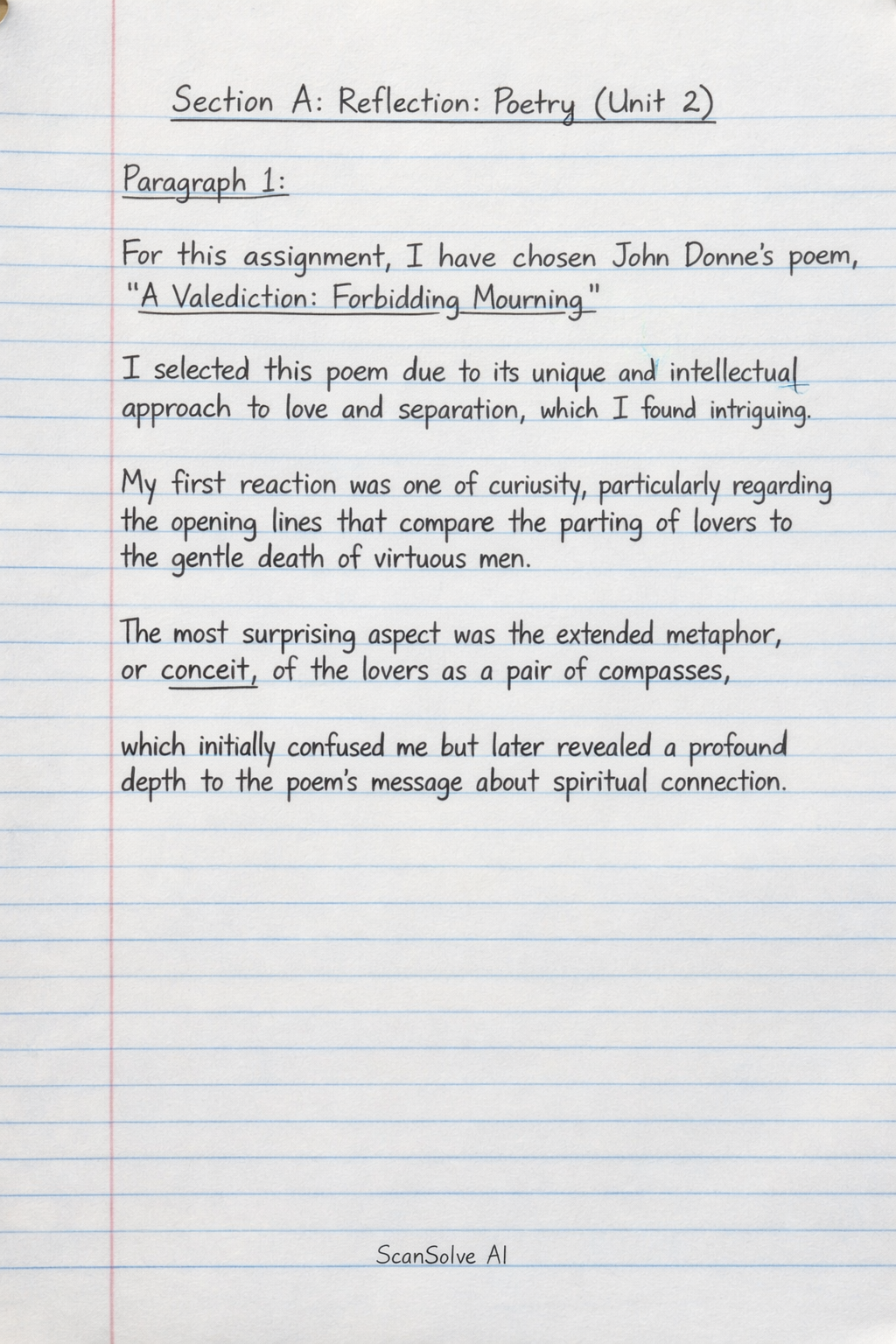
Section A: Reflection: Poetry (Unit 2)
Paragraph 1:
For this assignment, I have chosen John Donne's poem, "A Valediction: Forbidding Mourning." I selected this poem due to its unique and intellectual approach to love and separation, which I found intriguing. My first reaction was one of curiosity, particularly regarding the opening lines that compare the parting of lovers to the gentle death of virtuous men. The most surprising aspect was the extended metaphor, or conceit, of the lovers as a pair of compasses, which initially confused me but later revealed a profound depth to the poem's message about spiritual connection.
Paragraph 2:
Two poetic devices discussed in Unit 2 that helped me better understand the poem are conceit and simile. As discussed in TL501, Unit 2, a conceit is an extended metaphor that makes a comparison between two startlingly different things. Donne employs a powerful conceit when he writes, "If they be two, they are two so / As stiff twin compasses are two;" (lines 25-26). This comparison of lovers to a compass, with one foot fixed while the other roams, beautifully illustrates the steadfastness and interconnectedness of their souls despite physical distance, deepening the emotional impact of their unbreakable bond. Furthermore, the poem uses simile, a direct comparison using "like" or "as." An example is found in lines 1-2: "As virtuous men pass mildly away, / And whisper to their souls to go," comparing the lovers' quiet parting to a peaceful death. This simile immediately sets a tone of calm acceptance, suggesting that their separation, though sad, is not a cause for dramatic grief, thereby reinforcing the poem's central theme of a mature, spiritual love.
Paragraph 3:
Engaging with "A Valediction: Forbidding Mourning" significantly challenged my thinking about poetry, particularly love poetry. Before studying this poem, I often associated love poems primarily with overt emotional expression. However, Donne's use of intellectual argument and complex imagery demonstrated that poetry can convey profound emotion through intricate reasoning and extended metaphors, rather than just direct sentiment. This experience has changed how I read and respond to poems in general; I now approach them with a greater appreciation for their structural and intellectual layers. I am more inclined to look beyond the surface meaning, actively seeking out the underlying conceits, paradoxes, and logical progressions that contribute to a poem's overall message and emotional resonance, making my reading experience more analytical and rewarding.
Still stuck on this one?
Ask a follow-up, and the answer starts from this question.
More English Questions
Handwritten Step-by-Step Solution
Get this as a handwritten image on WhatsApp — like a tutor wrote it for you.
Try on WhatsApp