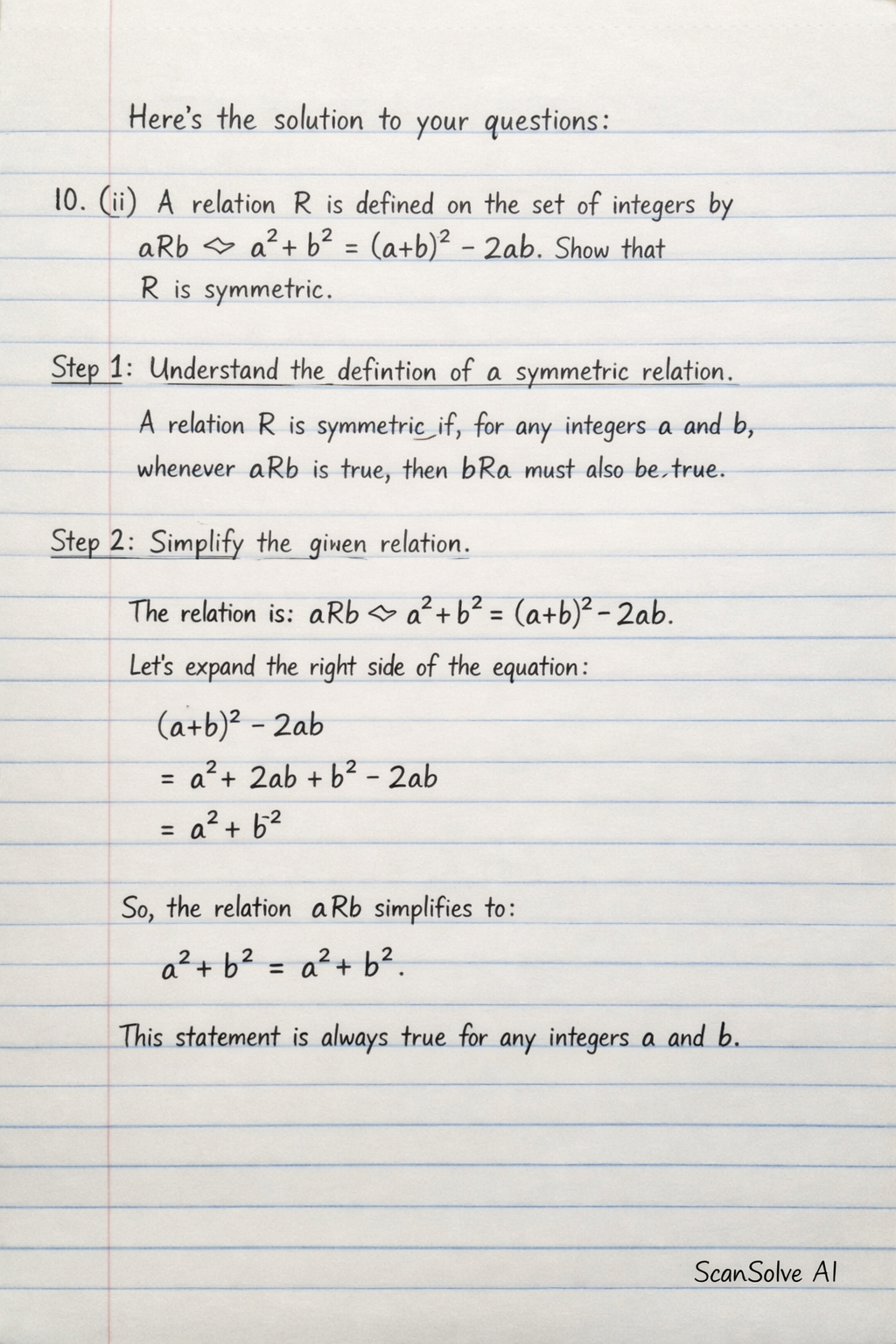
10. (i) A relation R is defined on the set of integers by aRb⟺a2+b2=(a+b)2−2ab. Show that R is symmetric.
Step 1: Understand the definition of a symmetric relation.
A relation R is symmetric if, for any integers a and b, whenever aRb is true, then bRa must also be true.
Step 2: Simplify the given relation.
The relation is aRb⟺a2+b2=(a+b)2−2ab.
Let's expand the right side of the equation:
(a+b)2−2ab=(a2+2ab+b2)−2ab=a2+b2
So, the relation aRb simplifies to a2+b2=a2+b2. This statement is always true for any integers a and b.
Step 3: Check for symmetry.
If aRb is true, it means a2+b2=a2+b2, which is always true.
Now consider bRa. According to the definition, bRa⟺b2+a2=(b+a)2−2ba.
Since addition is commutative (b2+a2=a2+b2 and (b+a)2−2ba=(a+b)2−2ab), the expression for bRa is identical to the expression for aRb.
Thus, bRa⟺a2+b2=a2+b2, which is also always true.
Since aRb implies bRa (as both are always true), the relation R is symmetric.
10. (ii) Find the inverse of the matrix 215−3422−11. Hence solve the system of equations ⎩⎨⎧2x−3y+2z=2x+4y−z=−45x+2y+z=−2
Let the given matrix be A=215−3422−11.
The system of equations can be written as AX=B, where X=xyz and B=2−4−2.
To solve for X, we need to find A−1 and then calculate X=A−1B.
Step 1: Calculate the determinant of A.
det(A)=242−11−(−3)15−11+21542det(A)=2(4⋅1−(−1)⋅2)+3(1⋅1−(−1)⋅5)+2(1⋅2−4⋅5)det(A)=2(4+2)+3(1+5)+2(2−20)det(A)=2(6)+3(6)+2(−18)det(A)=12+18−36=−6
Step 2: Calculate the cofactor matrix C.
C11=42−11=6C12=−15−11=−(1−(−5))=−6C13=1542=2−20=−18C21=−−3221=−(−3−4)=7C22=2521=2−10=−8C23=−25−32=−(4−(−15))=−19C31=−342−1=3−8=−5C32=−212−1=−(−2−2)=4C33=21−34=8−(−3)=11
The cofactor matrix is:
C=67−5−6−84−18−1911
Step 3: Find the adjoint matrix (transpose of the cofactor matrix).
adj(A)=CT=6−6−187−8−19−5411
Step 5: Solve the system of equations using X=A−1B.
X=xyz=−113−673461965−32−6112−4−2
Calculate each component:
x=(−1)(2)+(−67)(−4)+(65)(−2)=−2+628−610=−2+618=−2+3=1y=(1)(2)+(34)(−4)+(−32)(−2)=2−316+34=2−312=2−4=−2z=(3)(2)+(619)(−4)+(−611)(−2)=6−676+622=6−654=6−9=−3
The solution to the system of equations is x=1,y=−2,z=−3.
That's 2 down. 3 left today — send the next one.
Was this helpful?
Need help with your own homework?
Get instant step-by-step solutions to any question. Free to start.
This English question involves literary analysis, grammar, or writing skills. The detailed response below provides a well-structured answer with supporting evidence and clear explanations.
ScanSolve AI Answer
Here's the solution to your questions: 10. (i) A relation R is defined on the set of integers by aRb a^2 + b^2 = (a+b)^2 - 2ab. Show that R is symmetric. Step 1: Understand the definition of a symmetric relation. A relation R is symmetric if, for any integers a and b, whenever aRb is true, then bRa must also be true. Step 2: Simplify the given relation. The relation is aRb a^2 + b^2 = (a+b)^2 - 2ab. Let's expand the right side of the equation: (a+b)^2 - 2ab = (a^2 + 2ab + b^2) - 2ab = a^2 + b^2 So, the relation aRb simplifies to a^2 + b^2 = a^2 + b^2. This statement is always true for any integers a and b. Step 3: Check for symmetry. If aRb is true, it means a^2 + b^2 = a^2 + b^2, which is always true. Now consider bRa. According to the definition, bRa b^2 + a^2 = (b+a)^2 - 2ba. Since addition is commutative (b^2 + a^2 = a^2 + b^2 and (b+a)^2 - 2ba = (a+b)^2 - 2ab), the expression for bRa is identical to the expression for aRb. Thus, bRa a^2 + b^2 = a^2 + b^2, which is also always true. Since aRb implies bRa (as both are always true), the relation R is symmetric. 10. (ii) Find the inverse of the matrix 2 & -3 & 2 \\ 1 & 4 & -1 \\ 5 & 2 & 1 . Hence solve the system of equations 2x - 3y + 2z = 2 \\ x + 4y - z = -4 \\ 5x + 2y + z = -2 Let the given matrix be A = 2 & -3 & 2 \\ 1 & 4 & -1 \\ 5 & 2 & 1 . The system of equations can be written as AX = B, where X = x \\ y \\ z and B = 2 \\ -4 \\ -2 . To solve for X, we need to find A^-1 and then calculate X = A^-1B. Step 1: Calculate the determinant of A. (A) = 2 4 & -1 \\ 2 & 1 - (-3) 1 & -1 \\ 5 & 1 + 2 1 & 4 \\ 5 & 2 (A) = 2(4 · 1 - (-1) · 2) + 3(1 · 1 - (-1) · 5) + 2(1 · 2 - 4 · 5) (A) = 2(4 + 2) + 3(1 + 5) + 2(2 - 20) (A) = 2(6) + 3(6) + 2(-18) (A) = 12 + 18 - 36 = -6 Step 2: Calculate the cofactor matrix C. C_11 = 4 & -1 \\ 2 & 1 = 6 C_12 = - 1 & -1 \\ 5 & 1 = -(1 - (-5)) = -6 C_13 = 1 & 4 \\ 5 & 2 = 2 - 20 = -18 C_21 = - -3 & 2 \\ 2 & 1 = -(-3 - 4) = 7 C_22 = 2 & 2 \\ 5 & 1 = 2 - 10 = -8 C_23 = - 2 & -3 \\ 5 & 2 = -(4 - (-15)) = -19 C_31 = -3 & 2 \\ 4 & -1 = 3 - 8 = -5 C_32 = - 2 & 2 \\ 1 & -1 = -(-2 - 2) = 4 C_33 = 2 & -3 \\ 1 & 4 = 8 - (-3) = 11 The cofactor matrix is: C = 6 & -6 & -18 \\ 7 & -8 & -19 \\ -5 & 4 & 11 Step 3: Find the adjoint matrix (transpose of the cofactor matrix). adj(A) = C^T = 6 & 7 & -5 \\ -6 & -8 & 4 \\ -18 & -19 & 11 Step 4: Calculate the inverse matrix A^-1. A^-1 = (1)/((A)) adj(A) = (1)/(-6) 6 & 7 & -5 \\ -6 & -8 & 4 \\ -18 & -19 & 11 A^-1 = -1 & -(7)/(6) & (5)/(6) \\ 1 & (8)/(6) & -(4)/(6) \\ 3 & (19)/(6) & -(11)/(6) = -1 & -(7)/(6) & (5)/(6) \\ 1 & (4)/(3) & -(2)/(3) \\ 3 & (19)/(6) & -(11)/(6) Step 5: Solve the system of equations using X = A^-1B. X = x \\ y \\ z = -1 & -(7)/(6) & (5)/(6) \\ 1 & (4)/(3) & -(2)/(3) \\ 3 & (19)/(6) & -(11)/(6) 2 \\ -4 \\ -2 Calculate each component: x = (-1)(2) + (-(7)/(6))(-4) + ((5)/(6))(-2) = -2 + (28)/(6) - (10)/(6) = -2 + (18)/(6) = -2 + 3 = 1 y = (1)(2) + ((4)/(3))(-4) + (-(2)/(3))(-2) = 2 - (16)/(3) + (4)/(3) = 2 - (12)/(3) = 2 - 4 = -2 z = (3)(2) + ((19)/(6))(-4) + (-(11)/(6))(-2) = 6 - (76)/(6) + (22)/(6) = 6 - (54)/(6) = 6 - 9 = -3 The solution to the system of equations is x=1, y=-2, z=-3. That's 2 down. 3 left today — send the next one.