9. (i) The equations of two circles S1 and S2 are given byS1:x2+y2+2x+2y+1=0S2:x2+y2−4x+2y+1=0Show that S1 and S2 touch externally and obtain the equation of the common tangent T at the point of contact.
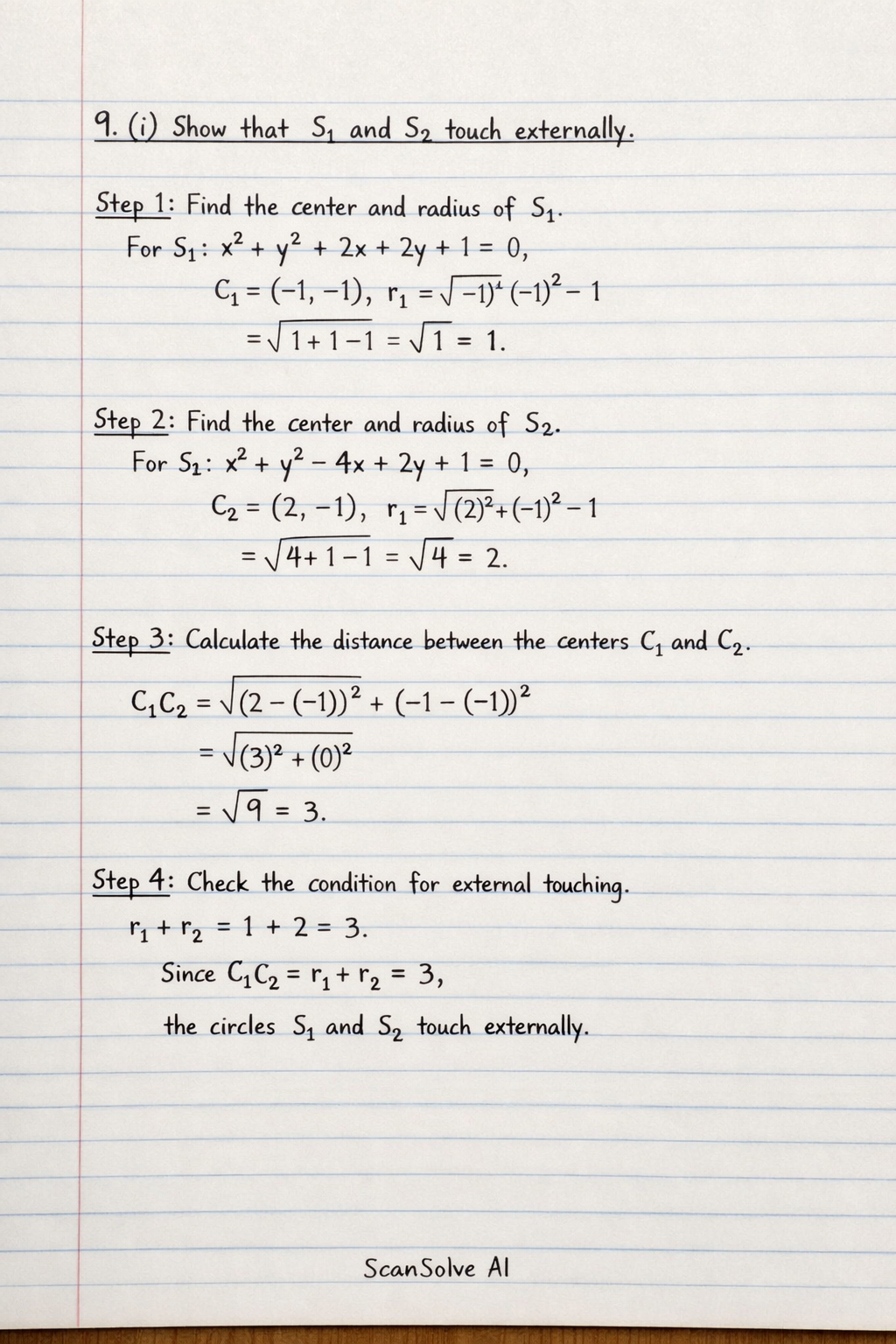
Part 1: Show that S1 and S2 touch externally.
Step 1: Find the center and radius of S1.
For S1:x2+y2+2x+2y+1=0, the center C1=(−1,−1) and the radius r1=(−1)2+(−1)2−1=1+1−1=1=1.
Step 2: Find the center and radius of S2.
For S2:x2+y2−4x+2y+1=0, the center C2=(2,−1) and the radius r2=(2)2+(−1)2−1=4+1−1=4=2.
Step 3: Calculate the distance between the centers C1 and C2.
C1C2=(2−(−1))2+(−1−(−1))2=(3)2+(0)2=9=3
Step 4: Check the condition for external touching.
The sum of the radii is r1+r2=1+2=3.
Since C1C2=r1+r2=3, the circles S1 and S2 touch externally.
Part 2: Obtain the equation of the common tangent T at the point of contact.
Step 5: The equation of the common tangent is found by subtracting the equations of the two circles (S1−S2=0).
(x2+y2+2x+2y+1)−(x2+y2−4x+2y+1)=0x2+y2+2x+2y+1−x2−y2+4x−2y−1=06x=0x=0
The equation of the common tangent T is x=0.
9. (ii) A father and a mother have 5 children. This family is to occupy a particular front-line bench in church on a special thanksgiving service. Given that this bench has a capacity of 7 persons, in how many ways can this family be seated on the bench(a) if the parents must seat adjacent to each other.(b) if the parents must seat adjacent to each other at one end of the bench.
The family has 2 parents and 5 children, totaling 7 people. The bench has 7 seats.
Part (a): If the parents must seat adjacent to each other.
Step 1: Treat the two parents as a single unit.
This leaves 6 entities to arrange (the parent unit and 5 children). The number of ways to arrange these 6 entities is 6!.
6!=720
Step 2: Account for the internal arrangement of the parents.
Within the parent unit, the father and mother can swap positions in 2! ways.
2!=2
Step 3: Calculate the total number of ways.
Total ways = 6!×2!=720×2=1440.
The number of ways is 1440.
Part (b): If the parents must seat adjacent to each other at one end of the bench.
Step 1: Consider the parents as a unit at one end.
There are 2 possible ends for the parents to sit (left end or right end).
Step 2: Arrange the parents at one end.
The parents can be arranged in 2! ways (FM or MF) at the chosen end.
Step 3: Arrange the remaining 5 children.
The remaining 5 children can be arranged in the remaining 5 seats in 5! ways.
5!=120
Step 4: Calculate the total number of ways.
Total ways = (Number of ends) × (Ways to arrange parents) × (Ways to arrange children)
Total ways = 2×2!×5!=2×2×120=480.
The number of ways is 480.
10. (i) Given that f(x)=x(x+1)(x+2)2, express f(x) in partial fractions. Hence show that ∫24f(x)dx=ln(2527).
Part 1: Express f(x) in partial fractions.
Step 1: Set up the partial fraction decomposition.
x(x+1)(x+2)2=xA+x+1B+x+2C
Step 2: Equate the numerators after finding a common denominator.
2=A(x+1)(x+2)+Bx(x+2)+Cx(x+1)
Step 5: Integrate f(x).
∫f(x)dx=∫(x1−x+12+x+21)dx=ln∣x∣−2ln∣x+1∣+ln∣x+2∣+K
Using logarithm properties, this can be written as:
=ln∣x∣+ln∣x+2∣−ln∣(x+1)2∣+K=ln(x+1)2x(x+2)+K
Step 6: Evaluate the definite integral from 2 to 4.
∫24f(x)dx=[ln(x+1)2x(x+2)]24=ln((4+1)24(4+2))−ln((2+1)22(2+2))=ln(524×6)−ln(322×4)=ln(2524)−ln(98)
Step 7: Simplify the result using logarithm properties.
=ln(8/924/25)=ln(2524×89)=ln(25×83×8×9)=ln(253×9)=ln(2527)
Thus, ∫24f(x)dx=ln(2527).
10. (ii) Sketch the graph of the curve whose equation is given by y=x−42x−7, showing clearly the points where the curve meets the coordinate axes and the behavior of the curve near its asymptotes.
Step 1: Find the intercepts.
x-intercept (set y=0):0=x−42x−7⇒2x−7=0⇒x=27=3.5. The x-intercept is (3.5,0).
y-intercept (set x=0):y=0−42(0)−7=−4−7=47=1.75. The y-intercept is (0,1.75).
Step 2: Find the asymptotes.
Vertical Asymptote: Set the denominator to zero: x−4=0⇒x=4.
Horizontal Asymptote: As x→±∞, y=limx→±∞x−42x−7=limx→±∞1−x42−x7=12=2. So y=2.
Step 3: Analyze the behavior near the vertical asymptote (x=4).
As x→4+ (e.g., x=4.1), y=4.1−42(4.1)−7=0.11.2=12. So y→+∞.
As x→4− (e.g., x=3.9), y=3.9−42(3.9)−7=−0.10.8=−8. So y→−∞.
Step 4: Analyze the behavior near the horizontal asymptote (y=2).
As x→+∞, y=x−42x−7=x−42(x−4)+8−7=2+x−41. Since x−4>0, y approaches 2 from above.
As x→−∞, y=2+x−41. Since x−4<0, y approaches 2 from below.
Sketch Description:
The graph of y=x−42x−7 is a hyperbola.
Draw the x and y axes.
Plot the x-intercept at (3.5,0) and the y-intercept at (0,1.75).
Draw a vertical dashed line at x=4 (vertical asymptote).
Draw a horizontal dashed line at y=2 (horizontal asymptote).
The curve has two branches:
For x>4, the curve starts from positive infinity near the vertical asymptote (x=4) and approaches the horizontal asymptote (y=2) from above as x increases.
For x<4, the curve starts from negative infinity near the vertical asymptote (x=4), passes through the intercepts (3.5,0) and (0,1.75), and approaches the horizontal asymptote (y=2) from below as x decreases.
Drop the next question.
Was this helpful?
Need help with your own homework?
Get instant step-by-step solutions to any question. Free to start.
9. (i) The equations of two circles S_1 and S_2 are given by S_1: x^2 + y^2 + 2x + 2y + 1 = 0 S_2: x^2 + y^2 - 4x + 2y + 1 = 0 Show that S_1 and S_2 touch externally and obtain the equation of the common tangent T at the point of contact.
This English question involves literary analysis, grammar, or writing skills. The detailed response below provides a well-structured answer with supporting evidence and clear explanations.
ScanSolve AI Answer
Here are the solutions to your questions: 9. (i) The equations of two circles S_1 and S_2 are given by S_1: x^2 + y^2 + 2x + 2y + 1 = 0 S_2: x^2 + y^2 - 4x + 2y + 1 = 0 Show that S_1 and S_2 touch externally and obtain the equation of the common tangent T at the point of contact. Part 1: Show that S_1 and S_2 touch externally. Step 1: Find the center and radius of S_1. For S_1: x^2 + y^2 + 2x + 2y + 1 = 0, the center C_1 = (-1, -1) and the radius r_1 = sqrt((-1)^2 + (-1)^2 - 1) = sqrt(1+1-1) = sqrt(1) = 1. Step 2: Find the center and radius of S_2. For S_2: x^2 + y^2 - 4x + 2y + 1 = 0, the center C_2 = (2, -1) and the radius r_2 = sqrt((2)^2 + (-1)^2 - 1) = sqrt(4+1-1) = sqrt(4) = 2. Step 3: Calculate the distance between the centers C_1 and C_2. C_1C_2 = sqrt((2 - (-1))^2 + (-1 - (-1))^2) = sqrt((3)^2 + (0)^2) = sqrt(9) = 3 Step 4: Check the condition for external touching. The sum of the radii is r_1 + r_2 = 1 + 2 = 3. Since C_1C_2 = r_1 + r_2 = 3, the circles S_1 and S_2 touch externally. Part 2: Obtain the equation of the common tangent T at the point of contact. Step 5: The equation of the common tangent is found by subtracting the equations of the two circles (S_1 - S_2 = 0). (x^2 + y^2 + 2x + 2y + 1) - (x^2 + y^2 - 4x + 2y + 1) = 0 x^2 + y^2 + 2x + 2y + 1 - x^2 - y^2 + 4x - 2y - 1 = 0 6x = 0 x = 0 The equation of the common tangent T is x=0. 9. (ii) A father and a mother have 5 children. This family is to occupy a particular front-line bench in church on a special thanksgiving service. Given that this bench has a capacity of 7 persons, in how many ways can this family be seated on the bench (a) if the parents must seat adjacent to each other. (b) if the parents must seat adjacent to each other at one end of the bench. The family has 2 parents and 5 children, totaling 7 people. The bench has 7 seats. Part (a): If the parents must seat adjacent to each other. Step 1: Treat the two parents as a single unit. This leaves 6 entities to arrange (the parent unit and 5 children). The number of ways to arrange these 6 entities is 6!. 6! = 720 Step 2: Account for the internal arrangement of the parents. Within the parent unit, the father and mother can swap positions in 2! ways. 2! = 2 Step 3: Calculate the total number of ways. Total ways = 6! × 2! = 720 × 2 = 1440. The number of ways is 1440. Part (b): If the parents must seat adjacent to each other at one end of the bench. Step 1: Consider the parents as a unit at one end. There are 2 possible ends for the parents to sit (left end or right end). Step 2: Arrange the parents at one end. The parents can be arranged in 2! ways (FM or MF) at the chosen end. Step 3: Arrange the remaining 5 children. The remaining 5 children can be arranged in the remaining 5 seats in 5! ways. 5! = 120 Step 4: Calculate the total number of ways. Total ways = (Number of ends) × (Ways to arrange parents) × (Ways to arrange children) Total ways = 2 × 2! × 5! = 2 × 2 × 120 = 480. The number of ways is 480. 10. (i) Given that f(x) = (2)/(x(x+1)(x+2)), express f(x) in partial fractions. Hence show that _2^4 f(x)\,dx = ((27)/(25)). Part 1: Express f(x) in partial fractions. Step 1: Set up the partial fraction decomposition. (2)/(x(x+1)(x+2)) = (A)/(x) + (B)/(x+1) + (C)/(x+2) Step 2: Equate the numerators after finding a common denominator. 2 = A(x+1)(x+2) + Bx(x+2) + Cx(x+1) Step 3: Solve for A, B, and C. Let x=0: 2 = A(1)(2) 2A = 2 A = 1. Let x=-1: 2 = B(-1)(-1+2) 2 = B(-1)(1) -B = 2 B = -2. Let x=-2: 2 = C(-2)(-2+1) 2 = C(-2)(-1) 2C = 2 C = 1. Step 4: Write the partial fraction decomposition. f(x) = (1)/(x) - (2)/(x+1) + (1)/(x+2) Part 2: Hence show that _2^4 f(x)\,dx = ((27)/(25)). Step 5: Integrate f(x). f(x)\,dx = ((1)/(x) - (2)/(x+1) + (1)/(x+2))\,dx = |x| - 2|x+1| + |x+2| + K Using logarithm properties, this can be written as: = |x| + |x+2| - |(x+1)^2| + K = |(x(x+2))/((x+1)^2)| + K Step 6: Evaluate the definite integral from 2 to 4. _2^4 f(x)\,dx = [|(x(x+2))/((x+1)^2)|]_2^4 = ((4(4+2))/((4+1)^2)) - ((2(2+2))/((2+1)^2)) = ((4 × 6)/(5^2)) - ((2 × 4)/(3^2)) = ((24)/(25)) - ((8)/(9)) Step 7: Simplify the result using logarithm properties. = ((24/25)/(8/9)) = ((24)/(25) × (9)/(8)) = ((3 × 8 × 9)/(25 × 8)) = ((3 × 9)/(25)) = ((27)/(25)) Thus, _2^4 f(x)\,dx = ((27)/(25)). 10. (ii) Sketch the graph of the curve whose equation is given by y = (2x-7)/(x-4), showing clearly the points where the curve meets the coordinate axes and the behavior of the curve near its asymptotes. Step 1: Find the intercepts. x-intercept (set y=0): 0 = (2x-7)/(x-4) 2x-7=0 x=(7)/(2)=3.5. The x-intercept is (3.5, 0). y-intercept (set x=0): y = (2(0)-7)/(0-4) = (-7)/(-4) = (7)/(4)=1.75. The y-intercept is (0, 1.75). Step 2: Find the asymptotes. Vertical Asymptote: Set the denominator to zero: x-4=0 x=4. Horizontal Asymptote: As x ±, y = _x ± (2x-7)/(x-4) = _x ± (2 - 7)/(x)1 - (4)/(x) = (2)/(1) = 2. So y=2. Step 3: Analyze the behavior near the vertical asymptote (x=4). As x 4^+ (e.g., x=4.1), y = (2(4.1)-7)/(4.1-4) = (1.2)/(0.1) = 12. So y +. As x 4^- (e.g., x=3.9), y = (2(3.9)-7)/(3.9-4) = (0.8)/(-0.1) = -8. So y -. Step 4: Analyze the behavior near the horizontal asymptote (y=2). As x +, y = (2x-7)/(x-4) = (2(x-4)+8-7)/(x-4) = 2 + (1)/(x-4). Since x-4 > 0, y approaches 2 from above. As x -, y = 2 + (1)/(x-4). Since x-4 < 0, y approaches 2 from below. Sketch Description: The graph of y = (2x-7)/(x-4) is a hyperbola. 1. Draw the x and y axes. 2. Plot the x-intercept at (3.5, 0) and the y-intercept at (0, 1.75). 3. Draw a vertical dashed line at x=4 (vertical asymptote). 4. Draw a horizontal dashed line at y=2 (horizontal asymptote). 5. The curve has two branches: For x > 4, the curve starts from positive infinity near the vertical asymptote (x=4) and approaches the horizontal asymptote (y=2) from above as x increases. For x < 4, the curve starts from negative infinity near the vertical asymptote (x=4), passes through the intercepts (3.5, 0) and (0, 1.75), and approaches the horizontal asymptote (y=2) from below as x decreases. Drop the next question.