
This English question involves literary analysis, grammar, or writing skills. The detailed response below provides a well-structured answer with supporting evidence and clear explanations.
ScanSolve AI Answer
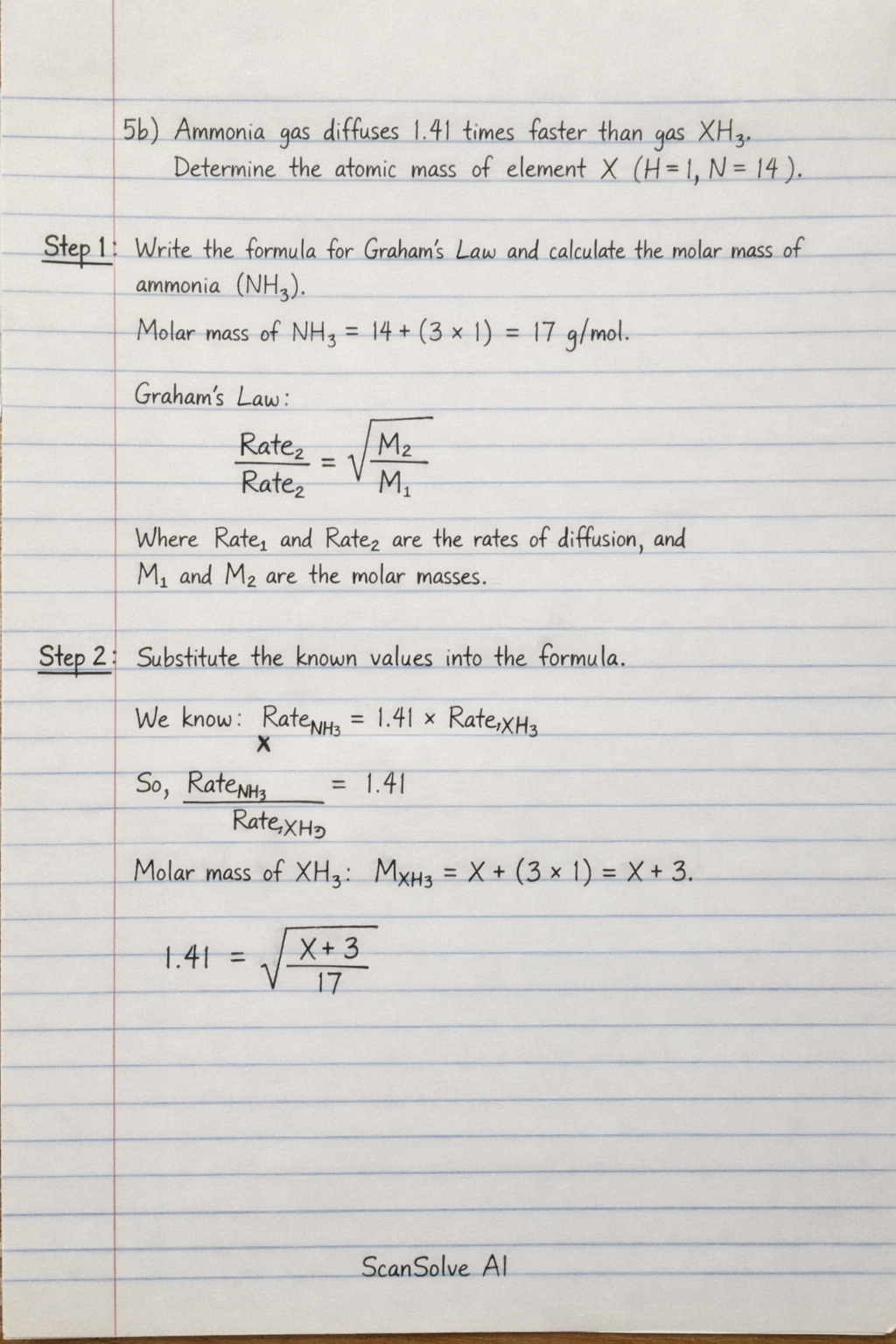
Okay, here are the solutions to your questions in English: 5a) Explain Graham's law of diffusion. Graham's law of diffusion states that the rate of diffusion of a gas is inversely proportional to the square root of its density or its molar mass. This means that lighter gases diffuse faster than heavier gases. 5b) Ammonia gas diffuses 1.41 times faster than gas XH_3. Determine the atomic mass of element X (H=1, N=14). Step 1: Write the formula for Graham's Law and calculate the molar mass of ammonia (NH_3). The molar mass of NH_3 = 14 + (3 × 1) = 17 g/mol. Graham's Law states: (Rate_1)/(Rate_2) = sqrt((M_2)/(M_1)) Where Rate_1 and Rate_2 are the rates of diffusion, and M_1 and M_2 are the molar masses. Step 2: Substitute the known values into the formula. We are given that Rate_NH_3 = 1.41 × Rate_XH_3. So, Rate_NH_3Rate_XH_3 = 1.41. The molar mass of XH_3 is M_XH_3 = X + (3 × 1) = X + 3. 1.41 = sqrt((X + 3)/(17)) Step 3: Solve for X. Square both sides of the equation: (1.41)^2 = (X + 3)/(17) 1.9881 = (X + 3)/(17) Multiply both sides by 17: 1.9881 × 17 = X + 3 33.7977 = X + 3 Subtract 3 from both sides: X = 33.7977 - 3 X = 30.7977 The atomic mass of X is approximately 31. The atomic mass of element X is 31. 6a) An iron ore was found to contain 7g of iron and 3g of oxygen. (Fe=56, O=16). Find its empirical formula. Step 1: Convert the mass of each element to moles. For iron (Fe): Moles of Fe = Mass of FeAtomic mass of Fe = 7\, g56\, g/mol = 0.125\, mol For oxygen (O): Moles of O = Mass of OAtomic mass of O = 3\, g16\, g/mol = 0.1875\, mol Step 2: Divide the number of moles by the smallest number of moles to find the simplest ratio. The smallest number of moles is 0.125 mol. For Fe: (0.125)/(0.125) = 1 For O: (0.1875)/(0.125) = 1.5 Step 3: Multiply the ratios by the smallest whole number to get a whole number ratio. To eliminate the 0.5, multiply both ratios by 2. For Fe: 1 × 2 = 2 For O: 1.5 × 2 = 3 The ratio of Fe:O is 2:3. The empirical formula is Fe_2O_3. 6b) Write a balanced equation for the reaction between magnesium and steam. The reaction between magnesium (Mg) and steam (H_2O(g)) produces magnesium oxide (MgO) and hydrogen gas (H_2). Mg(s) + H_2O(g) MgO(s) + H_2(g) This equation is already balanced, with one Mg, one O, and two H atoms on both sides. The balanced equation is Mg(s) + H_2O(g) MgO(s) + H_2(g). 7a) Carbon (iv) Oxide can undergo the changes below. CO_2(s) A CO_2(g) CO_2(g) B CO_2(s) What are processes A and B? A: The process of a solid changing directly into a gas without passing through a liquid phase is called sublimation. B: The process of a gas changing directly into a solid without passing through a liquid phase is called deposition (or reverse sublimation). A: Sublimation B: Deposition 7b) Suggest one use of carbon (iv) oxide that utilizes processes A and B. One use of carbon (iv) oxide that utilizes both processes A and B is as a refrigerant or cooling agent, particularly in the form of dry ice. Dry ice is formed by depositing gaseous CO_2 (process B) and then used to cool items by subliming into a gas (process A). One use is As a refrigerant (e.g., dry ice). That's 2 down. 3 left today — send the next one.