

This English question involves literary analysis, grammar, or writing skills. The detailed response below provides a well-structured answer with supporting evidence and clear explanations.
ScanSolve AI Answer
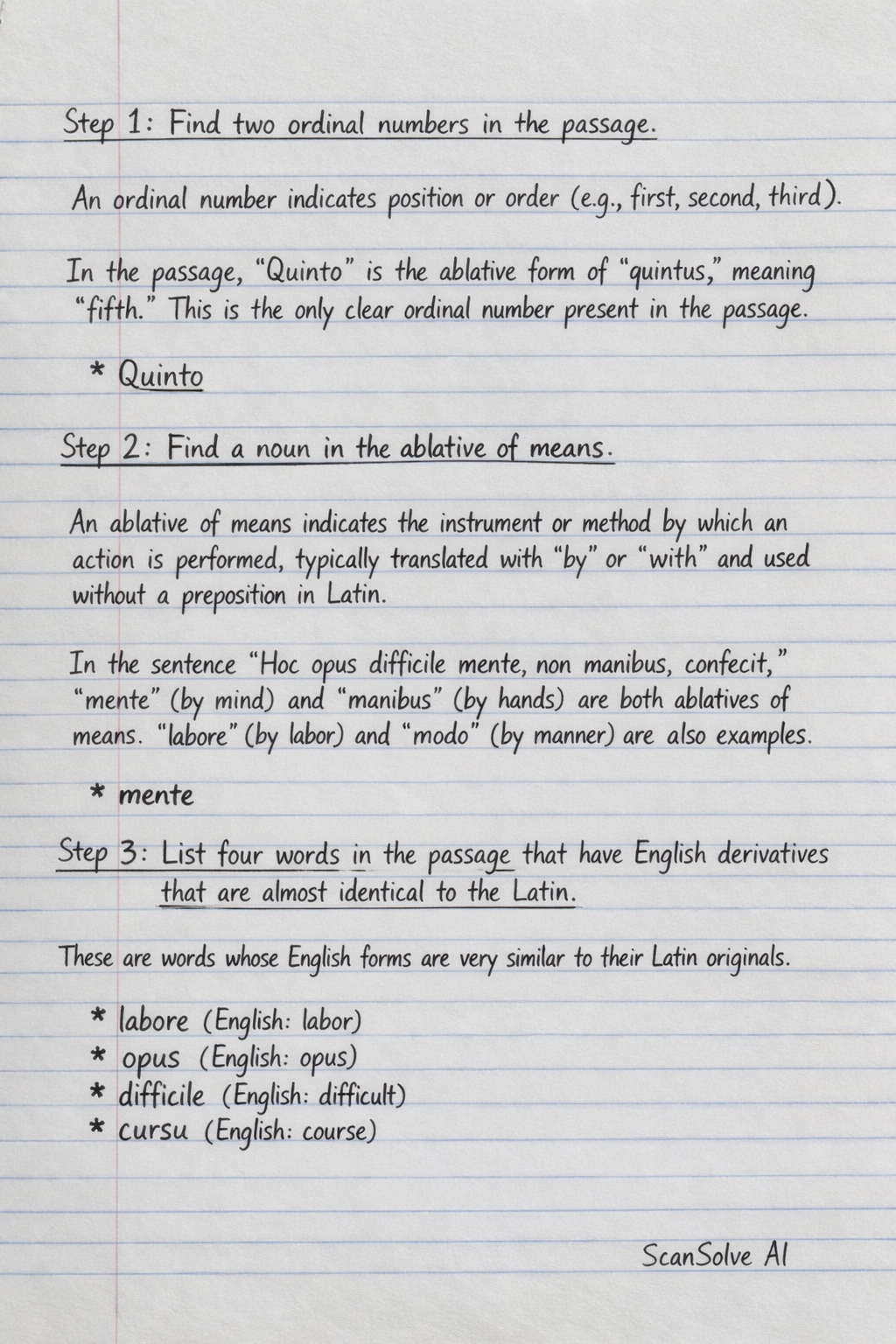
Step 1: Find two ordinal numbers in the passage. An ordinal number indicates position or order (e.g., first, second, third). In the passage, "Quinto" is the ablative form of "quintus," meaning "fifth." This is the only clear ordinal number present in the passage. Quinto* Step 2: Find a noun in the ablative of means. An ablative of means indicates the instrument or method by which an action is performed, typically translated with "by" or "with" and used without a preposition in Latin. In the sentence "Hoc opus difficile mente, non manibus, confecit," "mente" (by mind) and "manibus" (by hands) are both ablatives of means. "labore" (by labor) and "modo" (by manner) are also examples. mente* Step 3: List four words in the passage that have English derivatives that are almost identical to the Latin. These are words whose English forms are very similar to their Latin originals. labore* (English: labor) opus* (English: opus) difficile* (English: difficult) cursu* (English: course)