Understand the Essay Writing Process

English
Understand the Essay Writing Process

ScanSolve AI Answer

Hey WELZIE, good to see you again.

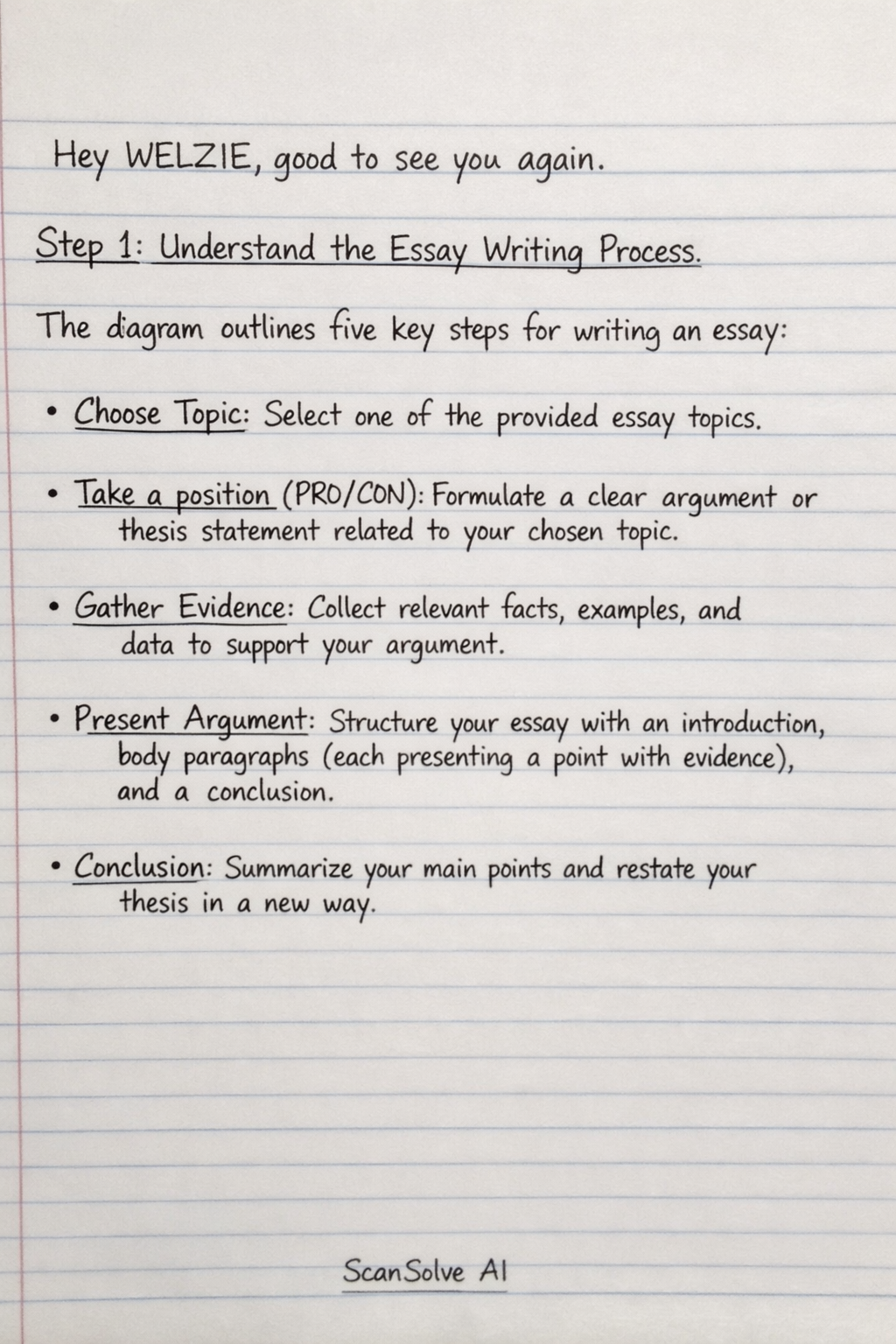
Step 1: Understand the Essay Writing Process The diagram outlines five key steps for writing an essay:

  • Choose Topic: Select one of the provided essay topics.
  • Take a position (PRO/CON): Formulate a clear argument or thesis statement related to your chosen topic.
  • Gather Evidence: Collect relevant facts, examples, and data to support your argument.
  • Present Argument: Structure your essay with an introduction, body paragraphs (each presenting a point with evidence), and a conclusion.
  • Conclusion: Summarize your main points and restate your thesis in a new way.

Step 2: Review the Essay Topics You need to write an essay of 350-450 words on one of these topics:

  • 1. Migration and its Impact on Your local Municipality: This topic requires you to analyze the reasons people move (causes) and what happens as a result of this movement (consequences) within and into your local area. You should cover effects on the economy, social structures, and infrastructure.
  • 2. Impacts of Climate change on South Africa's environment and people: This topic asks you to analyze how climate change affects different regions and communities in South Africa. You need to discuss both the socio-economic (how it affects people's lives and livelihoods) and environmental impacts.

Step 3: Strategy for Approaching the Essay For either topic, follow these steps:

  • Choose Topic: Select the topic you feel most confident discussing.
  • Take a position: For Topic 1, your position might be about whether migration has predominantly positive or negative impacts, or a balanced view. For Topic 2, your position could be on the urgency of climate action or the specific vulnerability of certain regions.
  • Gather Evidence: Research specific examples for your chosen topic. For migration, think about local job markets, housing, cultural integration, or public services. For climate change, consider drought, floods, food security, health impacts, or biodiversity loss in South Africa.
  • Present Argument: Organize your evidence into logical paragraphs. Each paragraph should focus on a specific cause/consequence or impact, supported by your gathered evidence.
  • Conclusion: Use phrases like "To conclude," "To sum up," or "In summation" (as noted in your handwriting) to signal your conclusion. Reiterate your main points and your overall position without introducing new information.

Step 4: Your Handwritten Notes Your notes "To conclude," "To recommend," and "To sum up" are excellent phrases for structuring your conclusion. The terms "Rural - urban" and "migration" are directly relevant to Topic 1, indicating good initial brainstorming for that essay. "Nonetheless" is a useful transition word for presenting contrasting ideas.

Send me the next one 📸

Was this helpful?

Need help with your own homework?

Get instant step-by-step solutions to any question. Free to start.

Ask Your Question
Handwritten step-by-step solution preview

Handwritten Step-by-Step Solution

Get this as a handwritten image on WhatsApp — like a tutor wrote it for you.

Try on WhatsApp

Still have questions?

Quick Answer

Hey WELZIE, good to see you again. Step 1: Understand the Essay Writing Process The diagram outlines five key steps for writing an essay: Choose Topic*: Select one of the provided essay topics.

Understand the Essay Writing Process
English

This English question involves literary analysis, grammar, or writing skills. The detailed response below provides a well-structured answer with supporting evidence and clear explanations.

ScanSolve AI Answer
Hey WELZIE, good to see you again. Step 1: Understand the Essay Writing Process The diagram outlines five key steps for writing an essay: Choose Topic*: Select one of the provided essay topics. Take a position (PRO/CON)*: Formulate a clear argument or thesis statement related to your chosen topic. Gather Evidence*: Collect relevant facts, examples, and data to support your argument. Present Argument*: Structure your essay with an introduction, body paragraphs (each presenting a point with evidence), and a conclusion. Conclusion*: Summarize your main points and restate your thesis in a new way. Step 2: Review the Essay Topics You need to write an essay of 350-450 words on one of these topics: 1. Migration and its Impact on Your local Municipality: This topic requires you to analyze the reasons people move (causes) and what happens as a result of this movement (consequences) within and into your local area. You should cover effects on the economy, social structures, and infrastructure*. 2. Impacts of Climate change on South Africa's environment and people: This topic asks you to analyze how climate change affects different regions and communities in South Africa. You need to discuss both the socio-economic (how it affects people's lives and livelihoods) and environmental* impacts. Step 3: Strategy for Approaching the Essay For either topic, follow these steps: Choose Topic*: Select the topic you feel most confident discussing. Take a position*: For Topic 1, your position might be about whether migration has predominantly positive or negative impacts, or a balanced view. For Topic 2, your position could be on the urgency of climate action or the specific vulnerability of certain regions. Gather Evidence*: Research specific examples for your chosen topic. For migration, think about local job markets, housing, cultural integration, or public services. For climate change, consider drought, floods, food security, health impacts, or biodiversity loss in South Africa. Present Argument*: Organize your evidence into logical paragraphs. Each paragraph should focus on a specific cause/consequence or impact, supported by your gathered evidence. Conclusion*: Use phrases like "To conclude," "To sum up," or "In summation" (as noted in your handwriting) to signal your conclusion. Reiterate your main points and your overall position without introducing new information. Step 4: Your Handwritten Notes Your notes "To conclude," "To recommend," and "To sum up" are excellent phrases for structuring your conclusion. The terms "Rural - urban" and "migration" are directly relevant to Topic 1, indicating good initial brainstorming for that essay. "Nonetheless" is a useful transition word for presenting contrasting ideas. Send me the next one 📸