

This English question involves literary analysis, grammar, or writing skills. The detailed response below provides a well-structured answer with supporting evidence and clear explanations.
ScanSolve AI Answer
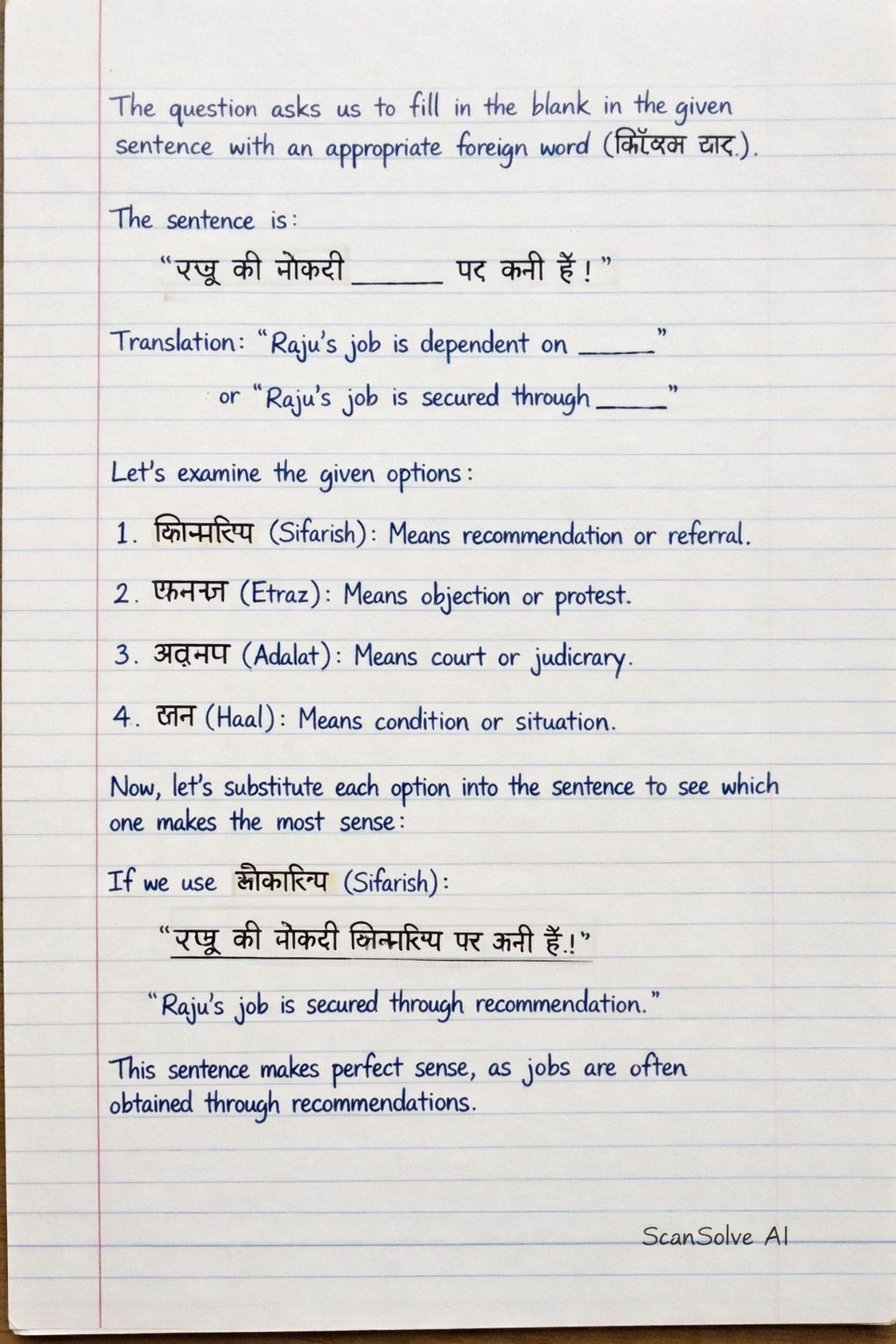
The question asks us to fill in the blank in the given sentence with an appropriate foreign word (विदेशज शब्द). The sentence is: "राजू की नौकरी ______ पर लगी है।" This translates to: "Raju's job is dependent on ______." or "Raju's job is secured through ______." Let's examine the given options: 1. सिफारिश (Sifarish): This is a foreign word (of Persian/Arabic origin) meaning recommendation or referral. 2. एतराज (Etraz): This is a foreign word (of Arabic origin) meaning objection or protest. 3. अदालत (Adalat): This is a foreign word (of Arabic origin) meaning court or judiciary. 4. हाल (Haal): This is a foreign word (of Arabic origin) meaning condition, state, or situation. It can also refer to a hall (from English). Now, let's substitute each option into the sentence to see which one makes the most sense: If we use सिफारिश (Sifarish): "राजू की नौकरी सिफारिश पर लगी है।" (Raju's job is secured through recommendation.) This sentence makes perfect sense, as jobs are often obtained through recommendations. If we use एतराज (Etraz): "राजू की नौकरी एतराज पर लगी है।" (Raju's job is dependent on objection.) This does not make logical sense in the context of getting a job. If we use अदालत (Adalat): "राजू की नौकरी अदालत पर लगी है।" (Raju's job is dependent on court.) While a job might be related to a court case, the phrase "पर लगी है" typically implies the means or basis of obtaining the job, not a legal dispute. It doesn't fit as well as 'recommendation'. If we use हाल (Haal): "राजू की नौकरी हाल पर लगी है।" (Raju's job is dependent on condition/state or hall.) Neither meaning of 'haal' fits the context of how a job is obtained or secured. Based on the meaning and context, "सिफारिश" (recommendation) is the most appropriate word to complete the sentence. The final answer is 1.