
We read your photo as:
Using relevant illustrations from John Lara's The Samaritan, write an essay supporting the statement: "Even though some leaders use their positions to protect their personal interests, the citizens ha
ScanSolve AI Answer
Step-by-step solution
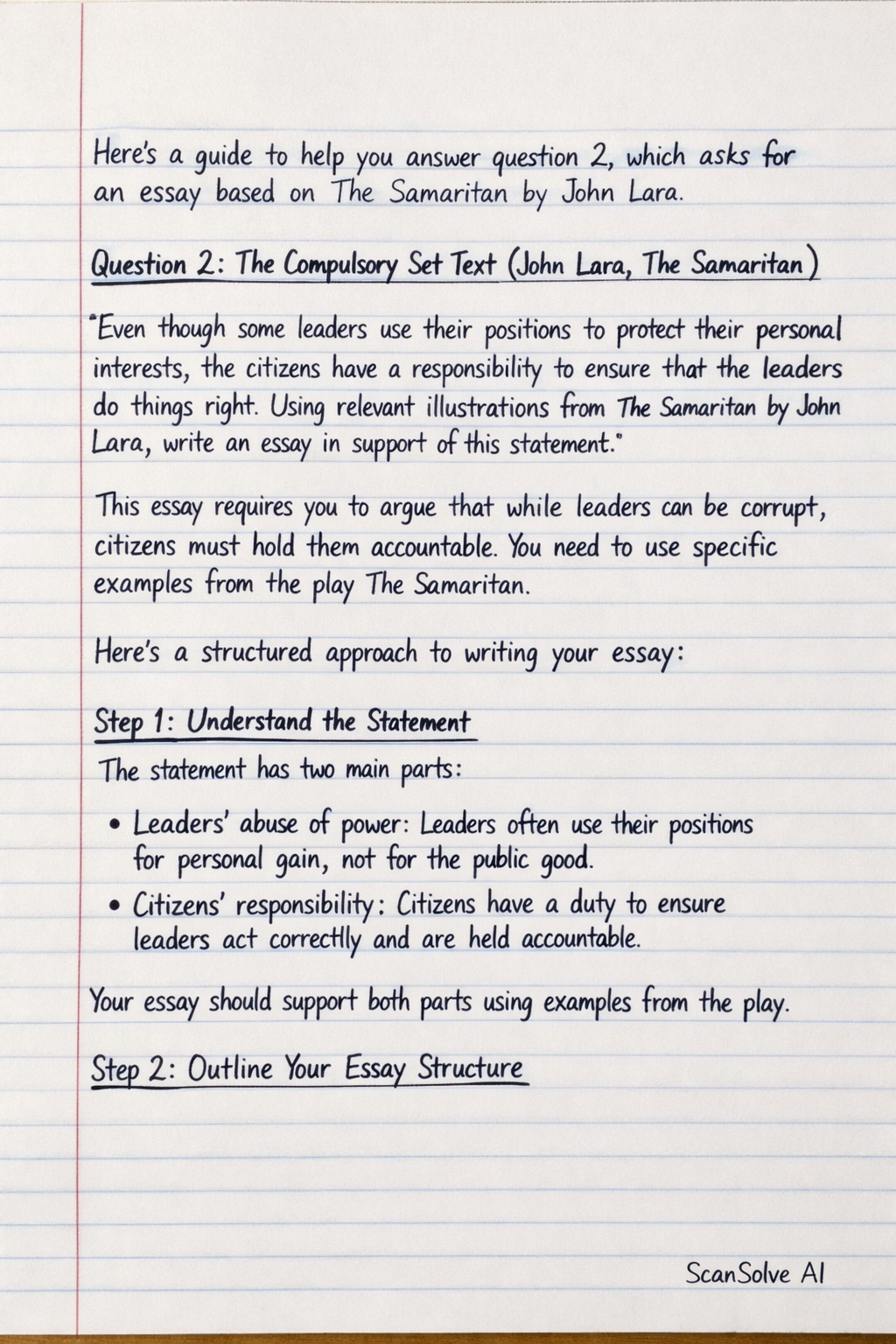
2 stepsHere's a guide to help you answer question 2, which asks for an essay based on The Samaritan by John Lara.
Question 2: The Compulsory Set Text (John Lara, The Samaritan)
"Even though some leaders use their positions to protect their personal interests, the citizens have a responsibility to ensure that the leaders do things right. Using relevant illustrations from The Samaritan by John Lara, write an essay in support of this statement."
This essay requires you to argue that while leaders can be corrupt, citizens must hold them accountable. You need to use specific examples from the play The Samaritan.
Here's a structured approach to writing your essay:
Understand the Statement
The statement has two main parts:
- Leaders' abuse of power: Leaders often use their positions for personal gain, not for the public good.
- Citizens' responsibility: Citizens have a duty to ensure leaders act correctly and are held accountable.
Your essay should support both parts using examples from the play.
Outline Your Essay Structure
-
Introduction:
- Start with a general statement about leadership, corruption, and accountability in society.
- Introduce The Samaritan by John Lara as a play that explores these themes.
- State your thesis: Agree with the statement, emphasizing that the play vividly portrays leaders' self-serving actions and the crucial role of citizens in demanding justice and good governance.
-
Body Paragraph 1: Leaders' Self-Serving Actions
- Topic Sentence: Discuss how leaders in The Samaritan exploit their positions for personal interests.
- Illustration 1: Focus on Mayor Mossy. Explain how he uses his office to enrich himself through corrupt land deals, manipulation of public resources, and silencing dissent. For example, his involvement in the illegal dumping of waste and his attempts to control the Samaritan app for his own benefit.
- Illustration 2: Mention other complicit figures like Jaden, the Mayor's secretary, who aids in the corrupt schemes, prioritizing personal loyalty and gain over ethical conduct.
- Explanation: Show how these actions demonstrate a clear disregard for public welfare in favor of individual profit and power.
-
Body Paragraph 2: The Negative Impact of Corrupt Leadership
- Topic Sentence: Explain the detrimental effects of such leadership on the community and environment.
- Illustration: Describe the environmental degradation caused by the dumping of toxic waste into the river, leading to health issues for the citizens. This directly results from Mossy's corrupt dealings.
- Illustration: Discuss the atmosphere of fear and apathy among citizens, who initially feel powerless against the corrupt system.
- Explanation: Connect these consequences back to the leaders' pursuit of personal interests, highlighting the suffering inflicted on the populace.
-
Body Paragraph 3: Citizens' Responsibility and Action
- Topic Sentence: Argue that despite corrupt leadership, citizens have a vital responsibility to ensure leaders do things right.
- Illustration 1: Focus on Alkali, the teacher and environmental activist. She embodies active citizenry, fearlessly challenging the Mayor and advocating for environmental protection and justice. Her persistence in exposing the truth is a key example.
- Illustration 2: Highlight the role of the students, particularly Montano and Nicole, who develop and utilize "The Samaritan" app. This app serves as a platform for transparency, allowing citizens to report corruption and hold leaders accountable.
- Explanation: Emphasize how these characters demonstrate courage, innovation, and a commitment to civic duty, showing that change is possible when citizens take action.
-
Body Paragraph 4: The Transformation and Empowerment of Citizens
- Topic Sentence: Discuss how citizen action can lead to a shift in power dynamics and greater accountability.
- Illustration: Show Bembe's transformation from a fearful and compliant principal to one who supports Alkali and the students, eventually exposing the Mayor's corruption. This illustrates how collective action can embolden individuals.
- Illustration: The eventual exposure of Mossy's corruption through the app and the media, leading to public outcry and potential legal consequences.
- Explanation: Conclude that the play demonstrates that active citizen participation is essential for good governance and for ensuring that leaders serve the public rather than themselves.
-
Conclusion:
- Restate Thesis: Reiterate your agreement with the statement, summarizing how The Samaritan effectively illustrates both the dangers of corrupt leadership and the indispensable role of an engaged citizenry.
- Final Thought: End with a powerful statement about the enduring message of the play: that true democracy and justice depend on the vigilance and active participation of its citizens.
By following this structure and using specific examples from The Samaritan, you can construct a comprehensive and well-supported essay.
-
Still stuck on this one?
Ask a follow-up, and the answer starts from this question.
More English Questions
Handwritten Step-by-Step Solution
Get this as a handwritten image on WhatsApp — like a tutor wrote it for you.
Try on WhatsApp