
We read your photo as:
Describe the visual representation for academic essay introductions and conclusions, explaining each part.
English
ScanSolve AI Answer
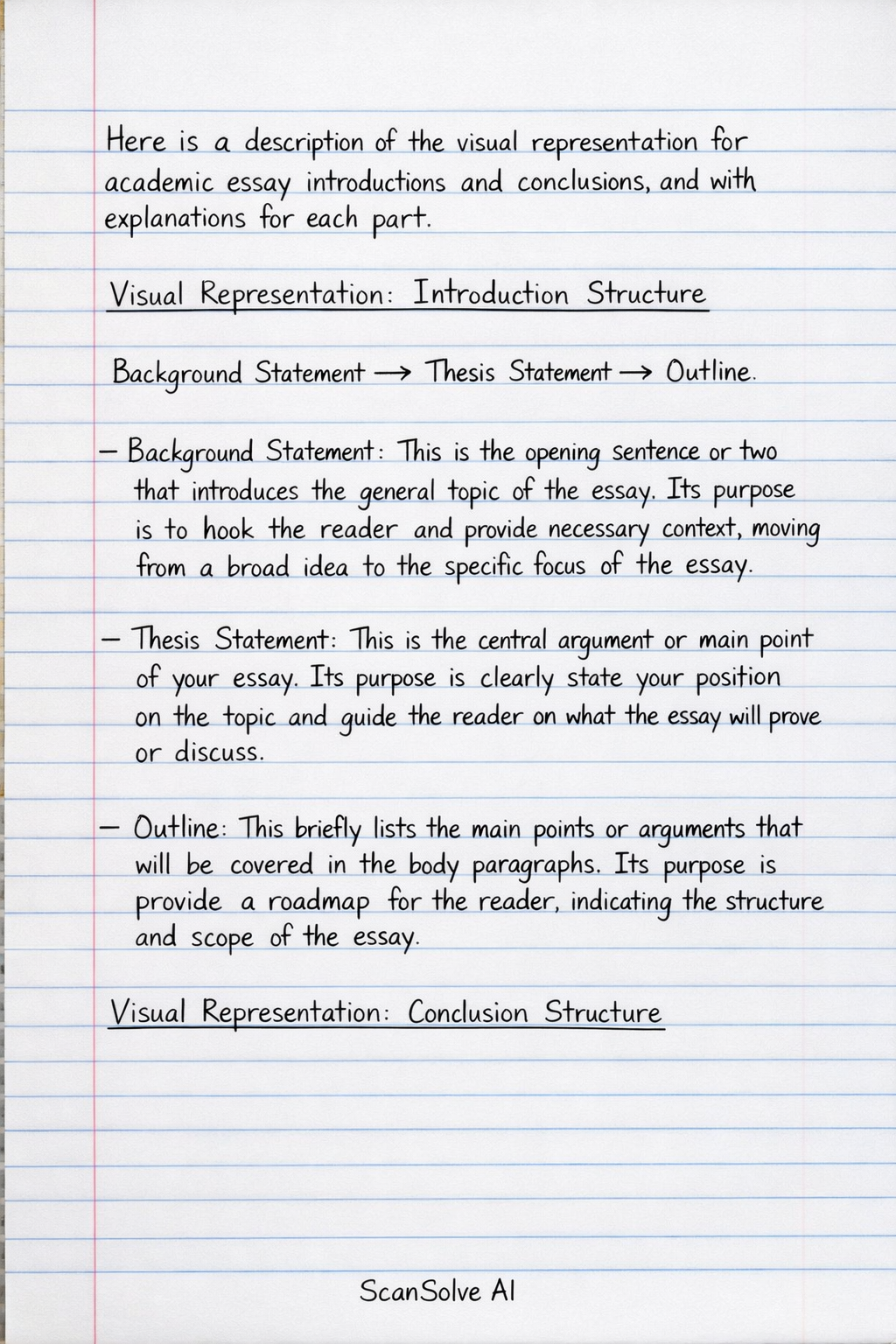
Here is a description of the visual representation for academic essay introductions and conclusions, along with explanations for each part.
Visual Representation: Introduction Structure
Imagine a flowchart with three boxes connected by arrows, flowing downwards:
- Background Statement: This is the opening sentence or two that introduces the general topic of the essay. Its purpose is to hook the reader and provide necessary context, moving from a broad idea to the specific focus of the essay.
- Thesis Statement: This is the central argument or main point of your essay. Its purpose is to clearly state your position on the topic and guide the reader on what the essay will prove or discuss.
- Outline: This briefly lists the main points or arguments that will be covered in the body paragraphs. Its purpose is to provide a roadmap for the reader, indicating the structure and scope of the essay.
Visual Representation: Conclusion Structure
Imagine a flowchart with three boxes connected by arrows, flowing downwards:
- Transition Phrase: This is a word or phrase that signals the end of the essay. Its purpose is to smoothly transition the reader from the body paragraphs to the concluding thoughts.
- Restatement of Thesis: This rephrases your original thesis statement in new words, reflecting the insights gained from the essay's arguments. Its purpose is to remind the reader of your main argument and reinforce its validity after presenting the evidence.
- Backing Statement: This offers a final thought, implication, or broader significance of your essay's argument. Its purpose is to provide a sense of closure and leave the reader with a lasting impression or a new perspective on the topic.
Name, Surname, Student Number: [Your Name, Your Surname, Your Student Number]
Was this helpful?
Still stuck on this one?
Ask a follow-up, and the answer starts from this question.
Got a different question?Ask your own question
More English Questions
QWhat is the purpose of the introduction and conclusion in an essay?QWhich part of an essay typically consists of introduction, body, and conclusion? What is the central…QIntroduction for English essayQI also need a mind map please give introduction , body and conclusion inserting those important…QWhat are the essential components of essay writing? Discuss each component in detail.
Browse by topic:Writing
Handwritten Step-by-Step Solution
Get this as a handwritten image on WhatsApp — like a tutor wrote it for you.
Try on WhatsApp