

This English question involves literary analysis, grammar, or writing skills. The detailed response below provides a well-structured answer with supporting evidence and clear explanations.
ScanSolve AI Answer
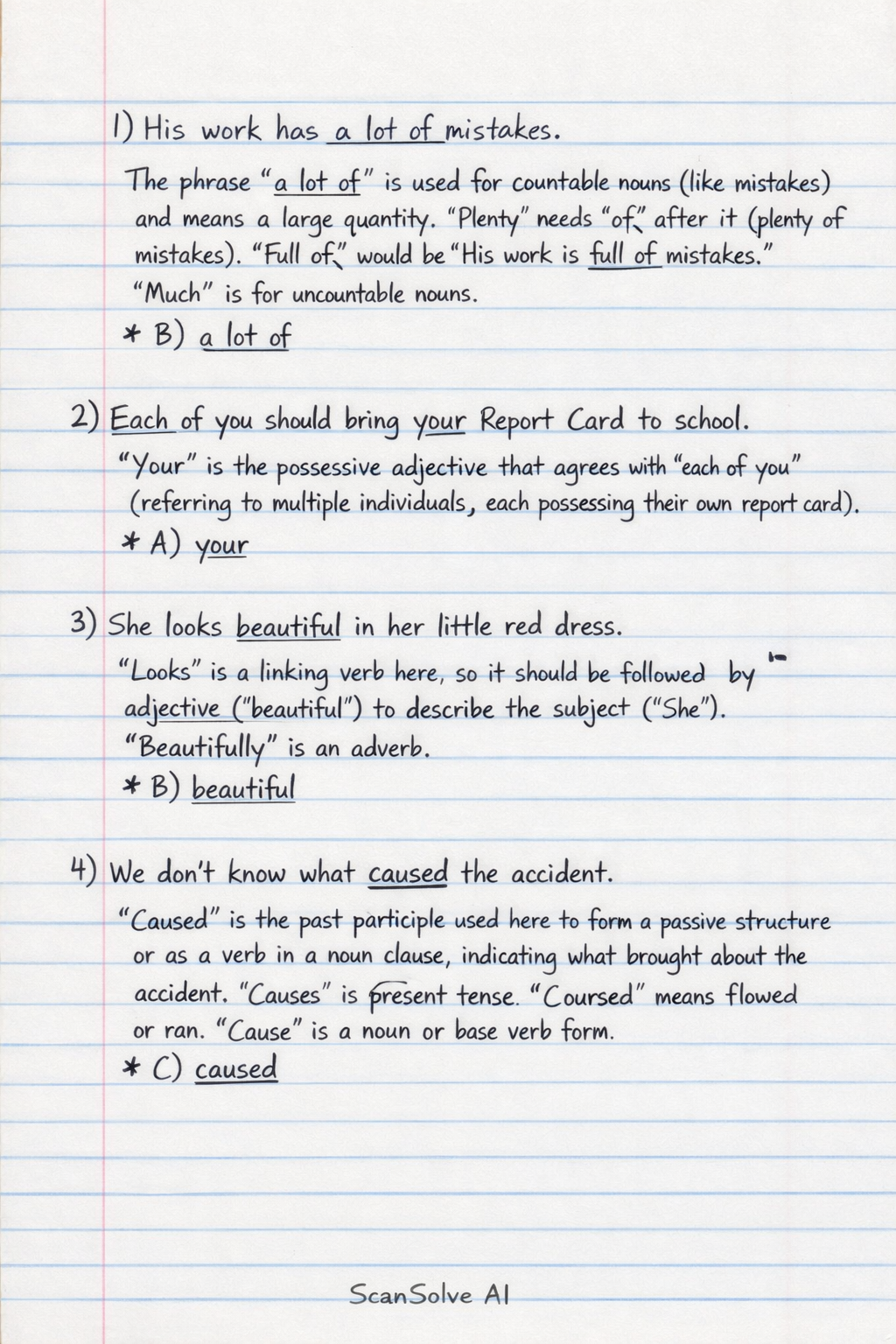
1) His work has a lot of mistakes. The phrase "a lot of" is used for countable nouns (like mistakes) and means a large quantity. "Plenty" needs "of" after it (plenty of mistakes). "Full of" would be "His work is full of mistakes." "Much" is for uncountable nouns. B) a lot of 2) Each of you should bring your Report Card to school. "Your" is the possessive adjective that agrees with "each of you" (referring to multiple individuals, each possessing their own report card). A) your 3) She looks beautiful in her little red dress. "Looks" is a linking verb here, so it should be followed by an adjective ("beautiful") to describe the subject ("She"). "Beautifully" is an adverb. B) beautiful 4) We don't know what caused the accident. "Caused" is the past participle used here to form a passive structure or as a verb in a noun clause, indicating what brought about the accident. "Causes" is present tense. "Coursed" means flowed or ran. "Cause" is a noun or base verb form. C) caused 5) Riku bought an expensive dress although she is still a student. "Although" is a conjunction that introduces a subordinate clause expressing a contrast or concession. Buying an expensive dress contrasts with the fact that she is still a student (implying limited income). C) although 6) Please, add some rice. The options are not fully visible, but assuming common options for uncountable nouns like "rice", "some" is the most appropriate quantifier for an unspecified amount. If the options were A) more, B) a, C) an, D) the, then "more" would be plausible if it implies adding additional rice. However, "some" is generally the most natural fit for an unspecified quantity of an uncountable noun in a request. Given the visible options, "more" is the only one that makes sense if we assume the blank is for a quantifier. Let's re-evaluate based on the visible options: A) more, B) a, C) an, D) the. "A" and "an" are for singular countable nouns. "The" is for specific nouns. "More" implies an additional quantity, which fits the context of "add rice". A) more 7) My uncle who lives in Douala, will be visiting us tomorrow. "Who" is a relative pronoun used to refer to people (my uncle) and acts as the subject of the relative clause "lives in Douala". B) who 8) They arrived early for the meeting yesterday. "Yesterday" indicates a past action, so the past simple tense "arrived" is correct. A) arrived 9) Between the twins, who is John? "Between" is used when referring to two distinct people or things (the twins). "Among" is used for three or more. A) Between 10) We are old enough to take care of ourselves. "Enough" is used after adjectives (old) to indicate sufficiency. C) enough 11) The sky is very bright this morning, isn't it? This is a tag question. The main clause "The sky is very bright this morning" uses the positive verb "is", so the tag question should be negative "isn't it?". C) isn't it? 12) Her younger brother is fond of crying. "Fond of" is a common idiom meaning to like or have a strong affection for something, or in this context, to be prone to something. "Fun" is a noun, "fon" is not a standard English word in this context, "fund" is a noun or verb. D) fond 13) Break time is at 10 o'clock everyday. "Everyday" indicates a habitual action or state, so the simple present tense "is" is appropriate for "Break time" (singular subject). B) is 14) He is washing his hands now. "Now" indicates an action happening at the moment of speaking, requiring the present continuous tense "is washing". C) is washing 15) What are you doing now? "What" is an interrogative pronoun used to ask about an action or activity. B) what