
Yes plot it on a graph
ScanSolve AI Answer
Step-by-step solution
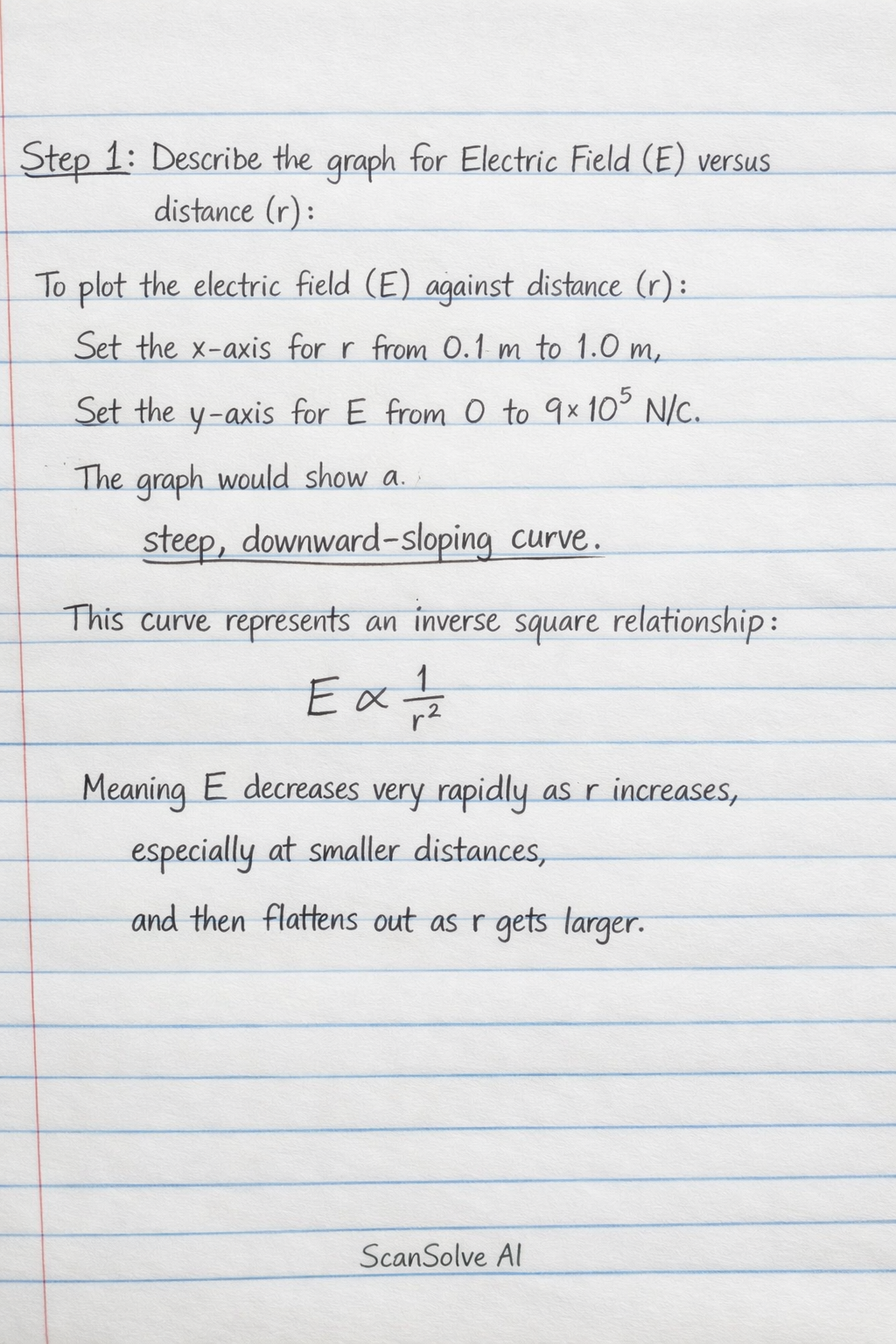
3 stepsDescribe the graph for Electric Field () versus distance ().
To plot the electric field () against distance (), you would set the horizontal axis (x-axis) for from to and the vertical axis (y-axis) for from 0 to approximately . The graph would show a steep, downward-sloping curve. This curve represents an inverse square relationship (), meaning decreases very rapidly as increases, especially at smaller distances, and then flattens out as gets larger.
Describe the graph for Electric Potential () versus distance ().
To plot the electric potential () against distance (), you would use the same horizontal axis for from to . The vertical axis for would range from 0 to approximately . This graph would also be a downward-sloping curve, but it would be less steep than the vs. graph. This curve represents an inverse relationship (), showing that decreases as increases, but at a slower rate compared to the electric field.
Summary of the plots.
Both graphs would start at high values for small and decrease towards zero as increases, reflecting the inverse relationships with distance. The vs. graph would be steeper due to its inverse square dependence, while the vs. graph would be less steep due to its inverse dependence.
Still stuck on this one?
Ask a follow-up, and the answer starts from this question.
More English Questions
Handwritten Step-by-Step Solution
Get this as a handwritten image on WhatsApp — like a tutor wrote it for you.
Try on WhatsApp