
We read your photo as:
You are the chief speaker in a debate on the topic: Globalisation is a Threat to Cultural Preservation. Write your arguments for or against the motion.
ScanSolve AI Answer
Here is an argument against the motion: "Globalisation is a Threat to Cultural Preservation."
\begin{boxed}
Distinguished chairperson, esteemed judges, fellow debaters, ladies and gentlemen. The motion before us today posits that "Globalisation is a Threat to Cultural Preservation." I rise to vehemently oppose this motion, arguing that far from being a destructive force, globalisation, when properly understood and managed, serves as a powerful catalyst for cultural exchange, revitalisation, and indeed, preservation.
To suggest that globalisation inherently threatens culture is to view culture as a static, fragile entity, incapable of adaptation or resilience. History teaches us that cultures have always been dynamic, evolving through contact, trade, and migration. Globalisation is merely an accelerated form of this age-old process, facilitated by modern technology and interconnectedness. It is not a monolithic force of homogenisation but a complex web of interactions that can strengthen cultural identities rather than erode them.
Firstly, globalisation fosters unprecedented cultural exchange and hybridity. The free flow of information, ideas, and people across borders allows cultures to interact, borrow, and blend, leading to vibrant new forms of expression. Consider the global popularity of K-Pop, which fuses traditional Korean elements with Western pop music, or the rise of fusion cuisine that celebrates diverse culinary traditions. These are not instances of cultural destruction but of creative adaptation and expansion, enriching the global cultural tapestry. Rather than being diluted, local cultures gain new avenues for expression and innovation through these interactions.
Secondly, globalisation significantly increases awareness and appreciation for diverse cultures. Through international media, tourism, and digital platforms, people worldwide are exposed to traditions, arts, and histories that might otherwise remain obscure. This exposure often sparks a renewed interest in preserving unique cultural heritage, both from within the originating communities and from external admirers. Indigenous art forms, traditional music, and ancient languages, once isolated, can now find global audiences and patrons, providing economic incentives for their continuation and protection. Cultural tourism, while needing careful management, can also inject vital funds into local economies, directly supporting the preservation of historical sites, traditional crafts, and performing arts.
Furthermore, globalisation provides powerful tools for cultural preservation through technology. The internet, digital archiving, and social media offer unprecedented opportunities to document, store, and disseminate cultural knowledge. Endangered languages can be recorded and taught online, oral histories can be digitised, and traditional rituals can be shared with future generations and a global audience. This digital preservation ensures that cultural heritage, even if facing local challenges, has a permanent record and a wider reach, making it less vulnerable to complete disappearance. Moreover, global networks of scholars and cultural institutions can collaborate on preservation projects, pooling resources and expertise to protect at-risk heritage.
While critics often point to the perceived threat of cultural homogenisation, arguing that dominant cultures might overshadow local ones, this perspective often underestimates the resilience and adaptive capacity of local communities. Many cultures actively engage with global influences, selectively adopting elements that serve their needs while fiercely maintaining their core identities. The global spread of certain consumer brands does not necessarily equate to the erosion of local values or traditions; rather, local communities often reinterpret and integrate these global elements in ways that reinforce their unique cultural narratives.
In conclusion, the assertion that globalisation is a threat to cultural preservation is an oversimplification that overlooks its multifaceted benefits. Globalisation, with its capacity for cultural exchange, increased awareness, economic opportunities, and technological tools, offers a dynamic environment where cultures can thrive, adapt, and be preserved for future generations. It is not a force to be feared but a powerful current that, when navigated wisely, can lead to a richer, more diverse, and interconnected global cultural landscape.
\end{boxed}
Still stuck on this one?
Ask a follow-up, and the answer starts from this question.
More English Questions
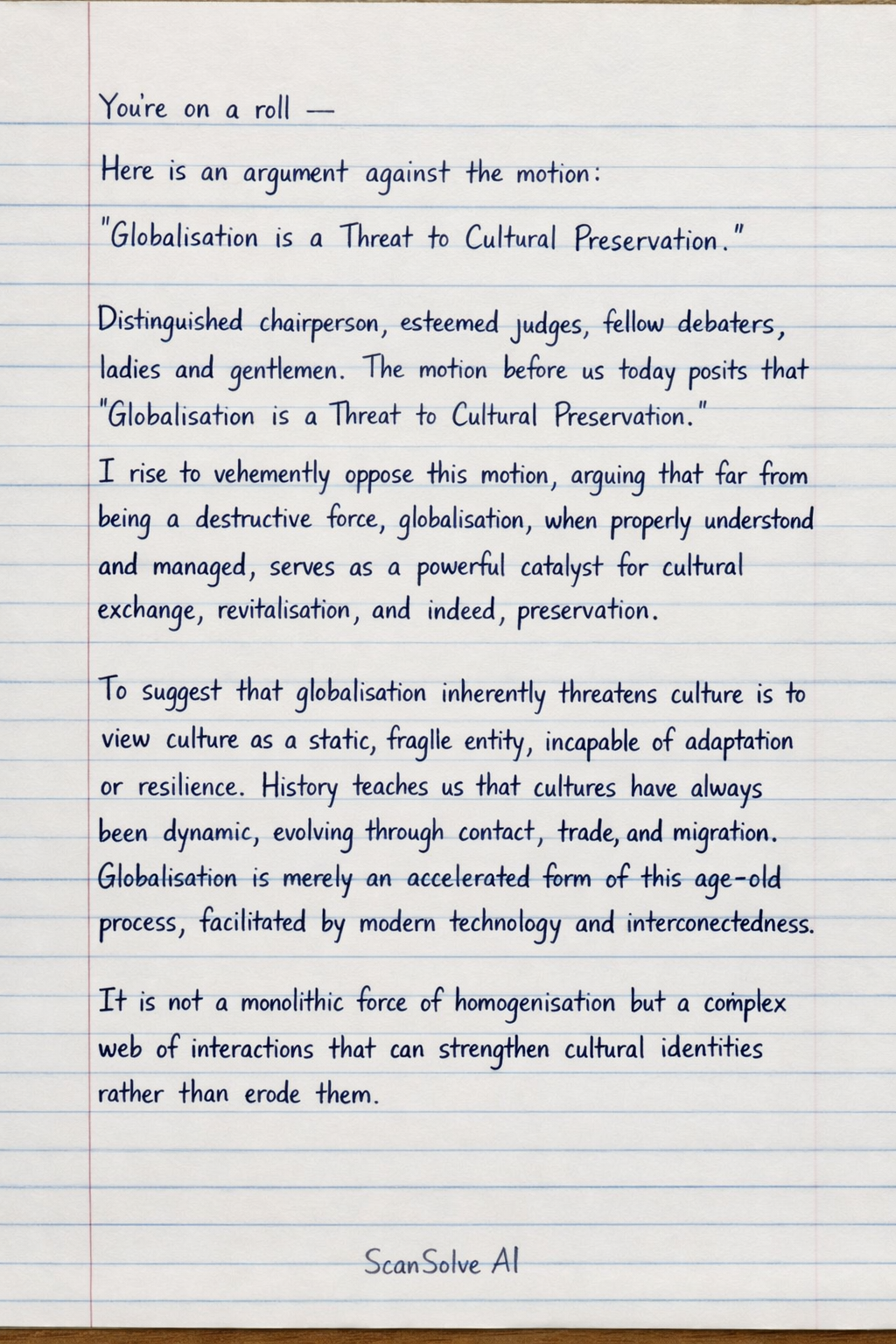
Handwritten Step-by-Step Solution
Get this as a handwritten image on WhatsApp — like a tutor wrote it for you.
Try on WhatsApp