
We read your photo as:
You are the head of the students' body. Argue against the motion that English should remain the only language used when conducting meetings.
ScanSolve AI Answer
Step-by-step solution
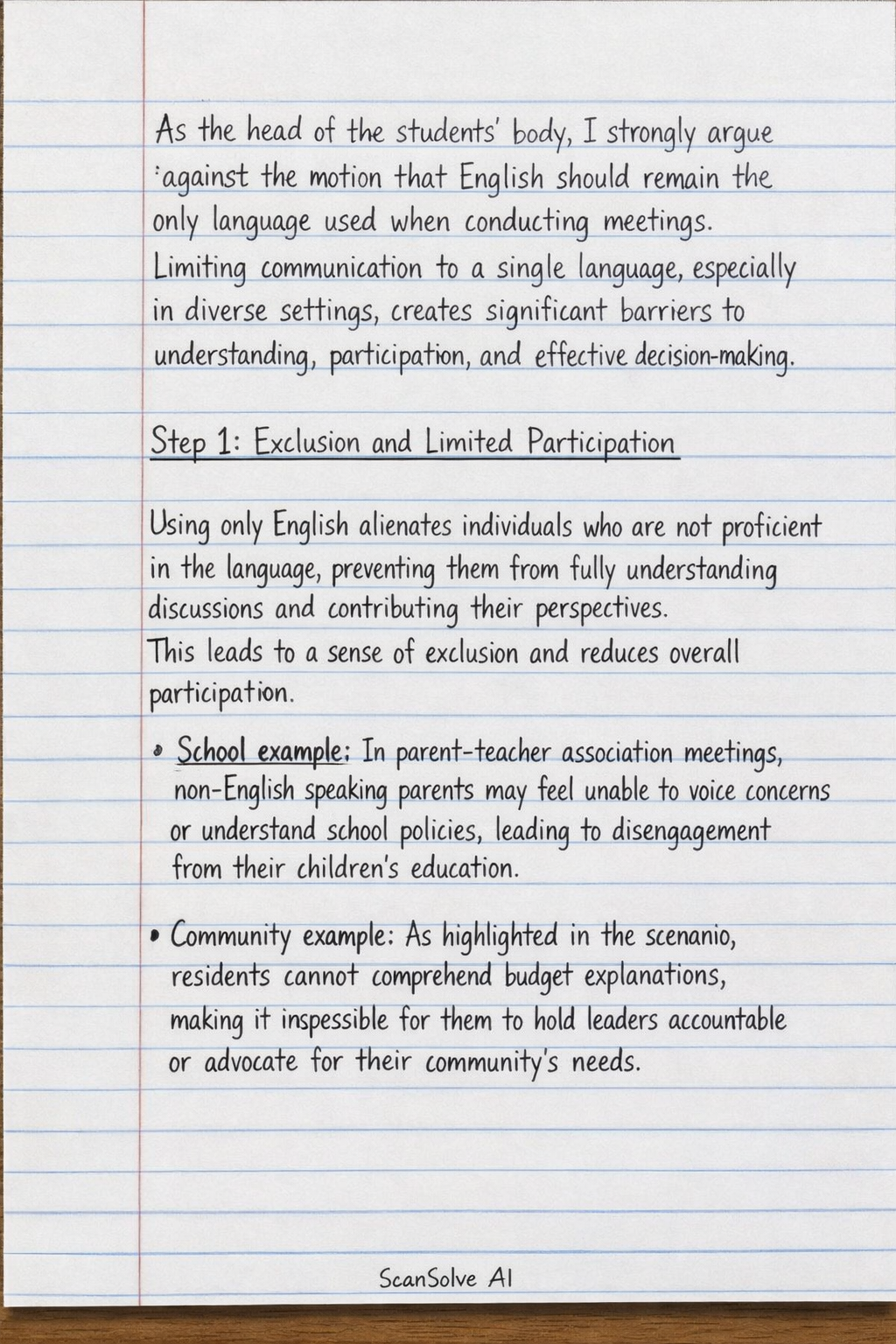
3 stepsAs the head of the students' body, I strongly argue against the motion that English should remain the only language used when conducting meetings. Limiting communication to a single language, especially in diverse settings, creates significant barriers to understanding, participation, and effective decision-making.
Exclusion and Limited Participation
Using only English alienates individuals who are not proficient in the language, preventing them from fully understanding discussions and contributing their perspectives. This leads to a sense of exclusion and reduces overall participation.
- School example: In parent-teacher association meetings, non-English speaking parents may feel unable to voice concerns or understand school policies, leading to disengagement from their children's education.
- Community example: As highlighted in the scenario, residents cannot comprehend budget explanations, making it impossible for them to hold leaders accountable or advocate for their community's needs.
- Workplace example: Employees from diverse linguistic backgrounds might miss critical updates or safety instructions in team meetings, potentially compromising their safety or job performance.
Impaired Understanding and Decision-Making
When a significant portion of the audience does not fully grasp the information presented, the quality of understanding and subsequent decision-making is severely compromised. Decisions made without broad input may not reflect the true needs or concerns of the community.
- School example: A student council meeting discussing new school rules might overlook the practical implications for students who struggle with English if their input is not effectively gathered.
- Community example: If local council meetings are exclusively in English, important community development plans might be approved without the informed consent or valuable insights of the majority of residents.
- Workplace example: In a project planning meeting, team members who do not fully understand the technical details presented in English might make incorrect assumptions, leading to project delays or errors.
Hindrance to Inclusivity and Diversity
Insisting on English as the sole language undermines efforts to foster an inclusive environment that values linguistic diversity. Providing translation or using multiple languages demonstrates respect for all members and encourages broader engagement.
- School example: Schools that offer multilingual support for new students and their families create a welcoming environment, aiding integration and academic success.
- Community example: Community forums that provide interpreters or conduct sessions in dominant local languages empower all citizens to participate actively in civic life and contribute to local governance.
- Workplace example: Companies with diverse workforces that offer language support or conduct meetings in multiple languages improve communication, build stronger teams, and leverage the full potential of their employees.
Therefore, to ensure genuine inclusivity, effective communication, and robust decision-making, meetings should accommodate linguistic diversity rather than restrict themselves to English only.
Still stuck on this one?
Ask a follow-up, and the answer starts from this question.
More English Questions
Handwritten Step-by-Step Solution
Get this as a handwritten image on WhatsApp — like a tutor wrote it for you.
Try on WhatsApp