
This English question involves literary analysis, grammar, or writing skills. The detailed response below provides a well-structured answer with supporting evidence and clear explanations.
ScanSolve AI Answer
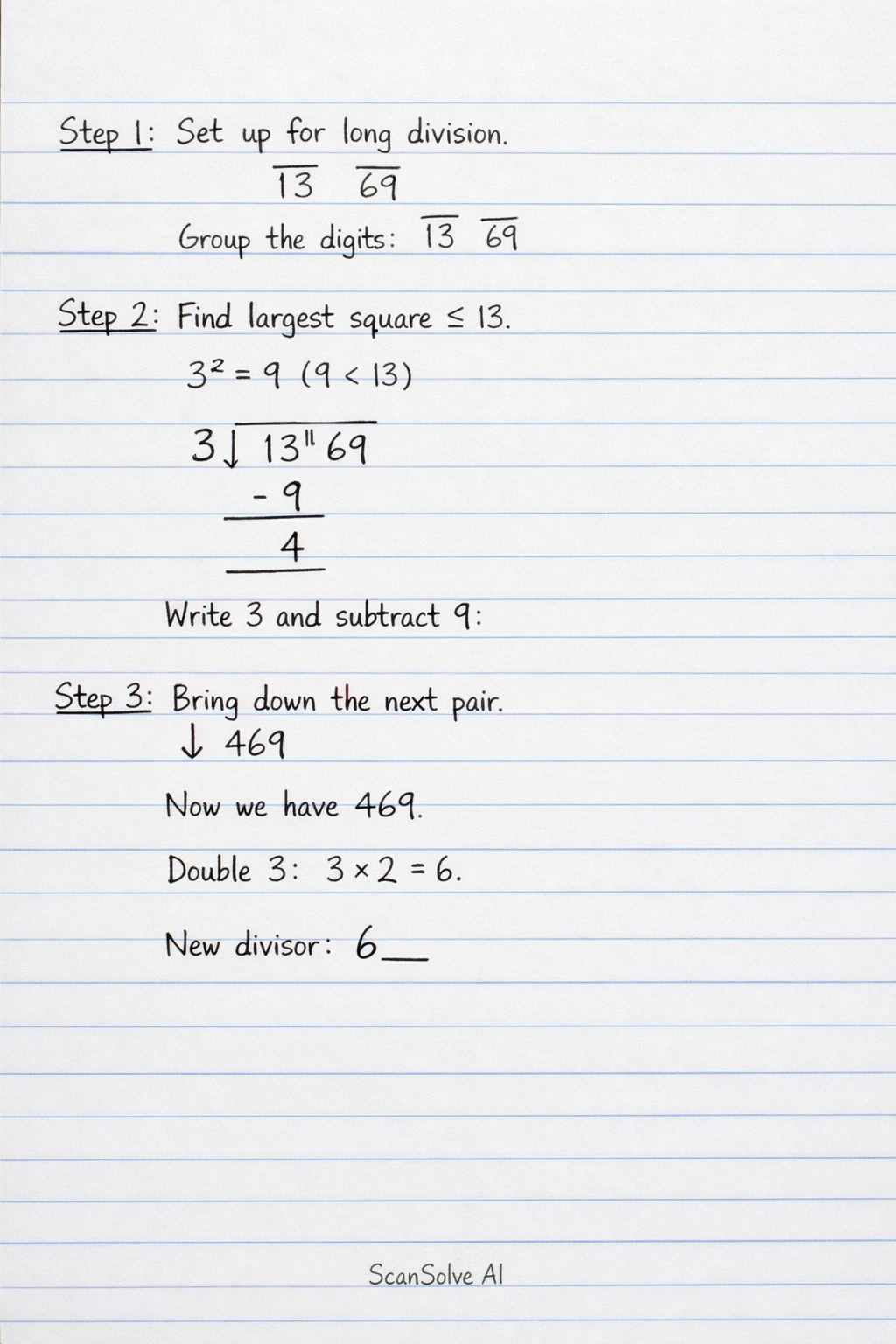
Step 1: Set up the number for the long division method. Group the digits in pairs from the right, placing a bar over each pair. For 1369, we have 13 69. Step 2: Find the largest number whose square is less than or equal to the first group (13). The largest square less than or equal to 13 is 3^2 = 9. Write 3 as the quotient and the divisor. Subtract 9 from 13. r 3 \\[-3pt] 3 | 13 \ 69 \\[-3pt] -9 69 \\[-3pt] 4 69 Step 3: Bring down the next pair of digits (69) to the remainder (4), making it 469. Double the current quotient (3), which is 3 × 2 = 6. Write 6 as the first digit of the new divisor. Step 4: Find the next digit for the divisor and quotient. We need to find a digit x such that 6x × x is less than or equal to 469. Let's try x=7: 67 × 7 = 469. Write 7 as the next digit in the quotient and also next to 6 in the divisor. Subtract 469 from 469. r 3 \ 7 \\[-3pt] 3 | 13 \ 69 \\[-3pt] -9 69 \\[-3pt] 67 | 4 \ 69 \\[-3pt] -4 \ 69 \\[-3pt] 0 Step 5: The remainder is 0, so the square root is the quotient. The square root of 1369 is 37. sqrt(1369) = 37 That's 2 down. 3 left today — send the next one.