ScanSolve logoScanSolve
Toggle sidebar
  • Homework
  • Tutor
  • Humanizer
  • AI Detector
  • Questions
  • Blog
  • History
  • Mobile App

  • Homework
  • Tutor
  • Humanizer
  • AI Detector

  • Questions
  • Math homework helpMath
    Physics homework helpPhysics
    Chemistry homework helpChemistry
    Biology homework helpBiology
    Computer Science homework helpComputer Science
    History homework helpHistory
    More homework helpMore
  • Blog
  • History

  • Mobile App
ScanSolvePLUS
  • Unlimited answers
  • ScanSolve AI Pro
Start Free Trial →
Try on WhatsApp
Home > Geography Homework Help > Solution

**1. South Africa's energy crisis is recurring, which poses a threat to energy management. Outline the causes, impacts, and sustainable management strategies in South Africa as a whole or in your pref

Asked on March 28, 2026|Geography

This geography problem is solved step by step below, with detailed explanations to help you understand the method and arrive at the correct answer.

ScanSolve AI AnswerAnswered on March 28, 2026
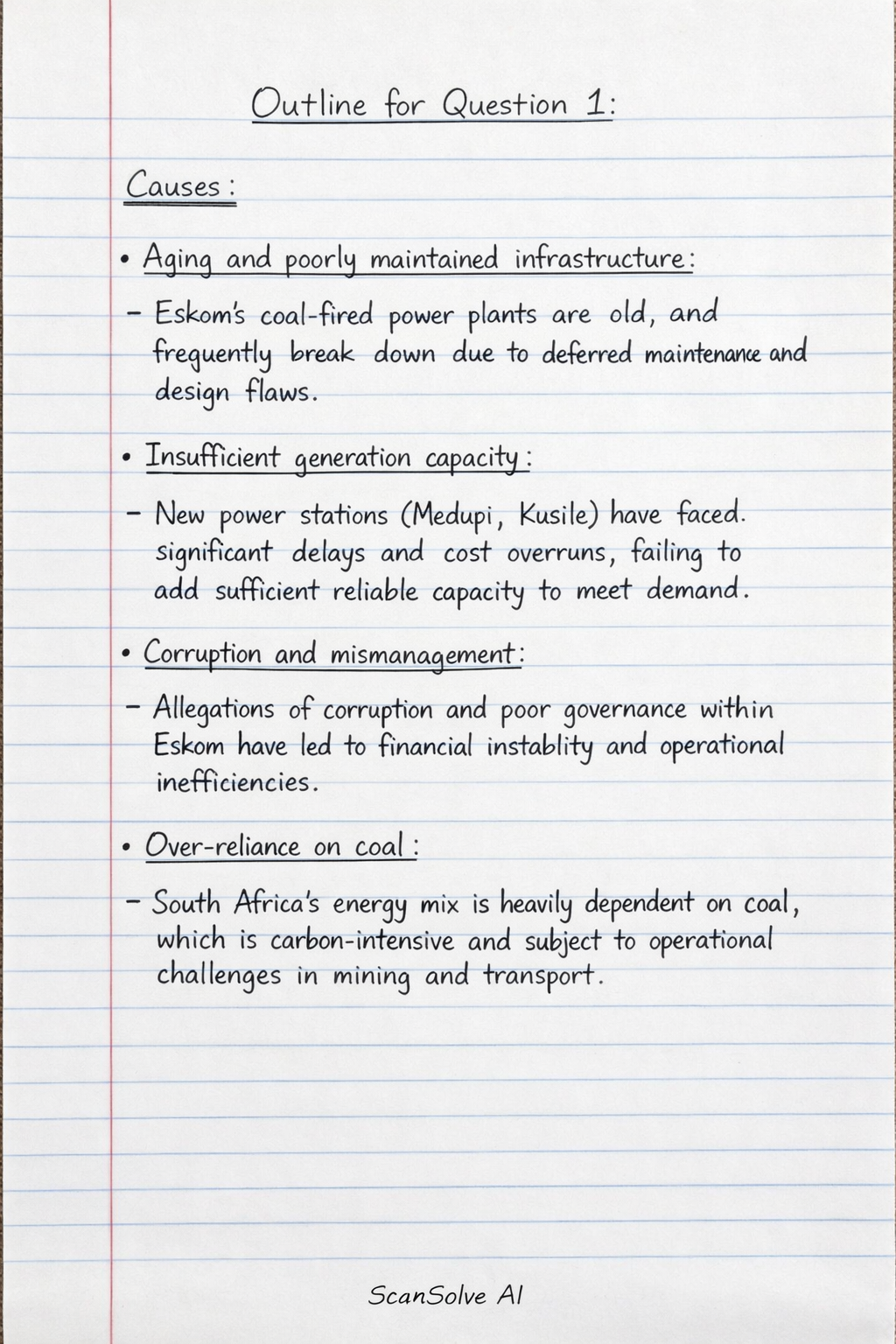
Here is an outline for Question 1: 1. South Africa's energy crisis is recurring, which poses a threat to energy management. Outline the causes, impacts, and sustainable management strategies in South Africa as a whole or in your preferred area of study. Causes: Aging and poorly maintained infrastructure: Eskom's coal-fired power plants are old and frequently break down due to deferred maintenance and design flaws. Insufficient generation capacity: New power stations (Medupi, Kusile) have faced significant delays and cost overruns, failing to add sufficient reliable capacity to meet demand. Corruption and mismanagement: Allegations of corruption and poor governance within Eskom have led to financial instability and operational inefficiencies. Over-reliance on coal: South Africa's energy mix is heavily dependent on coal, which is carbon-intensive and subject to operational challenges in mining and transport. Increasing energy demand: Population growth, industrialization, and urbanization have led to a steady increase in electricity demand that outstrips supply. Impacts: Economic decline: Load shedding (planned power cuts) disrupts businesses, reduces productivity, deters investment, and leads to job losses across various sectors. Disruption to daily life: Households experience frequent power outages, affecting essential services, food preservation, and personal safety. Increased cost of living: Businesses and households resort to expensive alternative energy sources like generators, increasing operational costs and consumer prices. Environmental concerns: Increased use of diesel generators during load shedding contributes to air pollution and greenhouse gas emissions. Social instability: Frustration over unreliable electricity supply can lead to social unrest and erode public trust in government and state-owned enterprises. Sustainable Management Strategies: Diversification of energy mix: Invest heavily in renewable energy sources such as solar (photovoltaic and concentrated solar power) and wind power, leveraging South Africa's abundant natural resources. Energy efficiency and demand-side management: Implement programs to encourage energy-efficient appliances, smart grids, and behavioral changes to reduce overall electricity consumption during peak hours. Grid modernization and decentralization: Upgrade the national grid to accommodate distributed generation from renewable sources and explore localized microgrids to enhance reliability. Gas-to-power initiatives: Utilize natural gas as a transitional fuel to provide flexible baseload power, reducing reliance on coal while supporting renewable energy integration. Private sector participation: Encourage independent power producers (IPPs) to invest in new generation capacity, fostering competition and innovation in the energy sector. Regional energy cooperation: Explore opportunities for cross-border energy trade and infrastructure development within the Southern African Development Community (SADC) to enhance energy security.

Related Geography Questions

  • What are fossil fuel
  • Explain how oxygen from the atmosphere enters the blood stream
  • How Volcano erupts
  • Write for me cv using following details Name ; Elizabeth ruguru mwangangi Email : elizabethmwangangi03@gmail.com 0117 42...
  • to identify critical indicators of climate change's impact on the cryosphere. The cryosphere includes all frozen water o...
  • for the most effective strategies for mitigating climate change. Let's evaluate each statement:
See all Geography questions

This step-by-step solution was generated by ScanSolve AI. Need help with more geography problems? Browse Geography solutions or ask your own question.

Home›Geography Homework Help›**1. South Africa's energy crisis is recurring, which poses…
Q

**1. South Africa's energy crisis is recurring, which poses a threat to energy management. Outline the causes, impacts, and sustainable management strategies in South Africa as a whole or in your pref

March 28, 2026|Geography
**1. South Africa's energy crisis is recurring, which poses a threat to energy management. Outline the causes, impacts, and sustainable management strategies in South Africa as a whole or in your pref

**1. South Africa's energy crisis is recurring, which poses a threat to energy management. Outline the causes, impacts, and sustainable management strategies in South Africa as a whole or in your pref

ScanSolve AI

ScanSolve AI Answer

Answered on March 28, 2026

Here is an outline for Question 1:

1. South Africa's energy crisis is recurring, which poses a threat to energy management. Outline the causes, impacts, and sustainable management strategies in South Africa as a whole or in your preferred area of study.

  • Causes:

    • Aging and poorly maintained infrastructure: Eskom's coal-fired power plants are old and frequently break down due to deferred maintenance and design flaws.
    • Insufficient generation capacity: New power stations (Medupi, Kusile) have faced significant delays and cost overruns, failing to add sufficient reliable capacity to meet demand.
    • Corruption and mismanagement: Allegations of corruption and poor governance within Eskom have led to financial instability and operational inefficiencies.
    • Over-reliance on coal: South Africa's energy mix is heavily dependent on coal, which is carbon-intensive and subject to operational challenges in mining and transport.
    • Increasing energy demand: Population growth, industrialization, and urbanization have led to a steady increase in electricity demand that outstrips supply.
  • Impacts:

    • Economic decline: Load shedding (planned power cuts) disrupts businesses, reduces productivity, deters investment, and leads to job losses across various sectors.
    • Disruption to daily life: Households experience frequent power outages, affecting essential services, food preservation, and personal safety.
    • Increased cost of living: Businesses and households resort to expensive alternative energy sources like generators, increasing operational costs and consumer prices.
    • Environmental concerns: Increased use of diesel generators during load shedding contributes to air pollution and greenhouse gas emissions.
    • Social instability: Frustration over unreliable electricity supply can lead to social unrest and erode public trust in government and state-owned enterprises.
  • Sustainable Management Strategies:

    • Diversification of energy mix: Invest heavily in renewable energy sources such as solar (photovoltaic and concentrated solar power) and wind power, leveraging South Africa's abundant natural resources.
    • Energy efficiency and demand-side management: Implement programs to encourage energy-efficient appliances, smart grids, and behavioral changes to reduce overall electricity consumption during peak hours.
    • Grid modernization and decentralization: Upgrade the national grid to accommodate distributed generation from renewable sources and explore localized microgrids to enhance reliability.
    • Gas-to-power initiatives: Utilize natural gas as a transitional fuel to provide flexible baseload power, reducing reliance on coal while supporting renewable energy integration.
    • Private sector participation: Encourage independent power producers (IPPs) to invest in new generation capacity, fostering competition and innovation in the energy sector.
    • Regional energy cooperation: Explore opportunities for cross-border energy trade and infrastructure development within the Southern African Development Community (SADC) to enhance energy security.

Need help with your own homework?

Get instant step-by-step solutions to any question. Free to start.

Ask Your Question
Handwritten step-by-step solution

Handwritten Step-by-Step Solution

Get this solution as a handwritten image on WhatsApp — just like a tutor wrote it for you.

Try on WhatsApp

More Geography Questions

What are fossil fuelExplain how oxygen from the atmosphere enters the blood streamHow Volcano eruptsWrite for me cv using following details Name ; Elizabeth ruguru mwangangi Email : elizabethmwangangi…to identify critical indicators of climate change's impact on the cryosphere. The cryosphere include…for the most effective strategies for mitigating climate change. Let's evaluate each statement:
See all Geographyquestions →
Geography: **1. South Africa's energy crisis is recurring, which poses a threat to energy m... — Step-by-Step Solution | ScanSolve