
We read your photo as:
13.2.1. Identify fluvial landform C on the sketch.
ScanSolve AI Answer
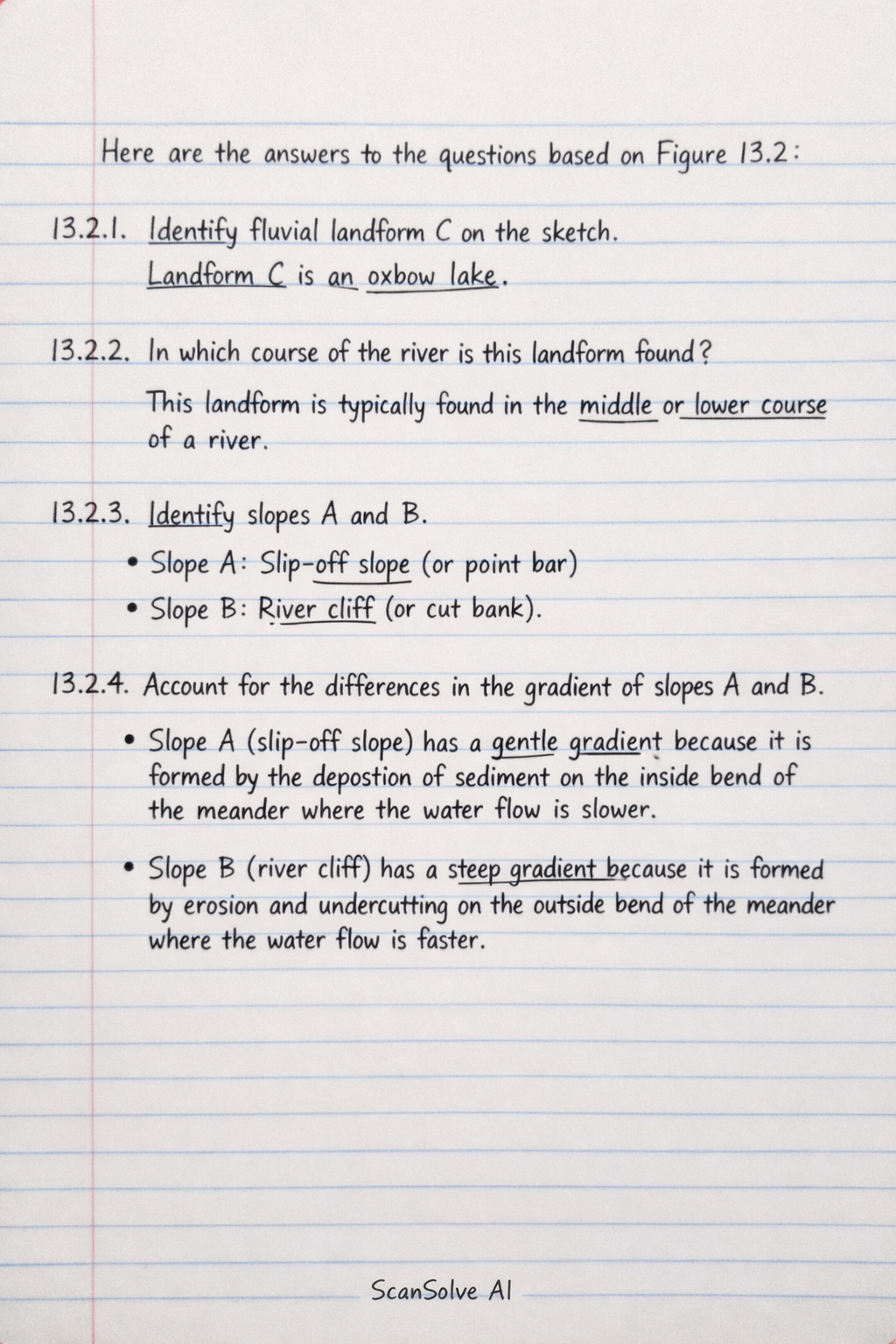
Here are the answers to the questions based on Figure 13.2:
13.2.1. Identify fluvial landform C on the sketch.
Landform C is an oxbow lake.
13.2.2. In which course of the river is this landform found?
This landform is typically found in the middle or lower course of a river.
13.2.3. Identify slopes A and B.
- Slope A: Slip-off slope (or point bar)
- Slope B: River cliff (or cut bank)
13.2.4. Account for the differences in the gradient of slopes A and B.
- Slope A (slip-off slope) has a gentle gradient because it is formed by the deposition of sediment on the inside bend of the meander where the water flow is slower.
- Slope B (river cliff) has a steep gradient because it is formed by erosion and undercutting on the outside bend of the meander where the water flow is faster.
13.2.5. Explain what will happen to feature C over time.
Over time, feature C (the oxbow lake) will gradually fill with sediment (silt, clay, and organic matter) carried by floodwaters or blown in by wind. Vegetation will colonize the edges and eventually the entire lake, transforming it into a marsh, then a swamp, and finally dry land.
13.2.6. Mention one significance of the landform C.
One significance of landform C (oxbow lake) is that it provides a habitat for various aquatic plants and animals, contributing to biodiversity.
Still stuck on this one?
Ask a follow-up, and the answer starts from this question.
More Geography Questions
Handwritten Step-by-Step Solution
Get this as a handwritten image on WhatsApp — like a tutor wrote it for you.
Try on WhatsApp