
We read your photo as:
Mahogany, obeche, African walnut are timber trees characteristic of the vegetation zone marked
ScanSolve AI Answer
Answer
Step-by-step solution
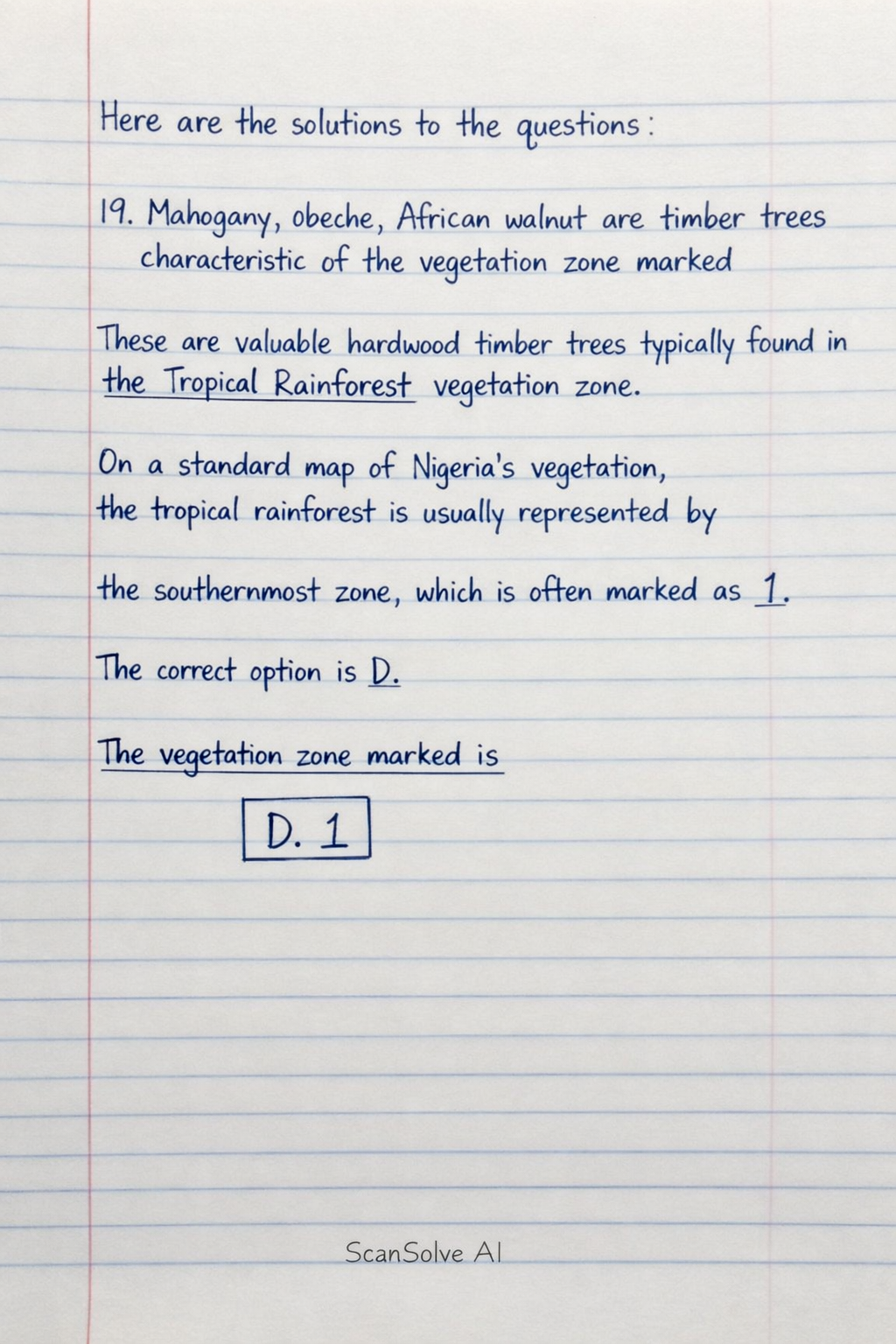
8 stepsHere are the solutions to the questions:
19. Mahogany, obeche, African walnut are timber trees characteristic of the vegetation zone marked
These are valuable hardwood timber trees typically found in the Tropical Rainforest vegetation zone. On a standard map of Nigeria's vegetation, the tropical rainforest is usually represented by the southernmost zone, which is often marked as 1.
The correct option is D.
The vegetation zone marked is .
20. Which of the following statements is TRUE of local craft industries in West Africa?
- I. They are the earliest industries in the region: This is true, as craft industries predate modern industrialization.
- II. They are widely scattered over the region: This is true, as they are often small-scale and community-based.
- III. Their products are mass produced: This is false. Craft industries typically involve manual labor and produce unique or limited quantities, not mass production.
- IV. They depend mainly on human energy: This is true, as they are labor-intensive and rely on manual skills. Therefore, statements I, II, and IV are true. The correct option is D. The true statements are .
21. What is the R.F. of a map whose linear scale is 4cm represents 1km?
Convert kilometers to centimeters to have consistent units.
So,
Express the given scale as a ratio.
The scale is 4 cm on the map represents 100,000 cm on the ground.
Simplify the ratio to have 1 on the map side.
Divide both sides by 4:
The Representative Fraction (R.F.) is 1:25,000.
The correct option is A.
The R.F. of the map is .22. A map scale of 1:250,000 can be expressed in words as what?
Understand the R.F.
1:250,000 means 1 unit on the map represents 250,000 units on the ground. Let's use centimeters.
So, 1 cm on the map represents 250,000 cm on the ground.Convert centimeters on the ground to kilometers.
We know that .
So, 1 cm on the map represents 2.5 km on the ground.
The correct option is B.
The map scale can be expressed as .23. Which one of the options is not part of the earth's interior layers?
The Earth's interior layers are generally considered to be the Crust, the Mantle, and the Core. The Hydrosphere refers to all the water on Earth (oceans, rivers, lakes, groundwater), which is found on or near the Earth's surface, not as an interior layer.
The correct option is B.
The option that is not part of the earth's interior layers is .24. A map drawn on a scale of 1:50,000 is reduced four times. What is the scale of the new map?
When a map is reduced, the scale number (the denominator in the R.F.) increases. If a map is reduced 'n' times, the new scale number is the original scale number multiplied by 'n'.Identify the original scale number.
Original scale = 1:50,000, so the scale number is 50,000.
Apply the reduction factor.
The map is reduced four times, so .
New scale number = Original scale number Reduction factorWrite the new scale.
The new scale is 1:200,000.
The correct option is C.
The scale of the new map is .
Try one yourself
A new problem that tests the same skill.
Still stuck on this one?
Ask a follow-up, and the answer starts from this question.
More Geography Questions
Handwritten Step-by-Step Solution
Get this as a handwritten image on WhatsApp — like a tutor wrote it for you.
Try on WhatsApp