

This geography problem is solved step by step below, with detailed explanations to help you understand the method and arrive at the correct answer.
ScanSolve AI Answer
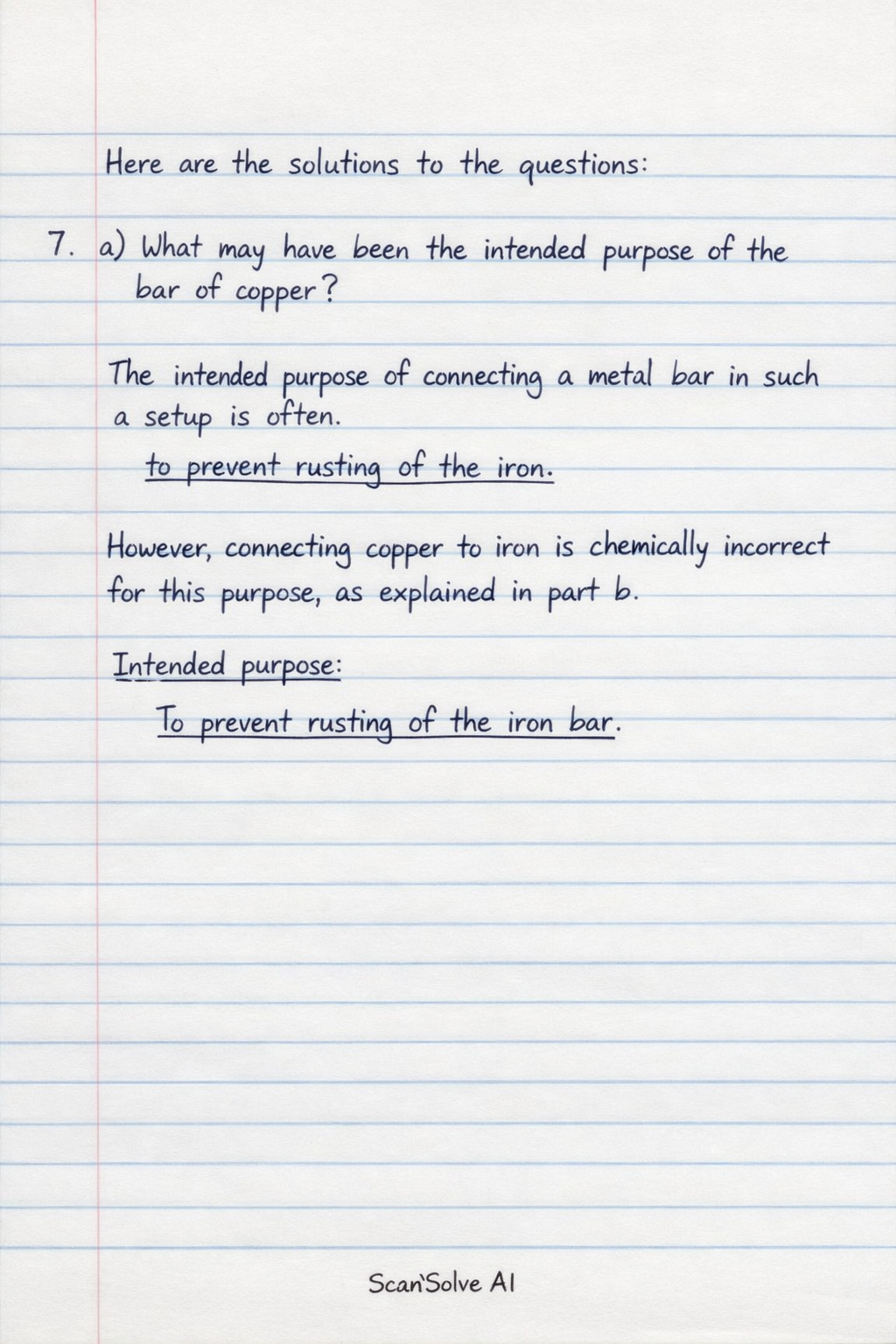
Here are the solutions to the questions: 7. The diagram below represents a newly erected iron pillar to support a pier in the shallow parts of an ocean. The iron pillar is connected to a bar of copper as shown. a) What may have been the intended purpose of the bar of copper? The intended purpose of connecting a metal bar in such a setup is often to prevent rusting of the iron. However, connecting copper to iron is chemically incorrect for this purpose, as explained in part b. Intended purpose: To prevent rusting of the iron bar.* b) State and explain the expected observation after two weeks, in the setup above. Observation: The iron bar will show signs of rusting*, appearing as a reddish-brown flaky solid. The copper bar will remain largely unchanged. Explanation: Iron is more reactive than copper. When two dissimilar metals are connected in the presence of an electrolyte (like seawater and moist soil), a galvanic cell is formed. The more reactive metal (iron) acts as the anode and undergoes oxidation (corrosion), while the less reactive metal (copper) acts as the cathode and is protected. This process is known as galvanic corrosion*, and it accelerates the rusting of iron. 8. A student represented an atom of element J using the diagram below. a) Write an equation for the formation of a stable ion of element J. From the diagram, element J has 2 electrons in the first shell, 8 in the second, and 6 in the outermost shell. Its electron configuration is 2, 8, 6. To achieve a stable octet (8 electrons in its outermost shell), element J will gain 2 electrons. The equation for the formation of its stable ion is: J + 2e^- J^2-