
8.Thebulkmodulusofamaterialismostrelevantwhenanalyzing: 12.Intheequationforthermalstress,sigma=Y(alpha)(Delta)T,thetermalpharepresents: C.3.75x10⁶N 11.AbonewithYoung'smodulus1.50x10¹⁰N/m²hasaminimumeffective D.Specificheatcapacity 9.Asteelcableofdiameter1mmcansupportatensionof0.2kN.What C.10mm B.3.75x10⁵N D.14.14mm 13.AwireoflengthLandcross-sectonalareaAisstretchedtotwiceits C.Thermalconductivity 10.Theshearmodulusofamaterialrelatesto: A.Coeffcientoffriction D.3.75x10³N A.Awireundertension C.Arodbeingtwistedaboutitsaxis A.3.75x10⁴N B.7.07mm causesfracture,whatisthemaximumforcethebonecanwithstand? diameterof2.50cm²cross-sectionalarea.Ifaforceexceedingthis D.Thermalexpansionunderheating D.Abeamsupportedatbothendswithacentralload stress? C.Changeinlengthundertension A.5mm A.Changeinvolumeunderpressure B.Coeffcientoflinearexpansion B.Changeinshapewithoutchangeinvolume B.Asolidcubeunderuniformpressurefromallsides minimumdiameterisneededtosupport20kNwithoutexceedingthesame originallength.Thetruestresscomparedtoengineeringstressi
ScanSolve AI Answer
This answer stops before the end.
It was cut off when it was first written. Ask ScanSolve this question again for the full working.
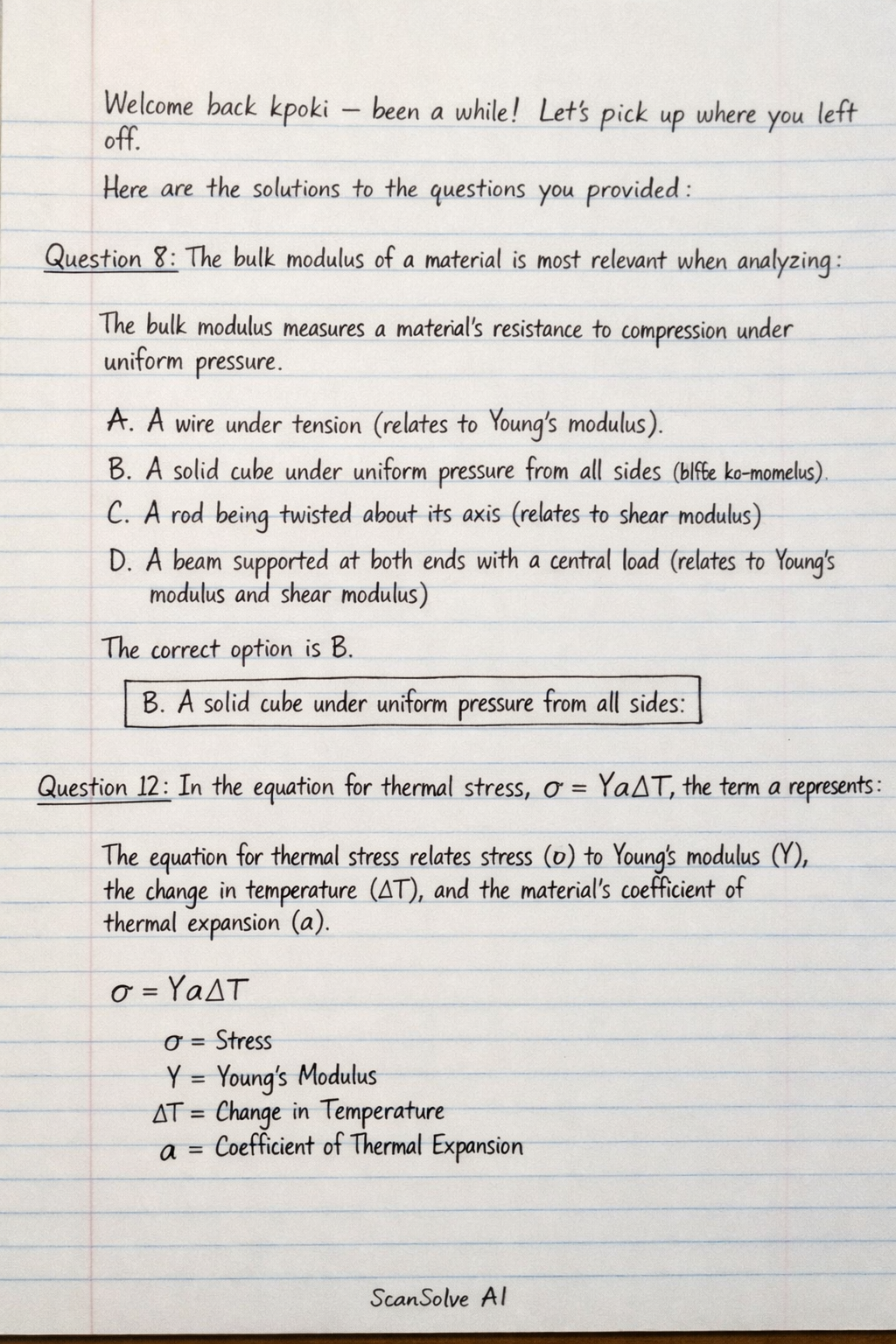
Here are the solutions to the questions you provided:
Question 8: The bulk modulus of a material is most relevant when analyzing:
The bulk modulus measures a material's resistance to compression under uniform pressure.
- A. A wire under tension (relates to Young's modulus)
- B. A solid cube under uniform pressure from all sides (relates to bulk modulus)
- C. A rod being twisted about its axis (relates to shear modulus)
- D. A beam supported at both ends with a central load (relates to Young's modulus and shear modulus)
The correct option is B.
Question 12: In the equation for thermal stress, , the term represents:
The equation for thermal stress relates stress () to Young's modulus (), the change in temperature (), and the material's coefficient of thermal expansion ().
- A. Coefficient of friction
- B. Coefficient of linear expansion
- C. Thermal conductivity
- D. Specific heat capacity
The correct option is B.
Question 11: A bone with Young's modulus has a minimum effective cross-sectional area of . If a force exceeding this causes fracture, what is the maximum force the bone can withstand?
Assumption: The Young's modulus given is intended to be used as the ultimate tensile strength (fracture stress) for the purpose of this problem, despite it being a measure of stiffness.
Step 1: Convert the cross-sectional area to square meters.
Step 2: Use the formula for stress, , to find the maximum force .
Substitute the given values, using Young's modulus as the fracture stress.
Still stuck on this one?
Ask a follow-up, and the answer starts from this question.
More Geography Questions
Handwritten Step-by-Step Solution
Get this as a handwritten image on WhatsApp — like a tutor wrote it for you.
Try on WhatsApp