
We read your photo as:
The benefits of the policy of District Focus for Rural Development (DFRD) in Kenya include:
ScanSolve AI Answer
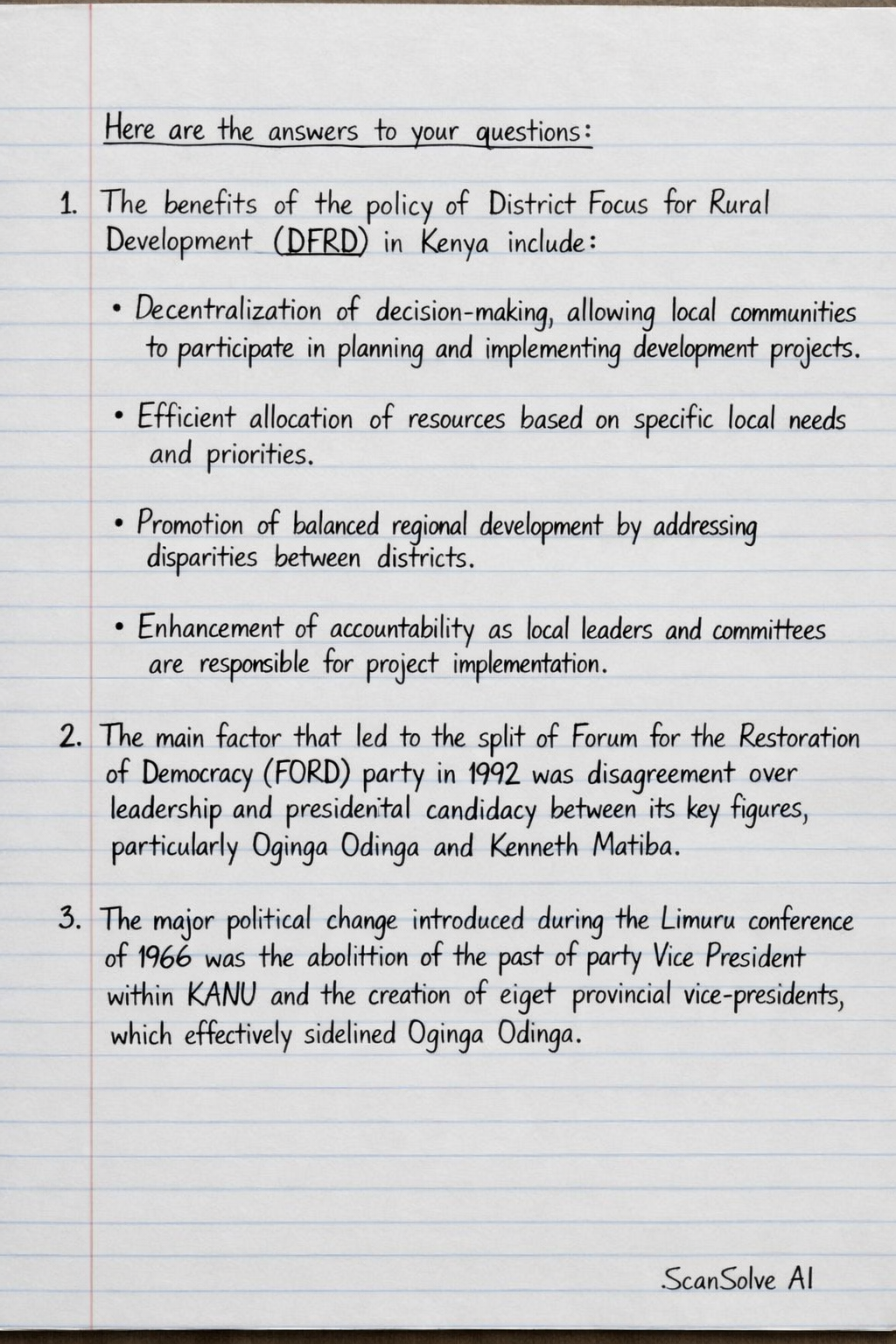
Here are the answers to your questions:
-
The benefits of the policy of District Focus for Rural Development (DFRD) in Kenya include:
- Decentralization of decision-making, allowing local communities to participate in planning and implementing development projects.
- Efficient allocation of resources based on specific local needs and priorities.
- Promotion of balanced regional development by addressing disparities between districts.
- Enhancement of accountability as local leaders and committees are responsible for project implementation.
-
The main factor that led to the split of the Forum for the Restoration of Democracy (FORD) party in 1992 was disagreement over leadership and presidential candidacy between its key figures, particularly Oginga Odinga and Kenneth Matiba.
-
The major political change introduced during the Limuru conference of 1966 was the abolition of the post of party Vice President within KANU and the creation of eight provincial vice-presidents, which effectively sidelined Oginga Odinga.
-
Five ways the government has attempted to preserve cultural heritage in Kenya since independence are:
- Establishing and funding national museums and cultural centers to collect, preserve, and display artifacts.
- Promoting national languages (Kiswahili) through education and media.
- Organizing and supporting national cultural festivals and events to showcase traditional music, dance, and arts.
- Including cultural studies and traditional practices in the school curriculum.
- Enacting legislation to protect historical sites and monuments.
-
The co-operative movement has played a significant role in promoting national development in Kenya since 1963 by:
- Mobilizing savings and providing credit to members, especially farmers, enabling them to invest in their enterprises.
- Facilitating the marketing of agricultural produce, ensuring farmers get better prices for their goods and reducing exploitation by middlemen.
- Creating employment opportunities in various sectors, including agriculture, processing, and retail.
- Improving the living standards of members through access to essential services and goods at fair prices.
- Promoting self-reliance and collective action among communities for economic empowerment.
-
The main role of opposition parties in Kenya is to provide checks and balances on the government, hold the ruling party accountable, offer alternative policies and solutions, and represent the interests of various segments of the population.
Still stuck on this one?
Ask a follow-up, and the answer starts from this question.
More Geography Questions
Handwritten Step-by-Step Solution
Get this as a handwritten image on WhatsApp — like a tutor wrote it for you.
Try on WhatsApp