
We read your photo as:
Discuss the strategies for improving urban development in Kenya.
ScanSolve AI Answer
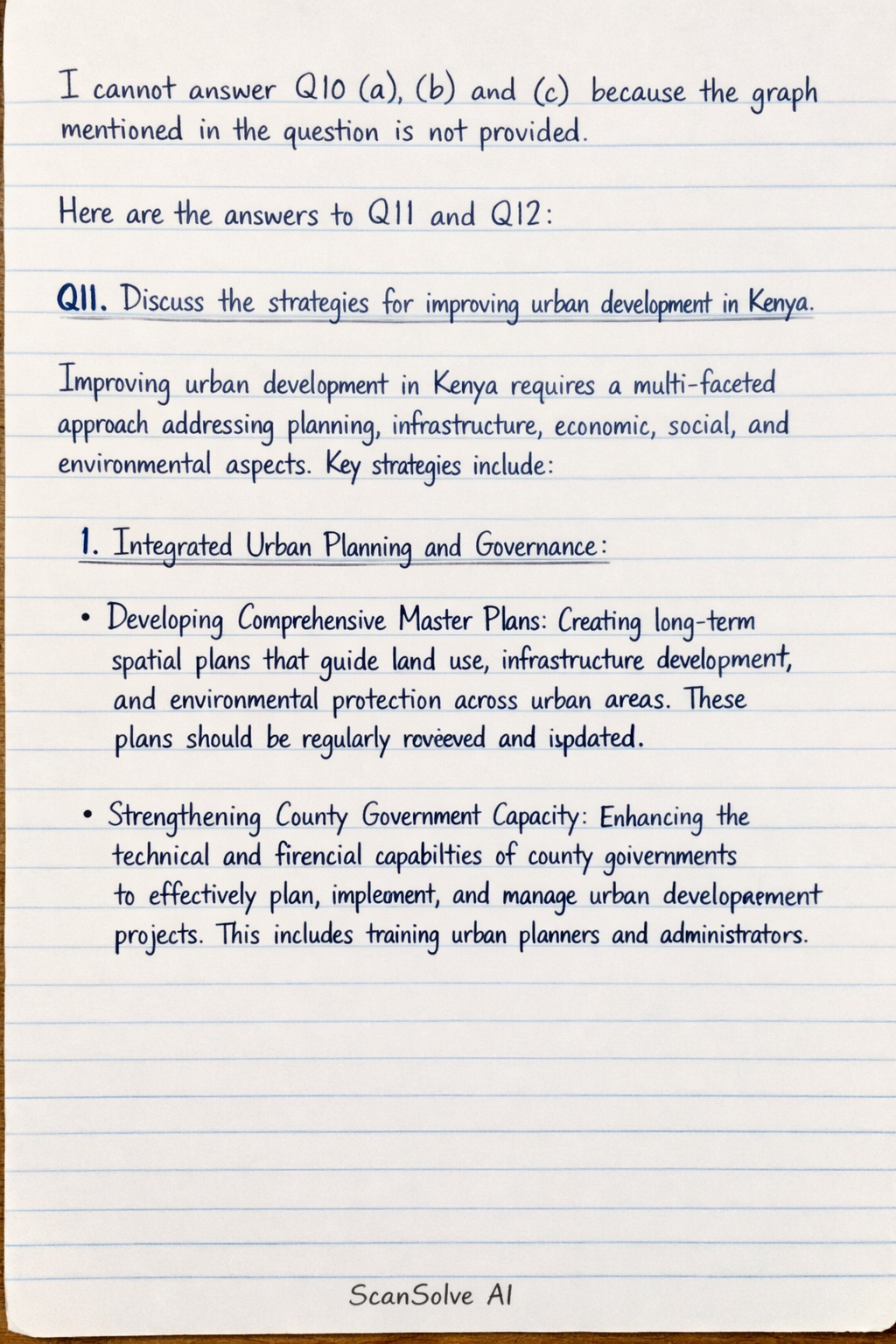
I cannot answer Q10 (a), (b), and (c) because the graph mentioned in the question is not provided.
Here are the answers to Q11 and Q12:
Q11. Discuss the strategies for improving urban development in Kenya.
Improving urban development in Kenya requires a multi-faceted approach addressing planning, infrastructure, economic, social, and environmental aspects. Key strategies include:
-
Integrated Urban Planning and Governance:
- Developing Comprehensive Master Plans: Creating long-term spatial plans that guide land use, infrastructure development, and environmental protection across urban areas. These plans should be regularly reviewed and updated.
- Strengthening County Government Capacity: Enhancing the technical and financial capabilities of county governments to effectively plan, implement, and manage urban development projects. This includes training urban planners and administrators.
- Promoting Participatory Planning: Involving local communities, civil society, and the private sector in the planning process to ensure that development initiatives are responsive to local needs and priorities.
-
Sustainable Infrastructure Development:
- Investing in Affordable Housing: Implementing policies and programs to increase the supply of affordable and adequate housing, particularly for low-income populations, to reduce the growth of informal settlements.
- Developing Efficient Public Transport Systems: Investing in reliable, affordable, and environmentally friendly public transport (e.g., bus rapid transit, commuter rail) to reduce traffic congestion and air pollution.
- Improving Water, Sanitation, and Waste Management: Expanding access to piped water, sewerage systems, and efficient solid waste collection and disposal services to enhance public health and environmental quality. This includes promoting recycling and waste-to-energy initiatives.
- Enhancing Energy Infrastructure: Investing in reliable and sustainable energy sources, including renewable energy, to power urban growth and reduce reliance on fossil fuels.
-
Economic Development and Job Creation:
- Supporting Small and Medium Enterprises (SMEs): Creating an enabling environment for SMEs through access to finance, training, and market linkages, as they are significant drivers of urban employment.
- Attracting Investment: Implementing policies that attract both domestic and foreign direct investment into urban areas, focusing on sectors that create jobs and foster innovation.
- Developing Urban Agriculture: Promoting urban and peri-urban agriculture to enhance food security, create livelihoods, and green urban spaces.
-
Social Inclusion and Service Delivery:
- Upgrading Informal Settlements: Implementing slum upgrading programs that provide basic services (water, sanitation, electricity, roads), improve housing, and regularize land tenure for residents of informal settlements.
- Improving Access to Social Services: Ensuring equitable access to quality education, healthcare facilities, and recreational spaces for all urban residents, regardless of their socio-economic status.
- Enhancing Public Safety and Security: Implementing community policing initiatives and improving urban design to create safer public spaces and reduce crime rates.
-
Environmental Sustainability and Resilience:
- Protecting Green Spaces and Biodiversity: Conserving and expanding urban green spaces, parks, and natural habitats to improve air quality, provide recreational areas, and enhance urban biodiversity.
- Implementing Pollution Control Measures: Enforcing regulations to control air, water, and noise pollution from industrial, commercial, and residential sources.
- Building Climate Change Resilience: Integrating climate change adaptation and mitigation strategies into urban planning, such as developing resilient infrastructure and promoting renewable energy.
Q12. Discuss sustainable development of both urban and rural areas by highlighting the salient features that are relevant to this concept.
Sustainable development is defined as development that meets the needs of the present without compromising the ability of future generations to meet their own needs. It is guided by three interconnected pillars: environmental protection, social equity, and economic viability.
Salient Features of Sustainable Development (General):
- Intergenerational Equity: Ensuring that current development does not deplete resources or degrade the environment to the detriment of future generations.
- Intragenerational Equity: Addressing inequalities within the current generation, ensuring fair access to resources and opportunities for all people.
- Integration of Pillars: Recognizing that economic growth, social progress, and environmental protection are interdependent and must be pursued simultaneously, not in isolation.
- Resource Efficiency: Promoting the efficient use of natural resources, reducing waste, and encouraging reuse and recycling.
- Precautionary Principle: Taking preventive action in the face of uncertainty about potential environmental harm.
- Participation and Governance: Emphasizing the importance of inclusive decision-making processes and good governance that involves all stakeholders.
Sustainable Development in Urban Areas (Relevant Features):
- Green Infrastructure: Integrating natural systems like parks, green roofs, and urban forests into city planning to improve air quality, manage stormwater, and enhance biodiversity.
- Sustainable Transport Systems: Prioritizing public transport, cycling, and walking over private car use to reduce emissions, congestion, and promote healthier lifestyles.
- Resource Management: Implementing strategies for efficient water use, waste reduction (e.g., recycling, composting), and transitioning to renewable energy sources for urban consumption.
- Mixed-Use Development and Compact Cities: Designing cities with a mix of residential, commercial, and recreational spaces to reduce commuting distances, foster community, and minimize urban sprawl.
- Affordable and Resilient Housing: Ensuring access to safe, affordable, and climate-resilient housing for all residents, including those in informal settlements.
- Pollution Control: Strict regulations and technologies to minimize air, water, and noise pollution from industrial and domestic sources.
Sustainable Development in Rural Areas (Relevant Features):
- Sustainable Agriculture and Land Management: Promoting farming practices that conserve soil fertility, minimize water use, reduce chemical inputs, and protect biodiversity (e.g., agroforestry, organic farming).
- Conservation of Natural Resources: Protecting forests, wetlands, water bodies, and wildlife habitats through community-based conservation, protected areas, and sustainable resource extraction.
- Diversification of Rural Economies: Moving beyond reliance on single agricultural crops by promoting ecotourism, small-scale industries, and value addition to agricultural products to create diverse income streams.
- Access to Basic Services: Ensuring rural communities have access to clean water, sanitation, healthcare, education, and reliable energy (often through decentralized renewable energy solutions).
- Community Empowerment and Local Governance: Strengthening local institutions and empowering communities to manage their natural resources and participate in development planning.
- Climate Change Adaptation: Implementing strategies to help rural communities adapt to the impacts of climate change on agriculture and livelihoods, such as drought-resistant crops and improved water harvesting.
Still stuck on this one?
Ask a follow-up, and the answer starts from this question.
More Geography Questions
Handwritten Step-by-Step Solution
Get this as a handwritten image on WhatsApp — like a tutor wrote it for you.
Try on WhatsApp