
We read your photo as:
A) A cross section of the area shown on the map between grid references 145550 and 160500; and on it mark and name the relief features, drainage features and land use types.
Geography
ScanSolve AI Answer
Here are the answers to your questions:
a) A cross section of the area shown on the map between grid references 145550 and 160500; and on it mark and name the relief features, drainage features and land use types.
- To accurately draw a cross-section and mark specific features, the map extract is required. Without the map, it is impossible to determine the exact elevation changes, drainage patterns, and land use types along the specified grid reference line.
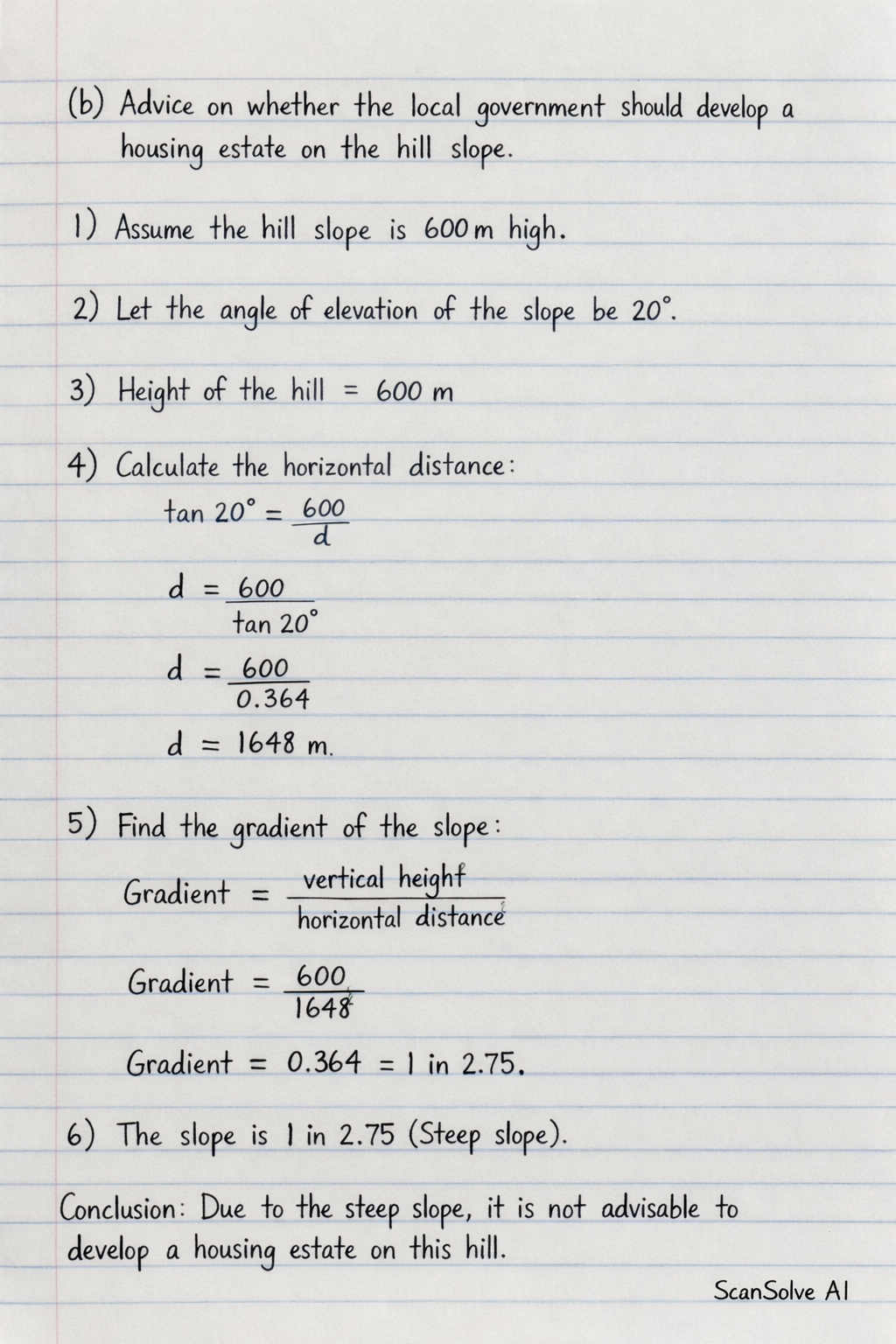
b) Advice, based on the cross section you have drawn, on whether the Local government should go ahead to develop a housing estate on this hill slope or not.
- Given the context of Kyamushumi Hill and the previous mention of recent landslides due to heavy rainfall, it is generally not advisable for the Local Government to proceed with developing a housing estate on this hill slope without extensive preliminary studies and robust mitigation measures. Hill slopes, especially those with a history of landslides, are inherently unstable. Development would expose residents and property to significant risks from landslides, erosion, and flash floods.
- Recommendation: The Local Government should not proceed with the housing estate development until a comprehensive geotechnical survey and environmental impact assessment are completed. These studies would determine the precise stability of the slopes, identify specific high-risk zones, and outline feasible engineering and ecological solutions to ensure safety. If the risks are deemed too high or mitigation costs prohibitive, the development should be reconsidered or relocated.
c) Possible measures which can be taken to reduce the occurrence of any one natural hazard that can affect the area shown on the map as a result of its relief.
- Let's focus on landslides as a natural hazard, which is common in hilly areas with steep relief.
- Slope Stabilization Techniques: Implement engineering solutions such as constructing retaining walls (e.g., gabion walls, reinforced concrete walls) at the toe or along unstable sections of the slope to prevent soil movement. Terracing can also be used to reduce the effective slope angle and slow down runoff.
- Drainage Management: Install effective surface and subsurface drainage systems (e.g., culverts, French drains, interceptor ditches) to divert water away from critical slopes and prevent soil saturation, which significantly reduces soil shear strength and triggers landslides.
- Vegetation Cover: Promote afforestation and revegetation with deep-rooted plant species (e.g., trees, shrubs) on unstable slopes. The root systems bind the soil together, increasing its stability and reducing erosion.
- Avoidance of High-Risk Areas: Strictly enforce land-use zoning to prohibit construction on very steep slopes or areas identified as highly susceptible to landslides based on geological and geotechnical surveys.
- Proper Grading and Excavation: Ensure that any necessary grading or excavation for construction is done carefully, following engineering guidelines to avoid destabilizing the natural slope profile.
Was this helpful?
Still stuck on this one?
Ask a follow-up, and the answer starts from this question.
Got a different question?Ask your own question
More Geography Questions
QUsing appropriate diagrams, illustrate the relief of the area from grid reference 580500 to 640450.QUsing the provided geological map, identify the feature with a N-S trend and the feature centered at…QOn the provided topographic map, draw a cross-section of the land along the line AB, indicating key…QWhat geological feature is located at grid reference 540895 on the map, and what is the reason for…QDraw a simple sketch map of Nakasongola between Eastings 37 and 44 Northings 40 and 50, and on it…
Handwritten Step-by-Step Solution
Get this as a handwritten image on WhatsApp — like a tutor wrote it for you.
Try on WhatsApp