
We read your photo as:
A) A soil profile is a vertical cross-section of the soil, showing the different layers or horizons from the surface down to the parent material.
Geography
ScanSolve AI Answer
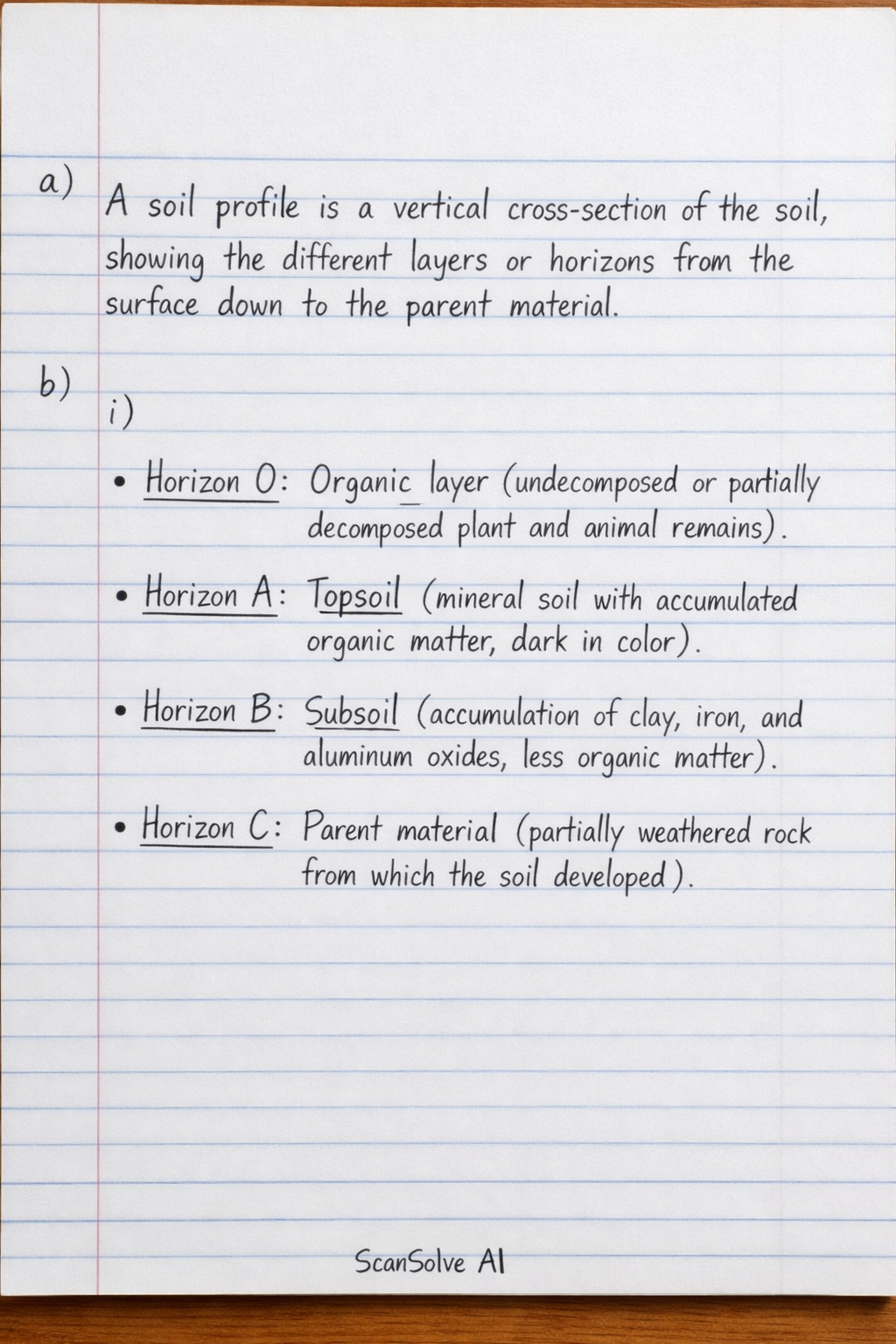
a) A soil profile is a vertical cross-section of the soil, showing the different layers or horizons from the surface down to the parent material.
b)
i)
- Horizon O: Organic layer (undecomposed or partially decomposed plant and animal remains).
- Horizon A: Topsoil (mineral soil with accumulated organic matter, dark in color).
- Horizon B: Subsoil (accumulation of clay, iron, and aluminum oxides, less organic matter).
- Horizon C: Parent material (partially weathered rock from which the soil developed).
ii) The horizons are important in crop production because:
- Horizon O provides organic matter that decomposes into humus, enriching the soil with nutrients and improving its structure.
- Horizon A (topsoil) is the most fertile layer, rich in nutrients and microorganisms, where most plant roots grow and absorb water and minerals essential for crop growth.
- Horizon B (subsoil) stores water and some nutrients, providing a reservoir for plant roots during dry periods and offering anchorage.
- Horizon C (parent material) is the source of minerals that become available to the upper horizons as it weathers, contributing to long-term soil fertility.
- Sheila and Geoffrey may have discussed the following benefits of various soil properties in crop production:
- Good soil texture (e.g., loamy soil) ensures a balance of water retention and drainage, providing adequate moisture and aeration for roots.
- High organic matter content improves soil fertility by releasing nutrients, enhances water-holding capacity, and promotes good soil structure, making it easier for roots to penetrate.
- Appropriate soil pH ensures that essential nutrients are available for plant uptake, as extreme pH levels can lock up nutrients.
- Good soil structure allows for proper aeration, which is vital for root respiration, and facilitates water infiltration, reducing runoff and erosion.
- Adequate drainage prevents waterlogging, which can suffocate roots and lead to crop failure, while sufficient water retention ensures plants have access to moisture.
- To show that soil has living organisms using the provided materials:
- Spread the soil sample thinly on the white sheet of paper.
- Use the stick to gently break apart any large clumps of soil.
- Carefully observe the soil with your naked eye, then use the hand lens to magnify and examine smaller particles.
- Look for any movement or visible organisms such as earthworms, insects, mites, or other small invertebrates within the soil sample. The white paper provides a clear contrast to easily spot these organisms.
Was this helpful?
Still stuck on this one?
Ask a follow-up, and the answer starts from this question.
Got a different question?Ask your own question
More Geography Questions
QWhat is a soil profile? (10 marks)QSoil profile in detailQDifferent type of soil profileQWith reference to a name major soil type, explain the formation of its profile.QA diagram shows a soil profile with labels I, II, III, IV representing different horizons. Answer…
Browse by topic:Earth Science
Handwritten Step-by-Step Solution
Get this as a handwritten image on WhatsApp — like a tutor wrote it for you.
Try on WhatsApp