
We read your photo as:
A. i. What do you understand by Natural Environment? a. ii. What do you understand by Environmental Degradation? b. What is the importance of the natural environment to man? c. Outline ways in which m
ScanSolve AI Answer
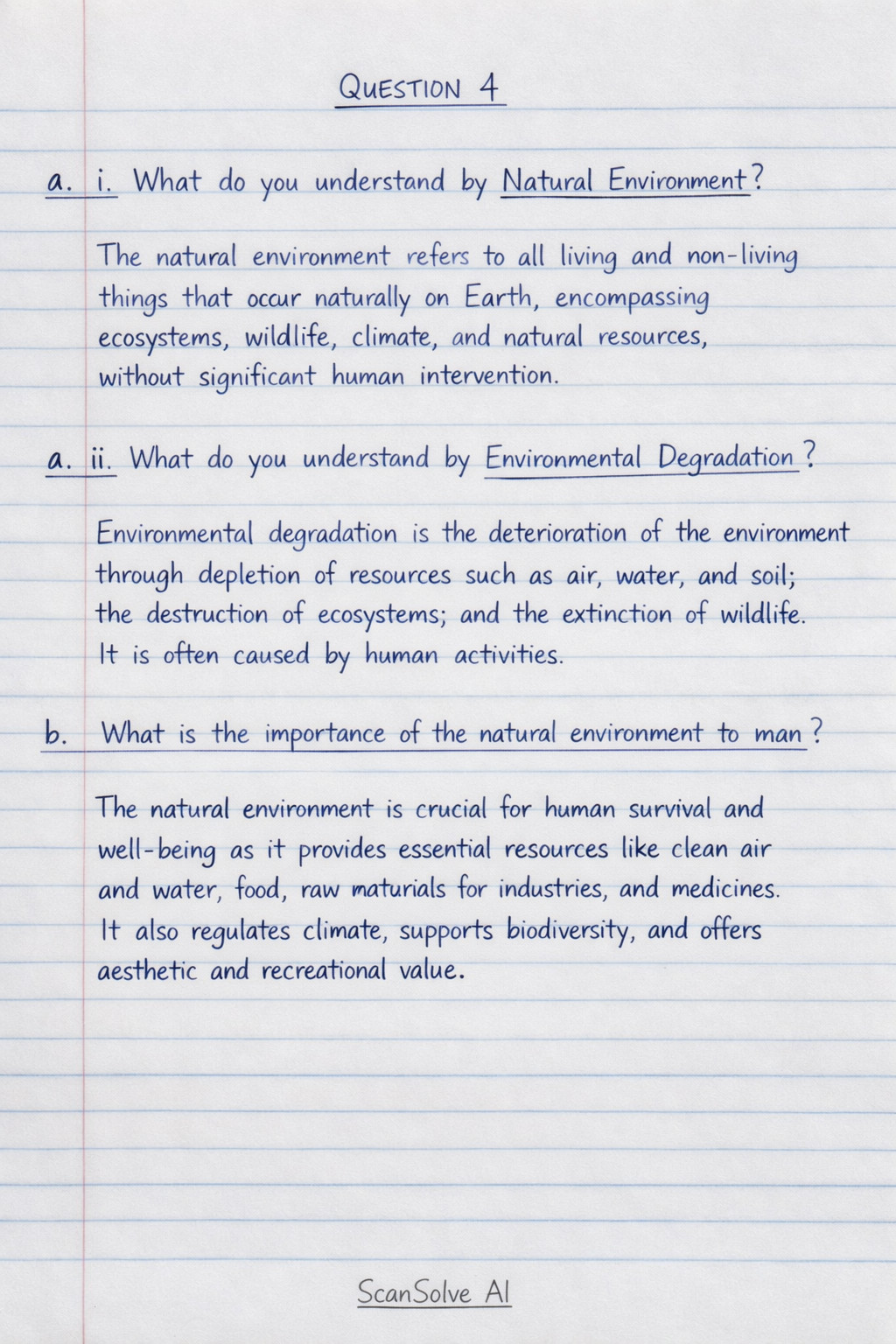
QUESTION 4
a. i. What do you understand by Natural Environment?
The natural environment refers to all living and non-living things that occur naturally on Earth, encompassing ecosystems, wildlife, climate, and natural resources, without significant human intervention.
a. ii. What do you understand by Environmental Degradation?
Environmental degradation is the deterioration of the environment through depletion of resources such as air, water, and soil; the destruction of ecosystems; and the extinction of wildlife. It is often caused by human activities.
b. What is the importance of the natural environment to man?
The natural environment is crucial for human survival and well-being as it provides essential resources like clean air and water, food, raw materials for industries, and medicines. It also regulates climate, supports biodiversity, and offers aesthetic and recreational value.
c. Outline ways in which man can protect and preserve the natural environment.
- Afforestation and Reforestation: Planting new trees and replanting deforested areas to combat soil erosion, regulate climate, and provide habitats.
- Waste Management: Implementing proper waste disposal, recycling, and reducing consumption to minimize pollution and resource depletion.
- Conservation of Biodiversity: Protecting endangered species and their habitats through national parks, wildlife reserves, and anti-poaching laws.
- Sustainable Resource Use: Utilizing natural resources at a rate that allows them to replenish, ensuring their availability for future generations.
- Pollution Control: Enforcing regulations to reduce air, water, and soil pollution from industrial, agricultural, and domestic sources.
- Environmental Education: Raising awareness among the public about environmental issues and the importance of conservation.
QUESTION 5
a. What are the Principles of Democracy?
- Rule of Law: All citizens, including those in power, are subject to and accountable under the law.
- Popular Sovereignty: The ultimate authority rests with the people, who exercise it through elected representatives.
- Equality: All citizens are equal before the law and have equal opportunities.
- Human Rights: Fundamental rights and freedoms of individuals are protected and respected.
- Free and Fair Elections: Citizens have the right to choose their leaders through regular, competitive, and transparent elections.
- Separation of Powers: Government powers are divided among legislative, executive, and judicial branches to prevent abuse of power.
b. State some of the factors that promote national integration in Cameroon.
- National Symbols: Shared national flag, anthem, and coat of arms foster a sense of common identity.
- Official Languages: English and French serve as unifying languages across diverse linguistic groups.
- National Institutions: Common government structures, educational systems, and legal frameworks bind the nation.
- Inter-ethnic Marriages: Marriages between individuals from different ethnic groups promote cultural exchange and understanding.
- Sports and Culture: National sports teams and cultural events bring people together and foster a sense of shared pride.
- Infrastructure Development: Roads, railways, and communication networks connect different regions, facilitating interaction and trade.
c. Outline some of the obstacles to national integration.
- Ethnicism/Tribalism: Strong loyalty to one's ethnic group over the nation, leading to discrimination and division.
- Regionalism: Prioritizing regional interests over national interests, often fueled by perceived imbalances in development or representation.
- Corruption: Undermines trust in public institutions and creates a sense of injustice, leading to disunity.
- Economic Disparities: Uneven distribution of wealth and development across regions can cause resentment and alienation.
- Political Exclusion: Perceived marginalization of certain groups from political power or decision-making processes.
- Language Barriers: While official languages exist, the multitude of local languages can still pose communication challenges and reinforce group identities.
QUESTION 6
a. Identify and describe three (03) different types of elections organized by the State in Cameroon.
- Presidential Elections: These are held to elect the President of the Republic, who serves as the Head of State and Government. The President is elected by direct universal suffrage for a seven-year term, renewable.
- Legislative Elections: These elections are for members of the National Assembly, the lower house of Parliament. Deputies are elected by direct universal suffrage to represent constituencies and legislate laws.
- Municipal Elections: These are local elections held to elect municipal councilors who then elect Mayors and their deputies to manage local affairs within communes. They are crucial for local governance and development.
- Senatorial Elections: These are held to elect members of the Senate, the upper house of Parliament. Senators are elected by indirect universal suffrage by regional and municipal councilors, with some appointed by the President.
b. Explain the weaknesses of the Cameroon electoral system.
- Lack of Transparency: The electoral process often lacks full transparency, leading to suspicions of irregularities and manipulation.
- Voter Apathy: Many citizens are disillusioned with the electoral process, resulting in low voter turnout.
- Unequal Access to Media: Opposition parties often have limited access to state-controlled media, giving an unfair advantage to the ruling party during campaigns.
- Allegations of Fraud: Persistent accusations of ballot stuffing, voter registration irregularities, and vote count manipulation undermine public confidence.
- Weak Independent Electoral Body: While ELECAM is constitutionally independent, its perceived lack of autonomy and effectiveness in addressing electoral malpractices is a concern.
- Funding Disparities: Political parties often face significant disparities in funding, which impacts their ability to campaign effectively.
c. What are the effects of electoral malpractice?
- Loss of Public Trust: Malpractice erodes citizens' faith in the democratic process and government institutions.
- Political Instability: Disputed election results can lead to protests, violence, and civil unrest.
- Illegitimate Government: A government that comes to power through fraudulent means lacks legitimacy in the eyes of its citizens and the international community.
- Reduced Citizen Participation: Disillusionment with rigged elections can lead to voter apathy and a decline in political engagement.
- Undermining Democracy: Electoral malpractice fundamentally subverts the principles of democracy, such as free choice and popular sovereignty.
- Corruption: Malpractice is often linked to broader corruption, as it involves illegal activities and abuse of power.
QUESTION 7
a. i. What do you understand by Economic growth?
Economic growth refers to the increase in the production of economic goods and services in an economy over a period of time, typically measured by the percentage rate of increase in real Gross Domestic Product (GDP).
a. ii. What do you understand by Economic development?
Economic development is a broader concept than economic growth, encompassing not only an increase in GDP but also improvements in the quality of life, living standards, education, health, infrastructure, and a reduction in poverty and inequality.
a. iii. What do you understand by Tax evasion?
Tax evasion is the illegal act of deliberately misrepresenting one's financial affairs to the tax authorities to reduce or avoid tax obligations, often by under-reporting income, overstating deductions, or hiding assets.
b. Explain consequences of tax evasion in an economy.
- Reduced Government Revenue: Tax evasion directly decreases the funds available to the government for public services like infrastructure, education, healthcare, and security.
- Increased Tax Burden on Compliant Citizens: To compensate for lost revenue, governments may increase taxes on those who comply, creating an unfair burden.
- Inequality: Tax evasion often benefits wealthier individuals or corporations, exacerbating income inequality and social injustice.
- Undermining Public Services: Insufficient government funds due to evasion can lead to a decline in the quality and availability of essential public services.
- Economic Instability: A significant loss of tax revenue can destabilize government finances and hinder economic planning and development.
- Corruption: Tax evasion can foster a culture of corruption and illegality within the economy.
c. What reasons may economic growth not lead to economic development?
- Unequal Distribution of Wealth: If economic growth primarily benefits a small segment of the population, it may not translate into improved living standards for the majority.
- Environmental Degradation: Growth achieved at the expense of the environment (e.g., deforestation, pollution) can harm public health and long-term sustainability, hindering true development.
- Lack of Investment in Human Capital: If growth is not accompanied by investments in education, healthcare, and skills training, the population's overall well-being and productivity may not improve.
- Corruption and Poor Governance: Funds generated by economic growth may be siphoned off through corruption or mismanaged due to poor governance, preventing them from being used for development projects.
- Over-reliance on a Single Sector: Economies heavily dependent on a single commodity (e.g., oil) can experience growth without diversified development, making them vulnerable to price fluctuations.
- High Population Growth: Rapid population growth can outpace economic growth, leading to a decline in per capita income and increased pressure on resources and services.
QUESTION 8
a. What are the various forms of gender-based violence on women in Cameroon?
- Physical Violence: Includes beating, slapping, kicking, burning, and other forms of bodily harm.
- Sexual Violence: Encompasses rape, sexual assault, forced prostitution, and sexual harassment.
- Psychological/Emotional Violence: Involves verbal abuse, intimidation, threats, humiliation, and isolation.
- Economic Violence: Denying women access to financial resources, property, employment, or education.
- Harmful Traditional Practices: Such as female genital mutilation (FGM), forced early marriage, and widow inheritance.
- Domestic Violence: Any of the above forms of violence occurring within the family or intimate relationships.
b. Describe some of the problems that are peculiar to women as a result of their gender.
- Limited Access to Education: Girls and women often face barriers to accessing education due to cultural norms, poverty, or early marriage, leading to lower literacy rates.
- Economic Disempowerment: Women often have fewer opportunities for formal employment, lower wages for similar work, and limited access to land or credit, leading to higher rates of poverty.
- Health Disparities: Women face specific health challenges related to reproductive health, maternal mortality, and higher vulnerability to certain diseases, often exacerbated by lack of access to quality healthcare.
- Political Underrepresentation: Women are often underrepresented in decision-making positions in government, traditional leadership, and other public spheres.
- Vulnerability to Violence: Women are disproportionately victims of gender-based violence, including domestic violence, sexual assault, and harmful traditional practices.
- Double Burden of Work: Women often bear the primary responsibility for household chores and childcare in addition to any paid work, leading to exhaustion and limited opportunities for personal development.
c. What measures have been put in place by the government to fight against gender inequality?
- Legal Reforms: Enacting and enforcing laws that protect women's rights, such as laws against gender-based violence, discrimination, and promoting equal inheritance rights.
- National Gender Policies: Developing and implementing national policies and strategies aimed at promoting gender equality in various sectors like education, health, and employment.
- Institutional Frameworks: Establishing ministries and commissions dedicated to women's empowerment and gender equality, such as the Ministry of Women's Empowerment and the Family (MINPROFF).
- Education and Awareness Campaigns: Promoting girls' education, conducting public awareness campaigns on gender equality, and challenging harmful stereotypes.
- Economic Empowerment Programs: Supporting women's entrepreneurship, providing access to microfinance, and promoting women's participation in economic activities.
- International Commitments: Ratifying and implementing international conventions and protocols related to women's rights, such as CEDAW (Convention on the Elimination of All Forms of Discrimination Against Women).
QUESTION 9
a. What are the favorable conditions necessary for peace to reign in a country?
- Good Governance and Rule of Law: Transparent, accountable, and inclusive governance that upholds justice and ensures all citizens are equal before the law.
- Economic Equity and Opportunity: Fair distribution of resources, equitable access to employment, education, and basic services, reducing disparities that fuel resentment.
- Respect for Human Rights: Protection and promotion of fundamental human rights and freedoms for all citizens, regardless of their background.
- Inclusive Political Participation: Mechanisms that allow all segments of society to participate meaningfully in political processes and decision-making.
- Social Cohesion and Tolerance: Promotion of mutual respect, understanding, and tolerance among different ethnic, religious, and cultural groups.
- Effective Conflict Resolution Mechanisms: Established and trusted systems for mediating disputes, addressing grievances, and resolving conflicts peacefully.
b. Outline the causes and effects of conflicts in some villages in Cameroon.
Causes of Conflicts:
- Land Disputes: Conflicts over ownership, boundaries, or access to fertile land and natural resources (e.g., water, forests).
- Chieftaincy Succession Disputes: Disagreements over who should inherit traditional leadership roles, often leading to power struggles.
- Ethnic and Tribal Rivalries: Historical animosities or competition for resources and political influence between different ethnic groups.
- Cattle Grazing Conflicts: Tensions between farmers and pastoralists over crop destruction by cattle and access to grazing lands.
- Political Interference: External political manipulation or partisan interests exacerbating local disputes.
- Resource Exploitation: Conflicts arising from the perceived unfair distribution of benefits or environmental damage from resource extraction projects.
Effects of Conflicts:
- Loss of Life and Injury: Direct casualties and physical harm to individuals involved in the conflict.
- Displacement of Populations: People are forced to flee their homes, becoming internally displaced persons (IDPs) or refugees.
- Destruction of Property: Homes, farms, and infrastructure are damaged or destroyed, leading to economic losses.
- Disruption of Livelihoods: Agricultural activities, trade, and other economic activities are halted, leading to food insecurity and poverty.
- Social Disintegration: Breakdown of community ties, trust, and social structures, leading to long-term divisions.
- Psychological Trauma: Individuals, especially women and children, suffer from lasting psychological and emotional distress.
QUESTION 10
a. What is globalization?
Globalization is the process of increasing interconnectedness and interdependence among countries worldwide, driven by the growing integration of economies, cultures, technologies, and governance through cross-border flows of goods, services, capital, people, and information.
b. State and explain the main features of globalization.
- Increased Trade and Economic Integration: Reduction of trade barriers and increased flow of goods, services, and capital across national borders, leading to a more integrated global economy.
- Technological Advancement: Rapid development and spread of information and communication technologies (ICTs) facilitate global communication, commerce, and cultural exchange.
- Cultural Homogenization and Hybridization: The spread of certain cultural elements (e.g., music, fashion, food) across the globe, sometimes leading to a blending of cultures or the dominance of one.
- Transnational Corporations (TNCs): The rise of large companies operating in multiple countries, influencing global production, employment, and economic policies.
- Global Governance and Institutions: The increasing role of international organizations (e.g., UN, WTO, IMF) in addressing global issues that transcend national borders.
- Increased Mobility of People: Greater movement of people across borders through migration, tourism, and labor mobility.
c. Outline the advantages and disadvantages of globalization in the world.
Advantages of Globalization:
- Economic Growth: Increased trade and investment can lead to higher economic growth, job creation, and improved living standards.
- Access to Goods and Services: Consumers gain access to a wider variety of goods and services at potentially lower prices due to international competition.
- Technological Transfer: Developing countries can benefit from the transfer of advanced technologies and knowledge from developed nations.
- Cultural Exchange: Globalization fosters greater understanding and appreciation of diverse cultures through increased interaction and communication.
- Poverty Reduction: In some cases, globalization has contributed to lifting millions out of poverty through increased economic opportunities.
- International Cooperation: Facilitates cooperation on global issues such as climate change, pandemics, and human rights.
Disadvantages of Globalization:
- Increased Inequality: Can exacerbate income inequality within and between countries, as benefits may not be evenly distributed.
- Job Displacement: Industries in developed countries may face job losses as companies move production to countries with lower labor costs.
- Cultural Erosion: The
Still stuck on this one?
Ask a follow-up, and the answer starts from this question.
More Geography Questions
Handwritten Step-by-Step Solution
Get this as a handwritten image on WhatsApp — like a tutor wrote it for you.
Try on WhatsApp