
We read your photo as:
A) The practice of reserving resources for future generation without any harm to the nature and other components of it is called sustainable development while environmental management is the pra
ScanSolve AI Answer
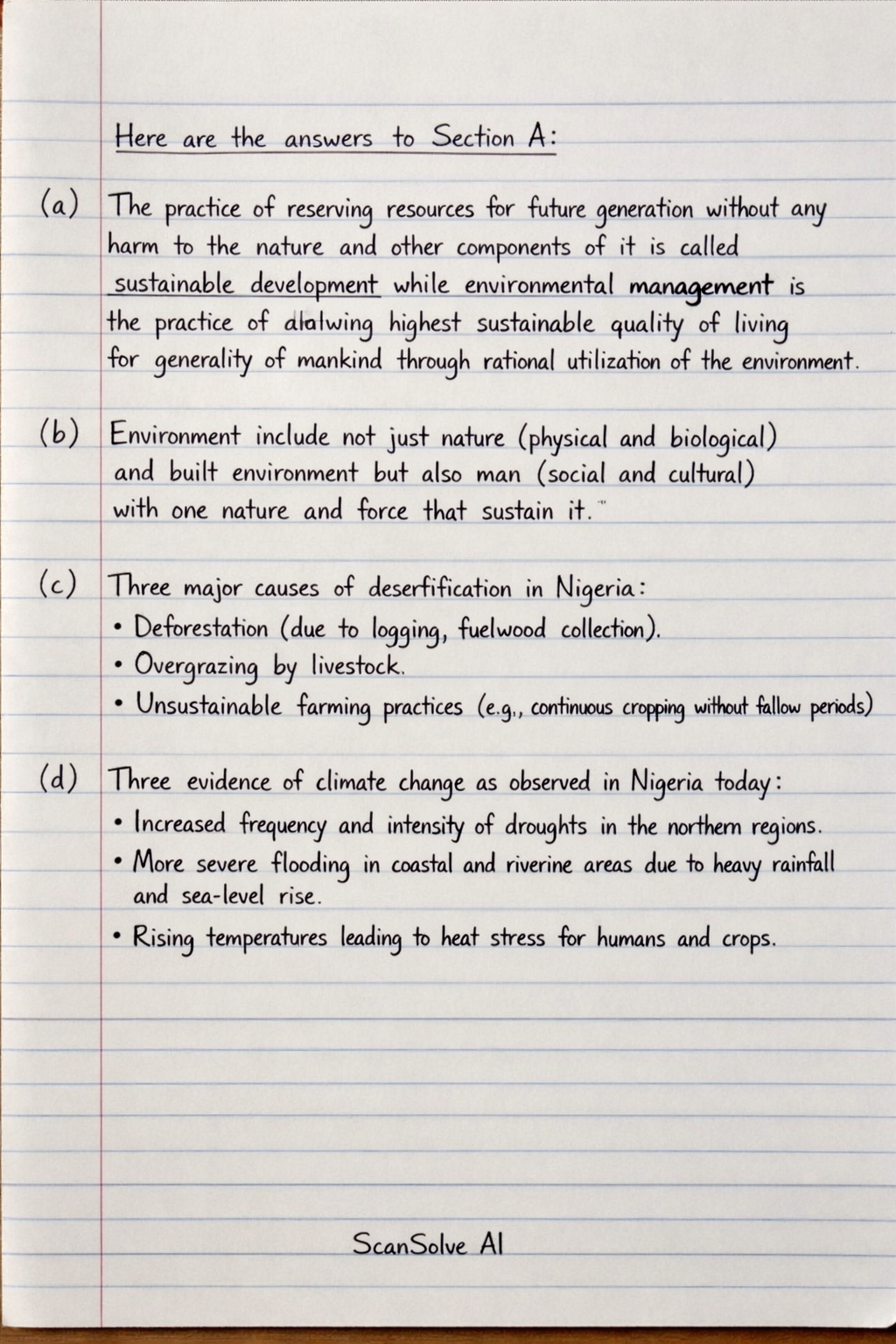
Here are the answers to Section A:
a) The practice of reserving resources for future generation without any harm to the nature and other components of it is called sustainable development while environmental management is the practice of achieving highest sustainable quality of living for generality of man land through rational utilization of the environment.
b) Environment include not just one nature (physical) and (biological) and built environment but also man (social) and (cultural) with one nature and force that sustain it.
c) Three major causes of desertification in Nigeria:
- Deforestation (due to logging, fuelwood collection)
- Overgrazing by livestock
- Unsustainable farming practices (e.g., continuous cropping without fallow periods)
d) Three evidence of climate change as observed in Nigeria today:
- Increased frequency and intensity of droughts in the northern regions.
- More severe flooding in coastal and riverine areas due to heavy rainfall and sea-level rise.
- Rising temperatures leading to heat stress for humans and crops.
e) Two benefits of coastal wetlands:
- They serve as habitats for diverse aquatic and terrestrial wildlife, including fish, birds, and invertebrates.
- They act as natural buffers against coastal erosion and storm surges, protecting inland areas.
f) Effects of climate change on agriculture:
- Reduced crop yields due to changes in temperature and rainfall patterns.
- Increased incidence of pests and diseases affecting crops and livestock.
- Water scarcity for irrigation in some regions, leading to crop failure.
- Soil degradation and erosion from extreme weather events.
g) Three categories or operations in practical silviculture:
- Regeneration: Establishing new tree stands through planting or natural seeding.
- Thinning: Selectively removing trees to improve growth and health of remaining trees.
- Pruning: Removing lower branches to improve timber quality.
h) Biodiversity of fresh means diversity of species and ecosystems.
i) The two major components of wildlife are flora and fauna.
j) Tolerance is the ability of an organism to live successfully without any adverse effect of change in environmental conditions while adaptation is the process of developing adaptive features to adopt to the environmental conditions in the new environment.
k) Ecology is the study of the interaction between individual organism and its environment while ethology is the study of animal behaviour in its natural environment.
l) General food relationship among major components of an ecosystem:
This flow represents the transfer of energy from one trophic level to the next, with decomposers breaking down dead organic matter from all levels.
m) Species is a group of individuals that exists together and interbreed to reproduce fertile individual while population is a group of individuals of the same specie that exist together in a particular place at a time.
n) Four regulating and supporting services of forest ecosystem:
- Climate regulation (carbon sequestration, temperature moderation)
- Water purification and regulation (filtering pollutants, regulating water flow)
- Soil formation and erosion control (preventing soil loss, building soil structure)
- Habitat provision (providing homes for diverse wildlife)
o) Two essential things forest provides us with:
- Timber and non-timber forest products (e.g., fuelwood, medicinal plants, food).
- Oxygen production and air purification.
Still stuck on this one?
Ask a follow-up, and the answer starts from this question.
More Geography Questions
Handwritten Step-by-Step Solution
Get this as a handwritten image on WhatsApp — like a tutor wrote it for you.
Try on WhatsApp