

This geography problem is solved step by step below, with detailed explanations to help you understand the method and arrive at the correct answer.
ScanSolve AI Answer
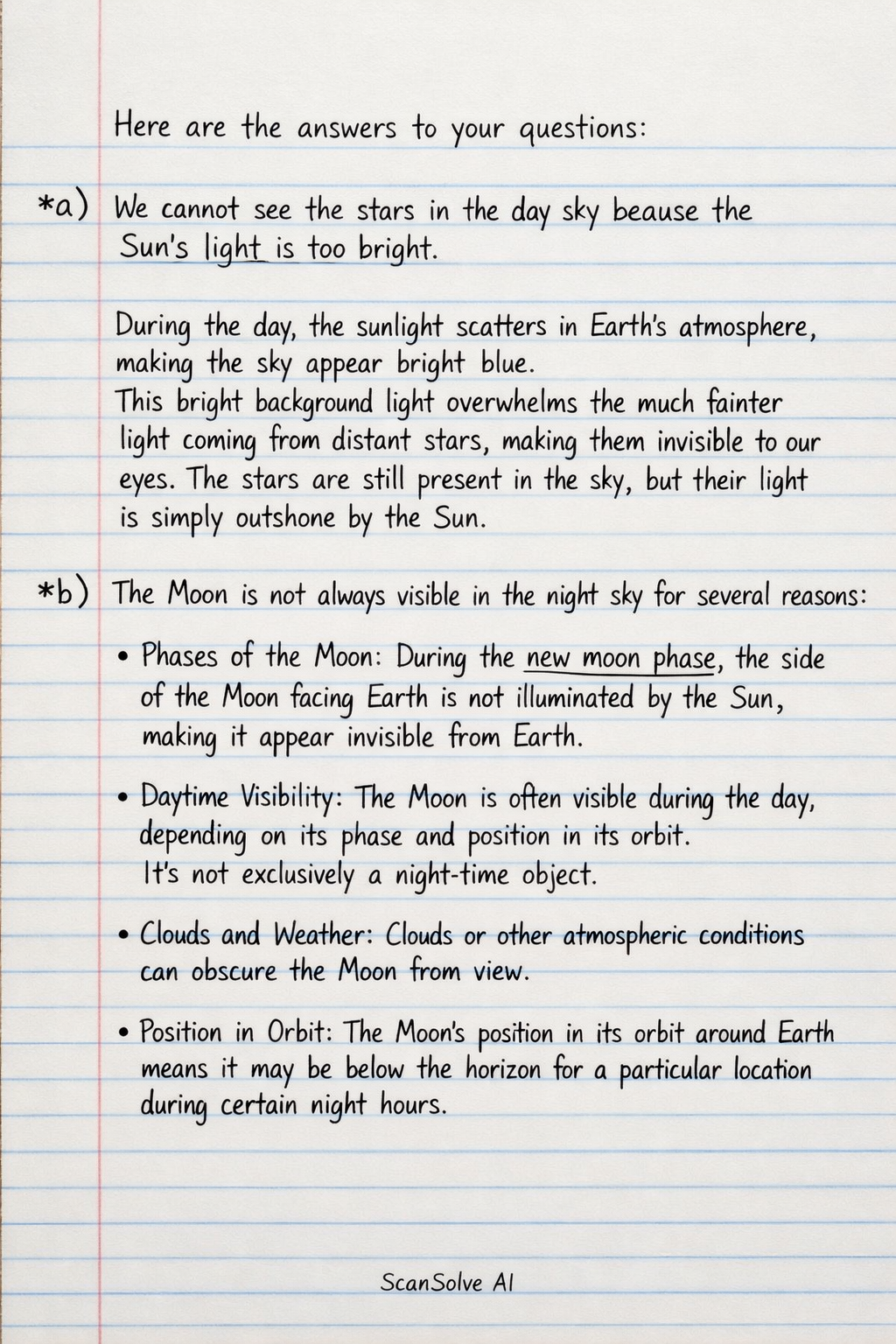
Here are the answers to your questions: a) We cannot see the stars in the day sky because the Sun's light is too bright. During the day, the sunlight scatters in Earth's atmosphere, making the sky appear bright blue. This bright background light overwhelms the much fainter light coming from distant stars, making them invisible to our eyes. The stars are still present in the sky, but their light is simply outshone by the Sun. b) The Moon is not always visible in the night sky for several reasons: • Phases of the Moon: During the new moon phase, the side of the Moon facing Earth is not illuminated by the Sun, making it appear invisible from Earth. • Daytime Visibility: The Moon is often visible during the day, depending on its phase and position in its orbit. It's not exclusively a night-time object. • Clouds and Weather: Clouds or other atmospheric conditions can obscure the Moon from view. • Position in Orbit: The Moon's position in its orbit around Earth means it may be below the horizon for a particular location during certain night hours. 3 done, 2 left today. You're making progress.