

This biology question covers important biological concepts and processes. The step-by-step explanation below helps you understand the underlying mechanisms and reasoning.
ScanSolve AI Answer
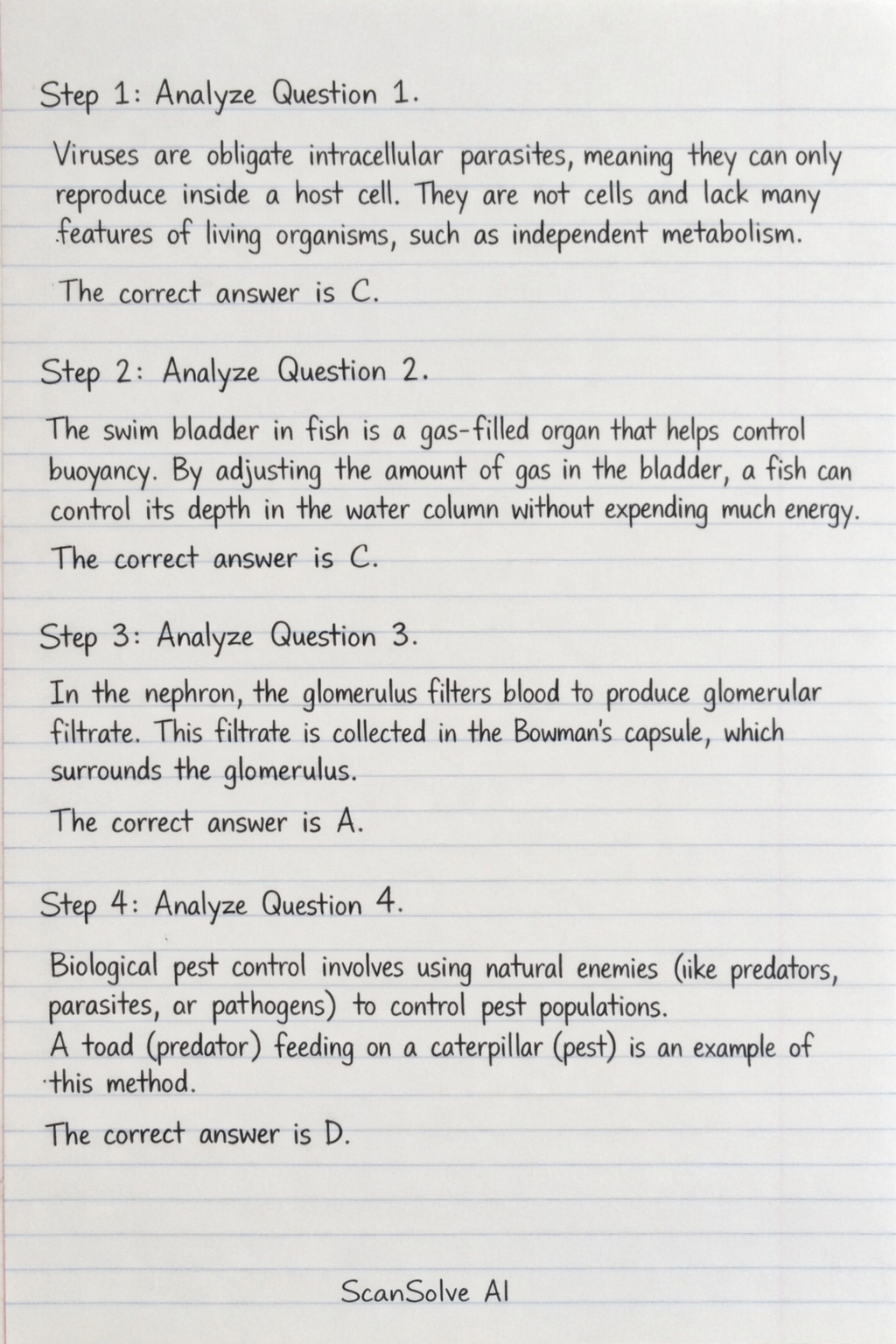
Step 1: Analyze Question 1. Viruses are obligate intracellular parasites, meaning they can only reproduce inside a host cell. They are not cells and lack many features of living organisms, such as independent metabolism. The correct answer is C. Step 2: Analyze Question 2. The swim bladder in fish is a gas-filled organ that helps control buoyancy. By adjusting the amount of gas in the bladder, a fish can control its depth in the water column without expending much energy. The correct answer is C. Step 3: Analyze Question 3. In the nephron, the glomerulus filters blood to produce glomerular filtrate. This filtrate is collected in the Bowman's capsule, which surrounds the glomerulus. The correct answer is A. Step 4: Analyze Question 4. Biological pest control involves using natural enemies (like predators, parasites, or pathogens) to control pest populations. A toad (predator) feeding on a caterpillar (pest) is an example of this method. The correct answer is D. Step 5: Analyze Question 5. In a food chain, primary consumers are herbivores that feed directly on producers (plants). The food chain is: Groundnut plant (producer) → Locust (primary consumer) → Frog (secondary consumer) → Snake (tertiary consumer) → Man (quaternary consumer, or can also be primary/secondary). The locust feeds on the groundnut plant, making it the primary consumer. The correct answer is C. Step 6: Analyze Question 6. Overfeeding, or consuming more calories than the body expends, leads to the accumulation of excess body fat, a condition known as obesity. The correct answer is B. Step 7: Analyze Question 7. A long-term shift in global or regional climate patterns, resulting in new weather patterns, is defined as climate change. Global warming is a component of climate change, and the greenhouse effect contributes to it. The correct answer is A. Step 8: Analyze Question 8. The left ventricle of the mammalian heart has thicker, more muscular walls because it is responsible for pumping oxygenated blood to the entire systemic circulation (all parts of the body except the lungs). This requires generating high pressure to overcome resistance and cover a long distance. The correct answer is A. Step 9: Analyze Question 9. Spinal nerves are mixed nerves, meaning they contain both afferent (sensory) fibers that carry impulses to the central nervous system (CNS) and efferent (motor) fibers that carry impulses away from the CNS. Therefore, a spinal nerve takes impulses both to and away from the central nervous system. The correct answer is C. Step 10: Analyze Question 10. In grafting, the scion is the upper part of the plant that is grafted onto the rootstock. The scion determines the characteristics of the shoot system, including the type and quality of fruits, flowers, or leaves produced. Therefore, the scion is chosen for the quality of its fruits (or other desired above-ground traits). The correct answer is B. Step 11: Analyze Question 11. The diagram shows a villus, an absorption structure in the small intestine. 1 points to a blood capillary. 2 points to the epithelial cells. 3 points to the lacteal, which is a lymphatic capillary. 4 points to the underlying blood vessels (arteriole/venule). Fatty acids and glycerol are absorbed by epithelial cells, re-esterified into triglycerides, packaged into chylomicrons, and then transported into the lacteal (lymphatic vessel) for entry into the lymphatic system. The correct answer is 3. Step 12: Analyze Question 12. The trachea, also known as the windpipe, is a flexible tube that extends from the larynx down into the chest, where it divides into the two main bronchi. The correct answer is A. The final answers are: 1. C 2. C 3. A 4. D 5. C 6. B 7. A 8. A 9. C 10. B 11. 3 12. A