

This geography problem is solved step by step below, with detailed explanations to help you understand the method and arrive at the correct answer.
ScanSolve AI Answer
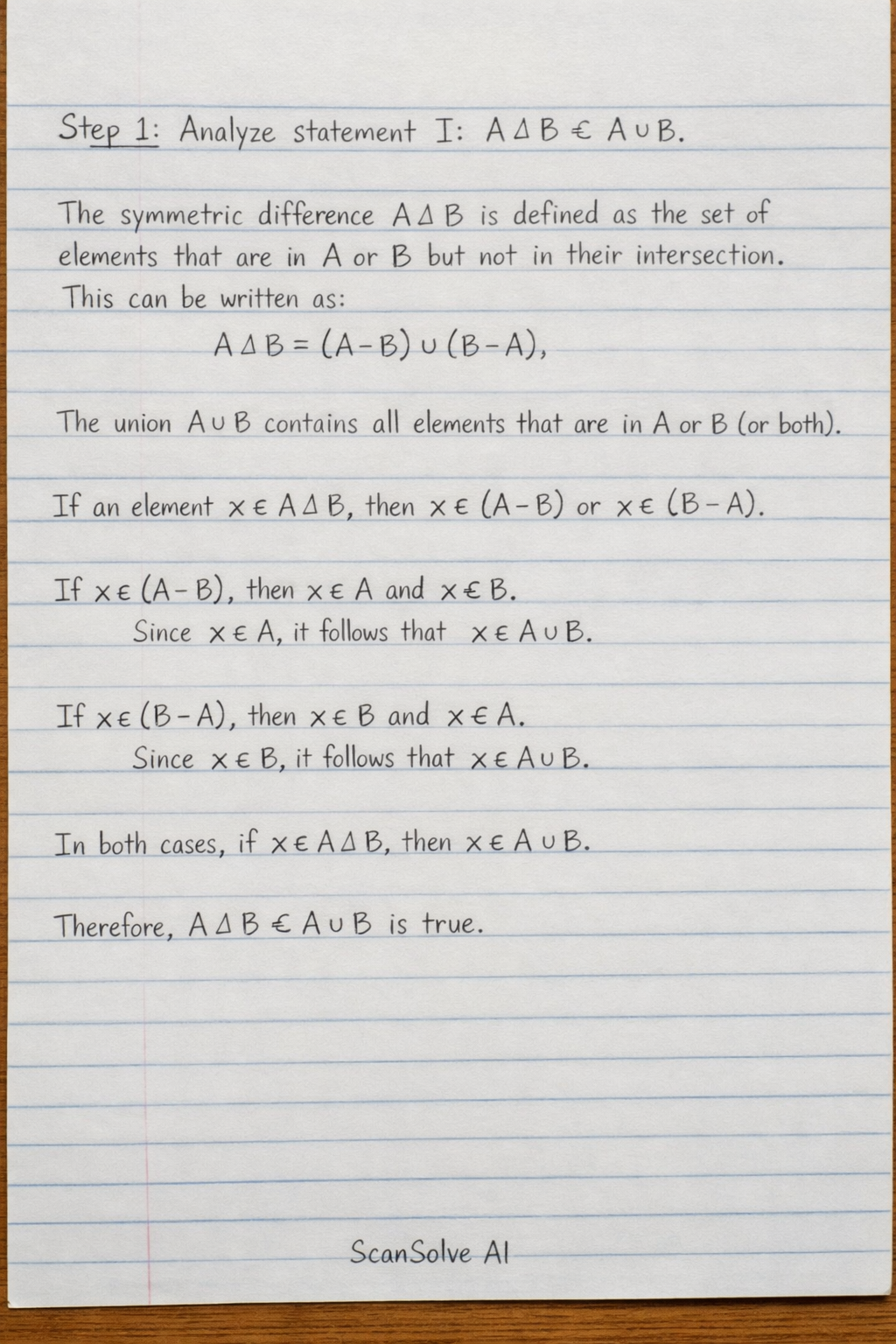
Step 1: Analyze statement I: A B A B. The symmetric difference A B is defined as the set of elements that are in A or B but not in their intersection. This can be written as A B = (A-B) (B-A). The union A B contains all elements that are in A or B (or both). If an element x A B, then x (A-B) or x (B-A). If x (A-B), then x A and x B. Since x A, it follows that x A B. If x (B-A), then x B and x A. Since x B, it follows that x A B. In both cases, if x A B, then x A B. Therefore, A B A B is true. Step 2: Analyze statement II: A B A B. The intersection A B contains elements that are common to both A and B. The symmetric difference A B contains elements that are in A or B, but not in both. This means A B = (A B) - (A B). If an element x A B, then x is in both A and B. By the definition of symmetric difference, x cannot be in A B. For example, let A = \1, 2\ and B = \2, 3\. Then A B = \2\. And A B = (A-B) (B-A) = \1\ \3\ = \1, 3\. Clearly, \2\ is not a subset of \1, 3\. Therefore, A B A B is false. Step 3: Analyze statement III: (A-B) A. The set difference A-B contains all elements that are in A but not in B. By definition, every element in A-B is an element of A. Therefore, (A-B) A is true. Step 4: Conclude which statements are true. Statements I and III are true. Step 5: Select the correct option. The option that states I and III are true is (D). The final answer is D Send me the next one 📸