
We read your photo as:
As a member of the Youth Advisory Committee, what solution would you propose for the public health and environmental crisis in Marula, considering the community's economic needs and cultural identity?
ScanSolve AI Answer
Step-by-step solution
4 stepsAs a member of the Youth Advisory Committee, I recognize the critical need to address the public health and environmental crisis in Marula while simultaneously respecting the community's deeply rooted economic needs and cultural identity. The government's proposed large-scale relocation, while well-intentioned, fails to acknowledge the vibrant, self-sustaining economy built around waste management that supports 5,000 people. A more sustainable and equitable solution involves transforming the existing informal economy into a formalized, safe, and environmentally sound operation in situ.
Addressing Respiratory Illnesses
The high rate of respiratory illness is directly linked to the uncontrolled landfill environment. Instead of displacement, we propose a multi-faceted approach to mitigate airborne pollutants.
- Improved Waste Management: Implement immediate measures for proper waste segregation at the source within Marula and surrounding areas. This reduces the volume of mixed waste at the landfill.
- Dust and Odor Control: Introduce regular covering of waste with soil or inert materials, and explore bio-filters or misting systems to suppress dust and odors.
- Protective Gear and Health Monitoring: Provide all residents working at the landfill with appropriate personal protective equipment (e.g., N95 masks, gloves). Establish a community health clinic offering regular respiratory screenings, education on preventative measures, and access to treatment.
- Green Buffer Zones: Plant dense vegetation belts around the landfill perimeter to act as natural filters, reducing the spread of dust and pollutants into residential areas.
Combating Water Contamination
Water contamination from landfill leachate poses a severe threat. Our plan focuses on preventing contamination and ensuring access to clean water.
- Landfill Infrastructure Upgrade: Advocate for the installation of impermeable liners and leachate collection and treatment systems at the landfill. This prevents toxic liquids from seeping into groundwater.
- Safe Water Sources: Develop and protect alternative, clean water sources for the community, such as boreholes with proper filtration or a community-managed water purification system.
- Community Education: Launch a public awareness campaign on safe water handling, storage, and the importance of boiling drinking water, especially during the transition period.
- Regular Water Testing: Implement a community-led water quality monitoring program with regular testing of all water sources to ensure safety and build trust.
Mitigating Fire Hazards
Frequent fire hazards are a direct consequence of uncontrolled waste accumulation and the presence of flammable materials.
- Waste Segregation and Compaction: Enforce strict segregation of highly flammable materials (e.g., plastics, textiles) at the collection point. Implement regular waste compaction to reduce oxygen flow and the risk of spontaneous combustion.
- Fire Breaks and Equipment: Establish clear fire breaks within the landfill area and ensure readily accessible fire-fighting equipment (e.g., water tanks, sand piles, basic extinguishers).
- Emergency Response Training: Train community members, particularly those working at the landfill, in basic fire prevention and emergency response procedures.
- Controlled Burning Alternatives: Explore safer, controlled methods for managing non-recyclable organic waste, such as composting, to reduce the need for open burning.
Respecting Economic Needs and Cultural Identity
The core of Marula's resilience lies in its informal economy. Our plan aims to formalize and empower this existing system, not dismantle it.
- Formalization and Training: Establish community-owned cooperatives for waste collection, sorting, and recycling. Provide comprehensive training in modern, safe recycling techniques, waste-to-value processes (e.g., turning organic waste into compost, plastic into new products), and business management.
- Infrastructure Investment: Invest in appropriate, safe infrastructure within Marula, such as covered sorting facilities, compactors, and basic processing machinery, to enhance efficiency and safety.
- Market Linkages: Facilitate connections between the Marula cooperatives and formal recycling industries and markets, ensuring stable income and fair prices for their processed materials.
- Community Ownership: Emphasize that these initiatives are community-driven, allowing residents to maintain their livelihoods, strengthen their social ties, and preserve their unique cultural identity tied to their work and collective enterprise. This approach ensures economic stability and prevents the social disruption associated with forced relocation.
By implementing these integrated solutions, the government can effectively address public safety concerns without sacrificing the economic vitality and cultural fabric of the Marula community. This collaborative approach fosters sustainable development and empowers residents to be agents of their own change.
Still stuck on this one?
Ask a follow-up, and the answer starts from this question.
More Geography Questions
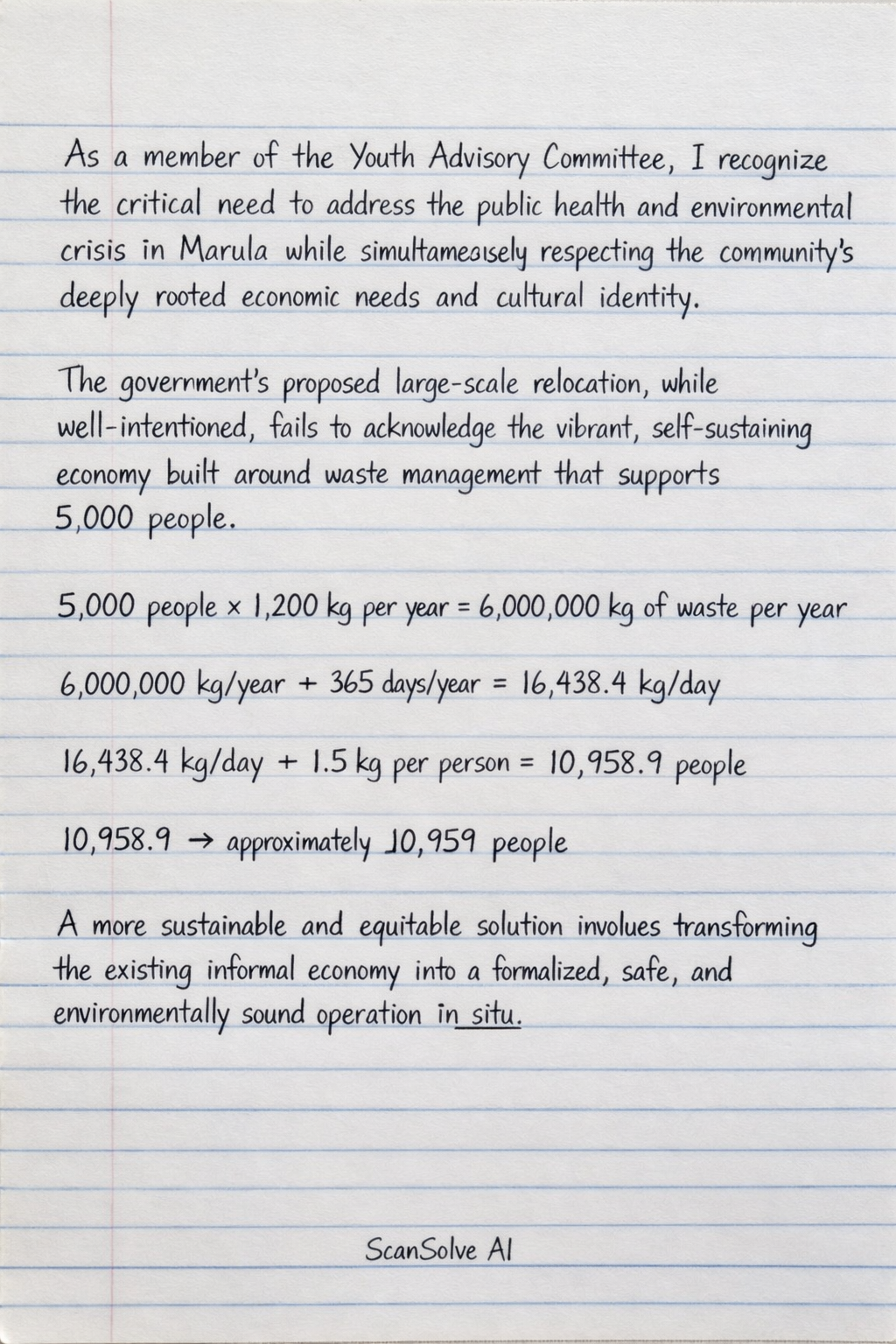
Handwritten Step-by-Step Solution
Get this as a handwritten image on WhatsApp — like a tutor wrote it for you.
Try on WhatsApp