
We read your photo as:
Briefly define the terms water cycle and ecosystem. (b) Using a well labeled diagram, show the pressure belts and planetary winds.
ScanSolve AI Answer
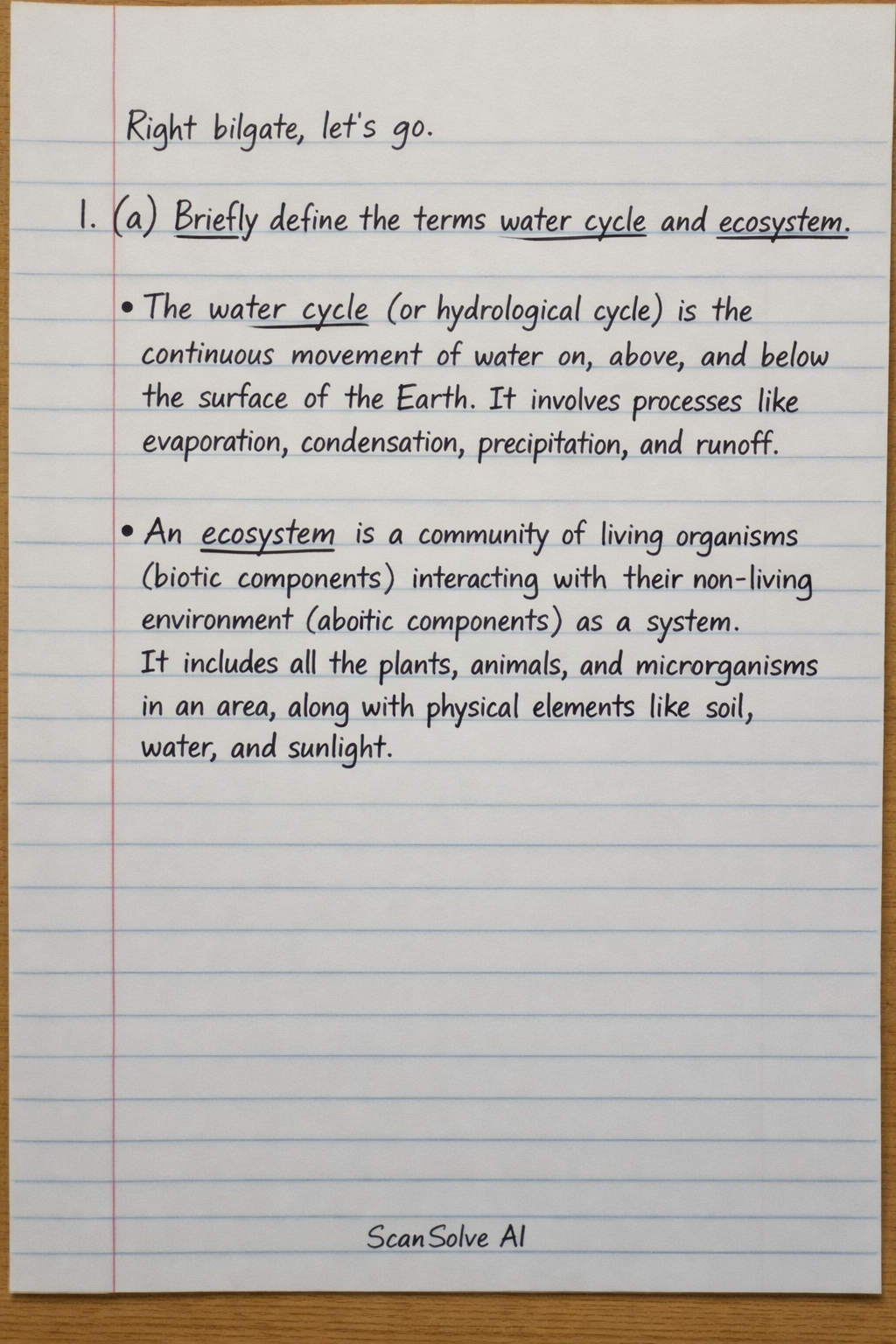
1. (a) Briefly define the terms water cycle and ecosystem.
- The water cycle (or hydrological cycle) is the continuous movement of water on, above, and below the surface of the Earth. It involves processes like evaporation, condensation, precipitation, and runoff.
- An ecosystem is a community of living organisms (biotic components) interacting with their non-living environment (abiotic components) as a system. It includes all the plants, animals, and microorganisms in an area, along with physical elements like soil, water, and sunlight.
1. (b) Using a well labeled diagram, show the pressure belts and planetary winds.
As an AI, I cannot draw diagrams. However, I can describe the pressure belts and planetary winds:
- Pressure Belts: These are zones of high and low atmospheric pressure that encircle the Earth. They include the Equatorial Low Pressure Belt (Doldrums), Subtropical High Pressure Belts (Horse Latitudes) at about N/S, Subpolar Low Pressure Belts at about N/S, and Polar High Pressure Belts at the poles.
- Planetary Winds: These are global wind patterns driven by the pressure belts and the Earth's rotation (Coriolis effect). They include the Trade Winds (blowing from subtropical highs towards the equatorial low), Westerlies (blowing from subtropical highs towards subpolar lows), and Polar Easterlies (blowing from polar highs towards subpolar lows).
1. (c) Give three reasons why the tropical rainforest is threatened.
- Deforestation for Agriculture: Large areas are cleared for commercial farming (e.g., palm oil, soy, cattle ranching) and subsistence agriculture.
- Logging: Illegal and legal logging for timber and wood products destroys vast tracts of forest.
- Mining and Infrastructure Development: Extraction of minerals and construction of roads, dams, and settlements lead to habitat destruction and fragmentation.
1. (d) Select two of the following terms: floods, droughts, water scarcity, desertification. Write a brief geographical essay using the following guidelines: Definition, example, consequences and solutions.
I will choose Floods and Desertification.
Floods:
Definition: A flood is an overflow of water that submerges land which is usually dry. It occurs when a body of water, such as a river or lake, overflows its banks, or when there is excessive rainfall that cannot be absorbed by the ground or drained away.
Example: The 2012 Cameroon floods, particularly in the Far North region, caused widespread displacement and destruction.
Consequences: Floods lead to loss of life, destruction of property, damage to infrastructure, displacement of populations, contamination of water sources, and disruption of economic activities. They can also cause soil erosion and loss of agricultural land.
Solutions: Solutions include constructing dams and levees, improving drainage systems, implementing early warning systems, enforcing strict land-use planning in flood-prone areas, and promoting reforestation to increase water absorption.
Desertification:
Definition: Desertification is the process by which fertile land becomes desert, typically as a result of drought, deforestation, or inappropriate agriculture. It is a form of land degradation in dryland regions.
Example: The Sahel region in Africa, including parts of northern Cameroon, is a prime example where desertification is a significant environmental challenge.
Consequences: Consequences include reduced agricultural productivity, food insecurity, loss of biodiversity, increased poverty, forced migration, and dust storms that affect air quality and health.
Solutions: Solutions involve sustainable land management practices such as afforestation and reforestation, soil conservation techniques (e.g., terracing, contour plowing), efficient water management, promoting drought-resistant crops, and educating local communities on sustainable resource use.
3. (a) You have visited a coastal area, desert, landscape and a river course and studied their features.
(i) On a table, list two features found on each of the areas.
| Area | Feature 1 | Feature 2 |
|---|---|---|
| Coastal Area | Beach | Cliff |
| Desert | Sand Dune | Oasis |
| River Course | Meander | Floodplain |
(ii) Show the appearance of any two features using diagrams.
As an AI, I cannot draw diagrams. I will describe the appearance of a Beach and a Sand Dune.
- Beach: A beach appears as a gently sloping expanse of loose sediment (sand, gravel, pebbles) along the shoreline, typically between the high and low tide marks. It often has a smooth, undulating surface shaped by wave action, sometimes with ripples or shell fragments.
- Sand Dune: A sand dune appears as a mound or ridge of sand, typically formed by the wind in deserts or coastal areas. They vary in shape (e.g., crescent-shaped barchans, linear seifs) and size, with a gentle windward slope and a steeper leeward (slip) face.
(iii) Explain the formation of one of the features drawn in a (ii) above.
I will explain the formation of a Sand Dune.
Formation of a Sand Dune: Sand dunes form through a process called aeolian deposition. First, a large supply of loose sand is needed, often from eroded rocks or coastal sediments. Second, strong, consistent winds are required to transport the sand grains. As the wind blows, it picks up sand particles (saltation and suspension). When the wind encounters an obstacle (like a rock, bush, or even a slight irregularity in the ground), its speed decreases, causing the sand to be deposited. Over time, more sand accumulates around this initial obstruction, forming a small mound. As the mound grows, it acts as a larger obstacle, further reducing wind speed and leading to more deposition. The windward side of the dune develops a gentle slope as sand is pushed up, while the leeward side forms a steeper slip face where sand cascades down when the angle of repose is exceeded. This continuous process of erosion, transportation, and deposition by wind leads to the growth and migration of sand dunes.
3. (b) Give four characteristics of the tropical rain forest that makes it different from other vegetation types.
- High Biodiversity: Tropical rainforests host an exceptionally high number of plant and animal species, far more than any other terrestrial biome.
- Layered Structure (Stratification): They exhibit distinct vertical layers, including the emergent layer, canopy, understory, and forest floor, each with specialized flora and fauna.
- Evergreen Vegetation: Most trees are evergreen, meaning they retain their leaves year-round, contributing to continuous photosynthesis and lush green appearance.
- Dense Canopy: The interlocking crowns of tall trees form a dense canopy that intercepts most sunlight, creating a dark, humid environment on the forest floor.
3. (c) Describe two ways by which man can reduce the effects of each of the following:
(i) Global warming.
- Reduce Greenhouse Gas Emissions: Transitioning from fossil fuels to renewable energy sources (solar, wind, hydro) and improving energy efficiency in homes and industries.
- Promote Reforestation and Afforestation: Planting new trees and protecting existing forests helps absorb carbon dioxide from the atmosphere, acting as carbon sinks.
(ii) Water erosion.
- Implement Contour Plowing and Terracing: Plowing across the slope (contour plowing) and creating step-like terraces on hillsides reduces the speed of water runoff, minimizing soil loss.
- Vegetation Cover: Maintaining or planting vegetation cover (e.g., cover crops, grass strips) on bare soil protects it from the direct impact of raindrops and binds the soil with roots.
(iii) Earthquakes.
- Enforce Strict Building Codes: Constructing earthquake-resistant buildings using flexible materials and designs that can withstand seismic forces.
- Develop Early Warning Systems and Emergency Preparedness: Implementing systems that detect seismic waves and issue warnings, along with educating the public on safety measures and evacuation plans.
SECTION C: HUMAN GEOGRAPHY
4. (a) (i) Distinguish between population growth and population density.
- Population growth refers to the increase in the number of individuals in a population over a specific period. It is determined by birth rates, death rates, and migration (immigration and emigration).
- Population density is a measure of the number of people per unit area of land, typically expressed as people per square kilometer or square mile. It indicates how crowded a region is.
4. (b) (i) State two main conclusions of Alfred Weber's Industrial location theory.
- Least Cost Location: Industries tend to locate where the total cost of production, including transportation, labor, and agglomeration costs, is minimized.
- Transportation Costs are Key: Transportation costs are a dominant factor, with industries locating closer to raw materials if they are heavy and lose weight during processing (material-oriented), or closer to markets if the finished product is heavier or perishable (market-oriented).
(ii) Describe THREE factors that explain the distribution of manufacturing industries in the world.
- Availability of Raw Materials: Industries often locate near sources of raw materials to minimize transportation costs, especially for bulky or perishable inputs (e.g., steel mills near iron ore and coal).
- Access to Markets: Proximity to large consumer markets reduces transportation costs for finished goods and allows for quicker response to consumer demand (e.g., food processing, consumer goods).
- Availability of Labour: Access to a skilled and affordable workforce is crucial. Industries may locate in areas with a large labor pool or where specific skills are abundant.
- Energy Supply: Reliable and affordable energy sources (e.g., electricity, coal, oil) are essential for manufacturing processes, influencing location decisions.
- Government Policies and Infrastructure: Favorable government policies (tax incentives, subsidies), well-developed infrastructure (roads, ports, communication), and political stability attract industries.
4. (c) Give TWO advantages and TWO disadvantages of urbanization.
Advantages of Urbanization:
- Economic Opportunities: Urban centers offer diverse job opportunities, higher wages, and better access to markets for goods and services.
- Improved Services and Infrastructure: Cities typically have better access to education, healthcare, sanitation, public transport, and communication networks. Disadvantages of Urbanization:
- Overcrowding and Strain on Resources: Rapid urbanization can lead to overcrowding, inadequate housing, and strain on public services like water, electricity, and waste management.
- Environmental Problems: Cities often face issues like air and water pollution, increased waste generation, and loss of green spaces.
4. (d) Suggest why people would want to travel by air instead of road transport.
- Speed and Time-Saving: Air travel is significantly faster over long distances, reducing travel time for business and personal trips.
- Comfort and Convenience: Airplanes offer a more comfortable experience for long journeys, often with amenities, and can bypass geographical obstacles that make road travel difficult or impossible.
- Safety (per passenger mile): Statistically, air travel is one of the safest modes of transport per passenger mile, despite the perception of high-profile accidents.
- Global Connectivity: Air transport provides direct access to international destinations that are not feasible by road.
SECTION D: CAMEROON GEOGRAPHY
5. (a) (i) State TWO rivers that have been harnessed for many uses.
- River Sanaga
- River Wouri
(ii) State THREE problems that are solved by creating such projects.
- Electricity Generation: Hydroelectric dams provide a renewable source of electricity, reducing reliance on fossil fuels.
- Water Supply: Reservoirs created by harnessing rivers ensure a reliable supply of water for domestic, industrial, and agricultural use (irrigation).
- Flood Control: Dams can regulate river flow, preventing downstream flooding during heavy rainfall.
5. (b) Suggest briefly THREE ways through which fish and forest resources can be conserved in the world today.
- Sustainable Harvesting Practices: Implementing quotas, size limits, and seasonal restrictions for fishing, and selective logging or replanting for forestry, to ensure resources regenerate.
- Establishment of Protected Areas: Creating marine protected areas, national parks, and forest reserves to safeguard critical habitats and biodiversity from exploitation.
- Combating Illegal Activities: Strengthening law enforcement to prevent illegal fishing, poaching, and logging, which deplete resources unsustainably.
5. (c) Briefly explain THREE ways by which a country can promote tourism.
- Infrastructure Development: Investing in and improving transport networks (roads, airports), accommodation facilities, and communication services to enhance visitor experience and accessibility.
- Marketing and Promotion: Launching international marketing campaigns, participating in global tourism fairs, and utilizing digital platforms to showcase attractions and unique cultural experiences.
- Preservation of Cultural and Natural Heritage: Protecting and maintaining historical sites, national parks, and cultural traditions to offer authentic and appealing attractions
Still stuck on this one?
Ask a follow-up, and the answer starts from this question.
More Geography Questions
Handwritten Step-by-Step Solution
Get this as a handwritten image on WhatsApp — like a tutor wrote it for you.
Try on WhatsApp