
We read your photo as:
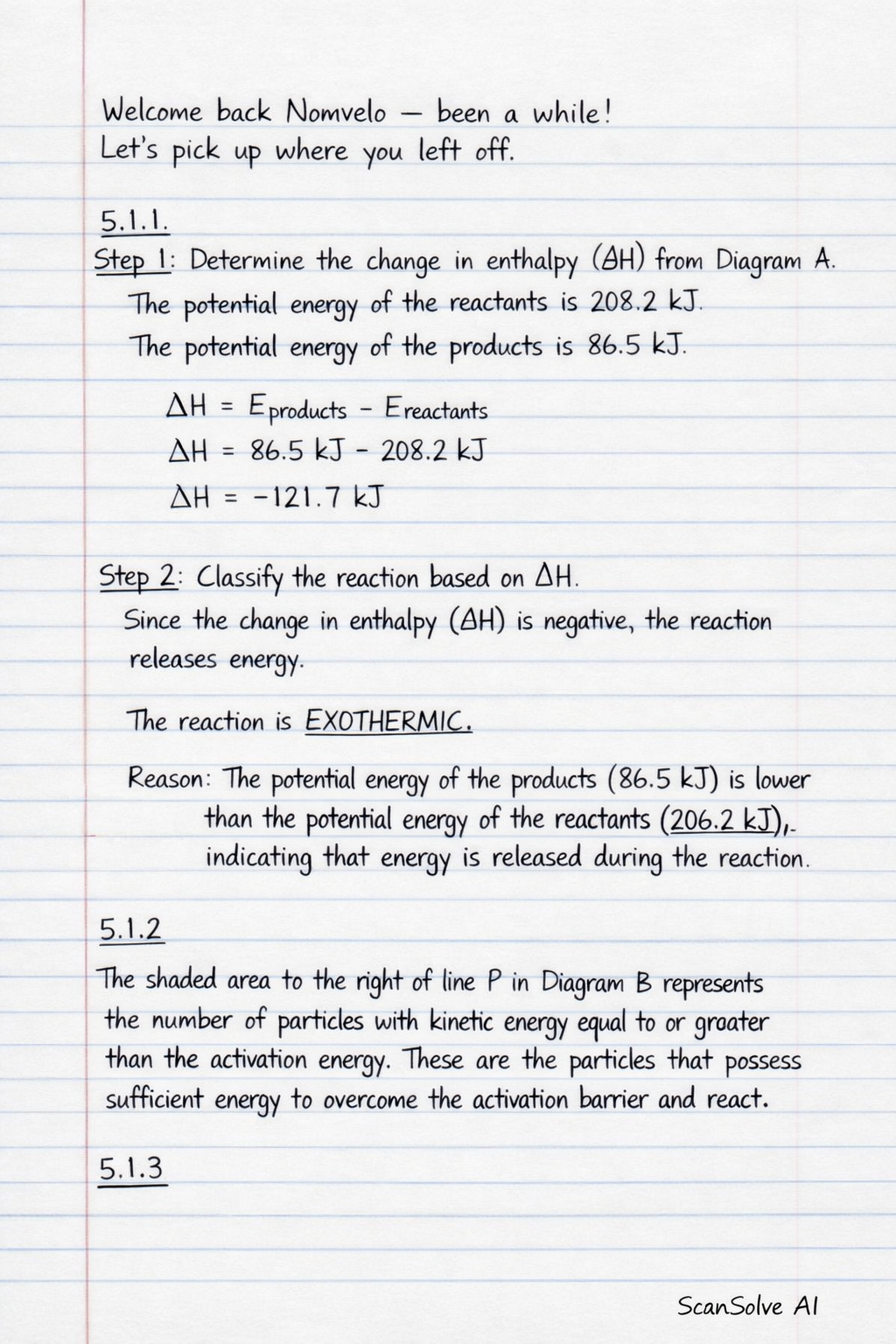
Determine the change in enthalpy ( H) from Diagram A.
ScanSolve AI Answer
Answer
Step-by-step solution
4 steps5.1.1
Determine the change in enthalpy () from Diagram A.
The potential energy of the reactants is .
The potential energy of the products is .Classify the reaction based on .
Since the change in enthalpy () is negative, the reaction releases energy.
The reaction is EXOTHERMIC.
Reason: The potential energy of the products () is lower than the potential energy of the reactants (), indicating that energy is released during the reaction.5.1.2
The shaded area to the right of line P in Diagram B represents the number of particles with kinetic energy equal to or greater than the activation energy. These are the particles that possess sufficient energy to overcome the activation barrier and react.
5.1.3
Identify the values from Diagram A for the uncatalyzed reaction.
The potential energy of the reactants is .
The potential energy of the activated complex (transition state) for the uncatalyzed reaction is .Calculate the activation energy for the uncatalyzed reaction.
The letter X in Diagram B represents the activation energy of the uncatalyzed reaction, as it is the higher activation energy.
The numerical value represented by the letter X is .
Try one yourself
A new problem that tests the same skill.
Still stuck on this one?
Ask a follow-up, and the answer starts from this question.
More Geography Questions
Handwritten Step-by-Step Solution
Get this as a handwritten image on WhatsApp — like a tutor wrote it for you.
Try on WhatsApp