This geography problem is solved step by step below, with detailed explanations to help you understand the method and arrive at the correct answer.
Identify the urban population in 2005 and 2030 from Table 2.
Geography

ScanSolve AI Answer
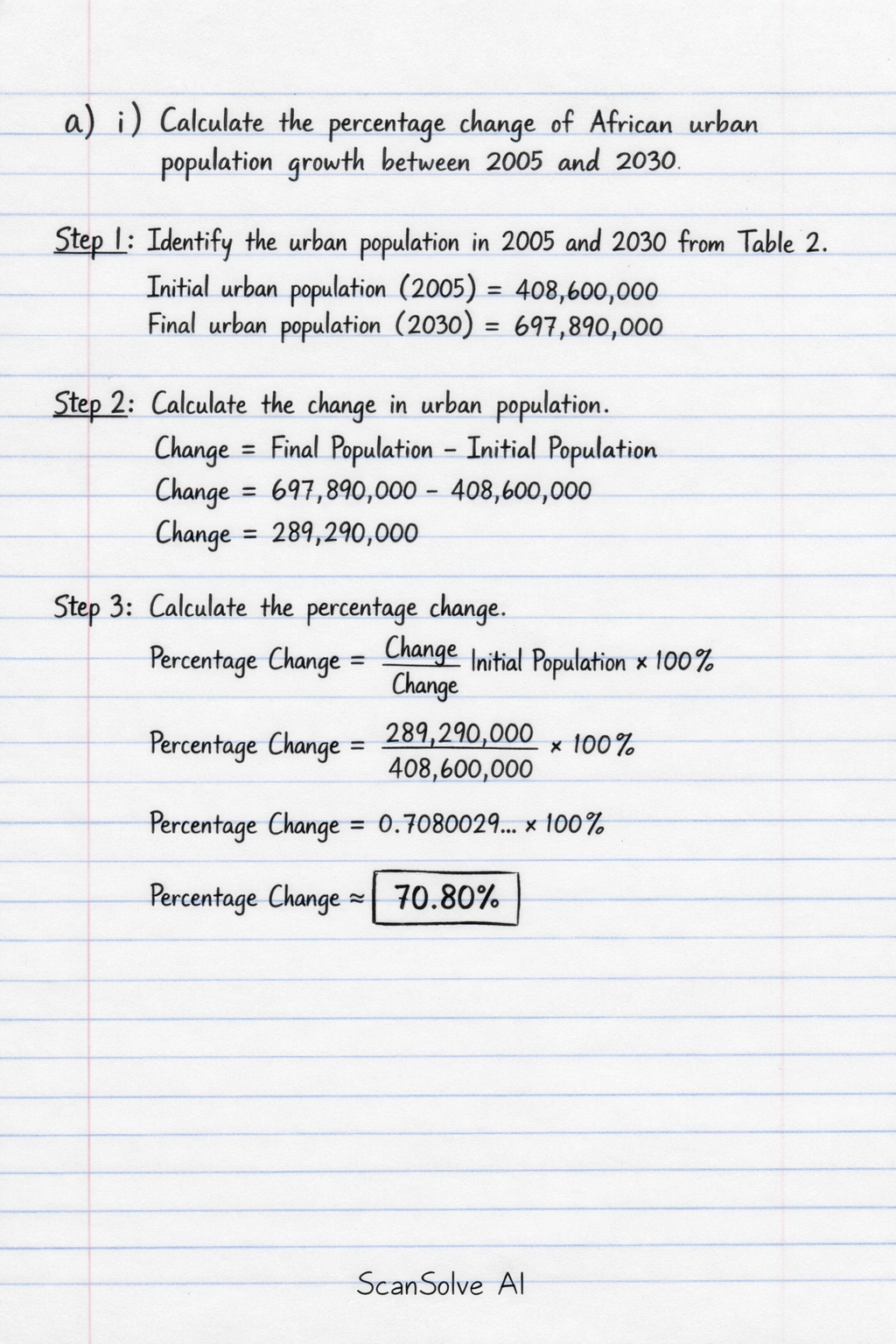
a) i) Calculate the percentage change of African urban population growth between 2005 and 2030.
Step 1: Identify the urban population in 2005 and 2030 from Table 2. Initial urban population (2005) Final urban population (2030)
Step 2: Calculate the change in urban population.
Step 3: Calculate the percentage change.
Was this helpful?
Still stuck on this one?
Ask a follow-up, and the answer starts from this question.
Got a different question?Ask your own question
More Geography Questions
QExplain demographic transition, karl theory of population and capitalistQDraw a simple sketch map of Nakasongola between Eastings 37 and 44 Northings 40 and 50, and on it ma…QComplete the statistics in the previous tables with the information provided in this table and state…Q6 year old children interview with questions and answers about Australian culture and geographyQAn interview question and answers about australia culture and geography

Handwritten Step-by-Step Solution
Get this as a handwritten image on WhatsApp — like a tutor wrote it for you.
Try on WhatsAppScanSolve AI Answer
a) i) Calculate the percentage change of African urban population growth between 2005 and 2030. Step 1: Identify the urban population in 2005 and 2030 from Table 2. Initial urban population (2005) = 408,600,000 Final urban population (2030) = 697,890,000 Step 2: Calculate the change in urban population. Change = Final Population - Initial Population Change = 697,890,000 - 408,600,000 Change = 289,290,000 Step 3: Calculate the percentage change. Percentage Change = ChangeInitial Population × 100\% Percentage Change = (289,290,000)/(408,600,000) × 100\% Percentage Change = 0.7080029... × 100\% Percentage Change ≈ 70.80\%