
We read your photo as:
Table of Household Numbers and Population Density
ScanSolve AI Answer
Step-by-step solution
2 stepsHere is the table of household numbers and population density, and a description of the population pyramid based on the hypothetical data from our previous interaction.
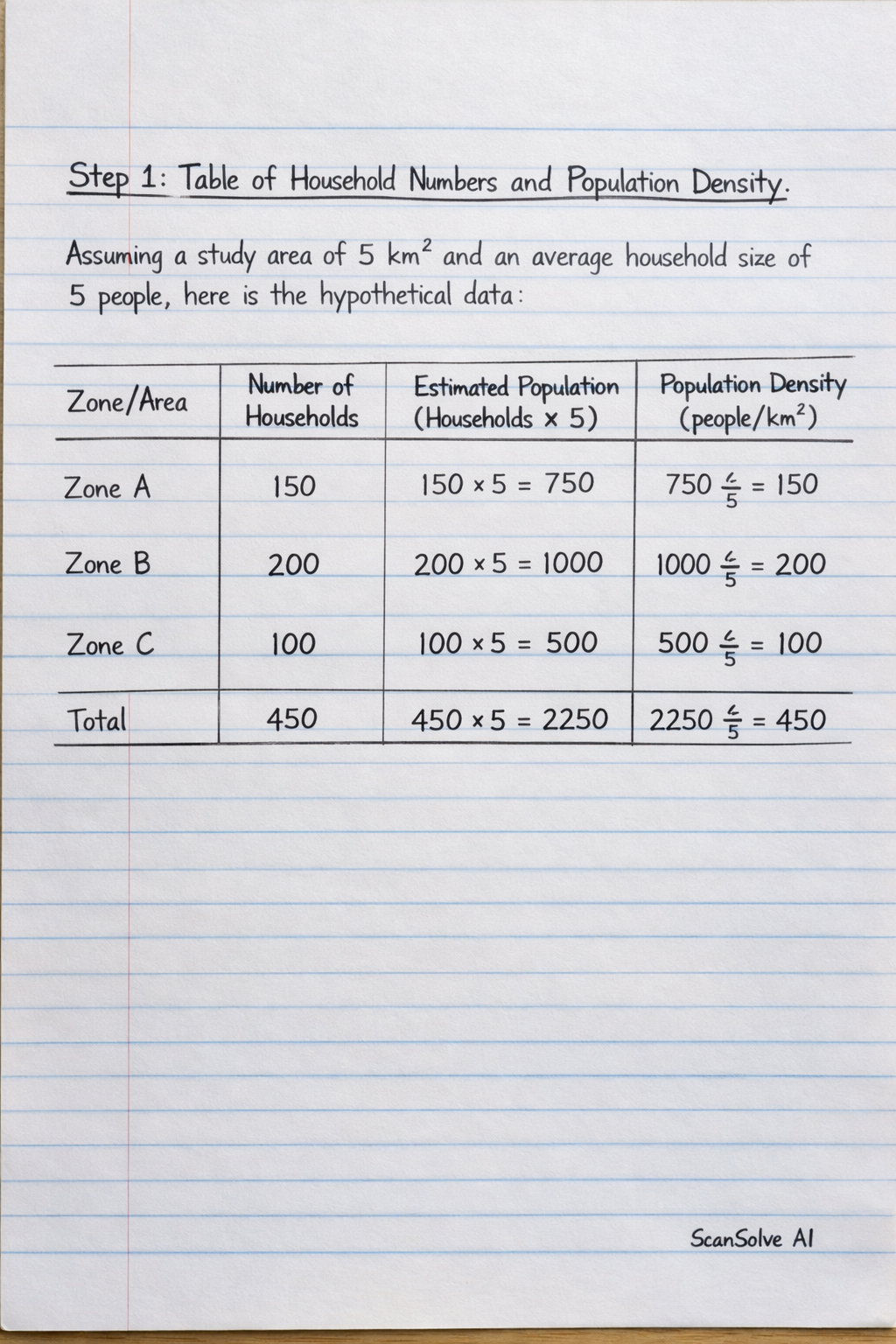
Table of Household Numbers and Population Density
Assuming a study area of and an average household size of 5 people, here is the hypothetical data:
Zone/Area Number of Households Estimated Population (Households 5) Population Density (people/km) Zone A 150 750 Zone B 200 1000 Zone C 100 500 Total 450 2250 Description of the Population Pyramid
Based on the hypothetical data provided previously:
Age Group Male (%) Female (%) 0-4 6.0 5.8 5-9 5.5 5.3 10-14 5.0 4.8 15-19 4.5 4.3 20-24 4.0 4.0 25-29 3.5 3.7 30-34 3.0 3.5 35-39 2.5 3.0 40-44 2.0 2.5 45-49 1.5 2.0 50-54 1.0 1.5 55-59 0.8 1.2 60-64 0.6 1.0 65-69 0.4 0.8 70-74 0.2 0.5 75+ 0.1 0.3 A population pyramid drawn from this data would typically have a broad base, indicating a high proportion of young people (0-14 years). The bars for the younger age groups (0-4, 5-9, 10-14) are the longest, showing a significant number of births. As the age groups increase, the bars would gradually shorten, forming a triangular or pyramid shape. This tapering indicates a decreasing number of people in older age cohorts due to mortality.
Specifically, the male bars would be on the left and female bars on the right. For most age groups, the male and female percentages are relatively close, but there's a slight tendency for females to have higher percentages in older age groups (e.g., 60+), suggesting higher female longevity. The overall shape would be characteristic of a developing population with high birth rates and a relatively younger demographic profile.
Still stuck on this one?
Ask a follow-up, and the answer starts from this question.
More Physics Questions
Handwritten Step-by-Step Solution
Get this as a handwritten image on WhatsApp — like a tutor wrote it for you.
Try on WhatsApp