
We read your photo as:
Calculate the acceleration shown by each of the graphs below.
Physics
ScanSolve AI Answer
Answers
3 partsStep-by-step solution
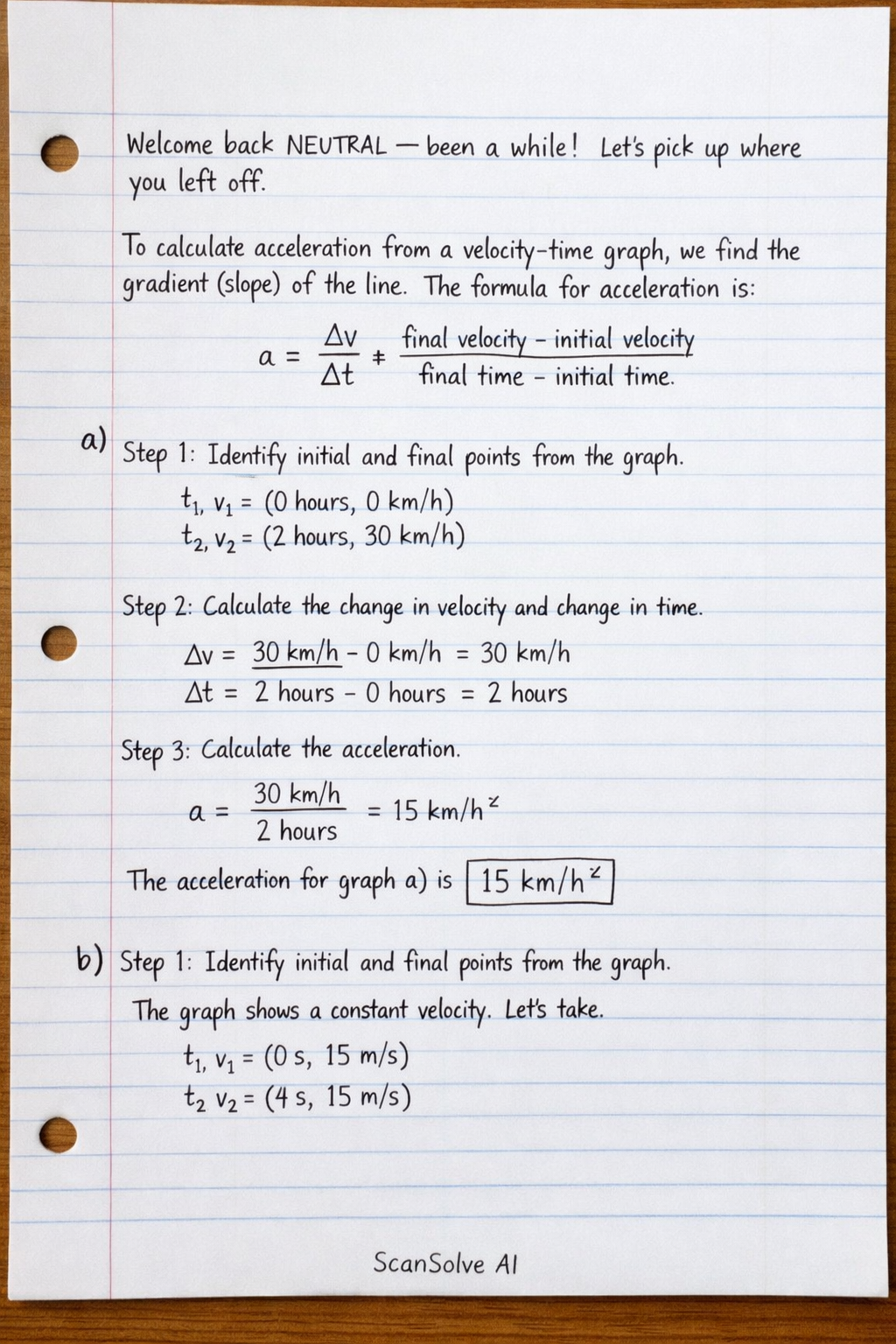
9 stepsTo calculate acceleration from a velocity-time graph, we find the gradient (slope) of the line. The formula for acceleration is:
Part a· 3 steps
Identify initial and final points from the graph.
The graph starts at and ends at .
Calculate the change in velocity and change in time.
Calculate the acceleration.
The acceleration for graph a) is
Part b
Identify initial and final points from the graph.
The graph shows a constant velocity. Let's take and .
Calculate the change in velocity and change in time.
Calculate the acceleration.
The acceleration for graph b) is
Part c
Identify initial and final points from the graph.
The graph starts at and ends at .
Calculate the change in velocity and change in time.
Calculate the acceleration.
The acceleration for graph c) is
Was this helpful?
Try one yourself
A new problem that tests the same skill.
Still stuck on this one?
Ask a follow-up, and the answer starts from this question.
Got a different question?Ask your own question
More Physics Questions
QCalculate the acceleration for each of the three systems.QCalculate the acceleration for each car.QA motorcycle's velocity-time graph is described by four segments. Calculate the acceleration for…QThe diagram below shows the velocity-time graph of a body. The acceleration of the body in the…QIdentify the components of acceleration.
Browse by topic:Mechanics
Handwritten Step-by-Step Solution
Get this as a handwritten image on WhatsApp — like a tutor wrote it for you.
Try on WhatsApp